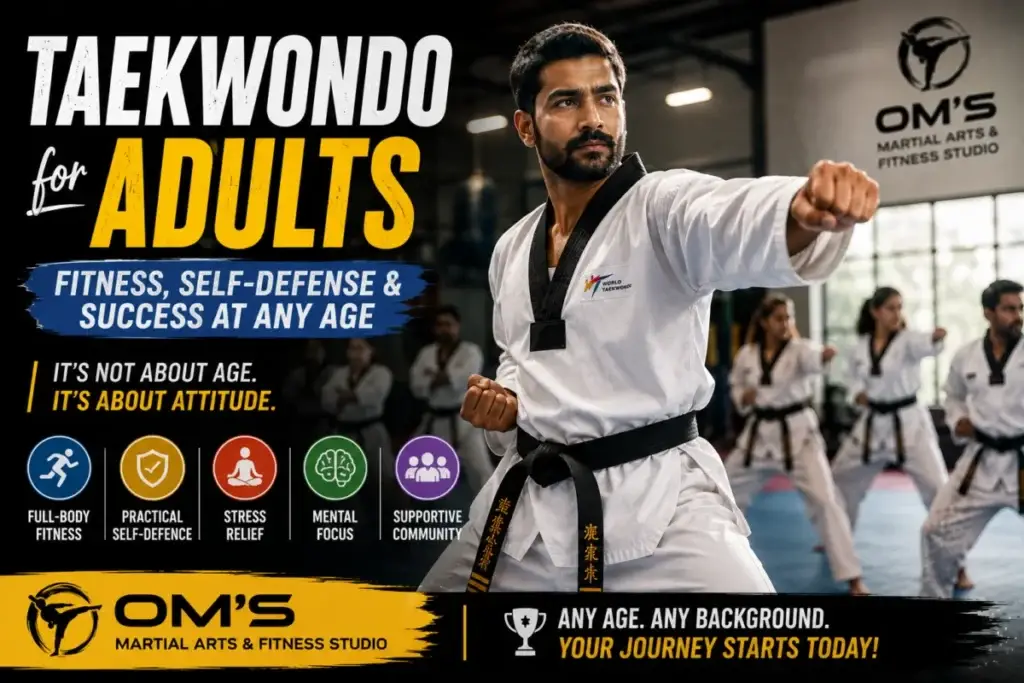

Taekwondo is accessible to adults of all ages through adapted training methods. It provides functional fitness, stress relief, and practical self-defense skills. While beginners may worry about flexibility or age, the curriculum focuses on gradual progression and personal improvement within a supportive community of peers.
Success for adult practitioners involves prioritizing recovery and maintaining realistic goals. Students typically advance from basic techniques to sparring, with many achieving a black belt within two to four years. Training emphasizes consistency and listening to one’s body to ensure long-term health and personal development.
Adults of any age can successfully begin Taekwondo by utilizing training methods adapted to their physical capabilities. The practice offers functional fitness, stress relief, and practical self-defense while fostering a supportive community. It emphasizes that perceived barriers like age or lack of flexibility are manageable through consistent, modified instruction.
The curriculum for adult beginners focuses on gradual progression, starting with basic techniques before moving to sparring. Success requires prioritizing recovery, maintaining realistic goals, and focusing on personal improvement rather than comparison with others. Dedicated students can typically achieve a black belt within two to four years.
The Doubt That Holds You Back
You are 25, 35, 42, or 55. You have always been curious about martial arts. Maybe you watched Taekwondo in the Olympics and thought, “I wish I could do that.” Maybe you want to get fit but hate the gym. Maybe you want to learn self-defence. Maybe you simply want to try something new.
And then the voice in your head says:
“I’m too old.”
“I’m not flexible.”
“I’ll be the worst person in the class.”
“It’s a kids’ sport.”
“I’ll embarrass myself.”
“My knees / back / shoulders can’t handle it.”
This article exists to silence that voice.
You are not too old. You are not too stiff. You are not too slow. You are not too anything.
At Om’s Martial Arts & Fitness Studio, we have trained adults who started at 25, 35, 45, and 58. They earned their belts. They broke boards. They sparred. They competed. They transformed their bodies and their minds.
“I wish I had started sooner.”
[↑ Back to: The Complete Guide to Taekwondo]
The Truth About Age and Taekwondo
What the Data Says
- The average age of a new Taekwondo student globally is not 8 years old. It is 28.
- Adult Taekwondo participation has grown by 22% since 2018 (World Taekwondo membership data).
- The oldest active Taekwondo practitioner on record is in his 90s.
- In India, adult enrollment in martial arts academies has doubled since 2020, driven by fitness awareness, self-defence interest, and post-pandemic health consciousness.
What Your Body Can Do at Any Age
| Age | Physical Reality | Taekwondo Adaptation |
|---|---|---|
| 20-30 | Peak recovery, high flexibility potential, fast learning | Full curriculum, competition track available |
| 30-40 | Slightly slower recovery, flexibility trainable, strength peak | Full curriculum, modified intensity as needed |
| 40-50 | Joint care important, flexibility trainable with consistency, endurance strong | Full curriculum, emphasis on warm-up and mobility, optional competition |
| 50-60 | Recovery slower, flexibility requires patience, balance training critical | Modified curriculum, emphasis on technique over power, no high-impact sparring |
| 60+ | Gentle approach, joint health priority, social and cognitive benefits primary | Modified curriculum, balance and coordination focus, no sparring |
The key insight: Taekwondo is adaptable. A 50-year-old does not train identically to a 15-year-old. But they train the same art, learn the same techniques (modified as needed), earn the same belts, and experience the same pride.
Why Adults Start Taekwondo (And Why They Stay)
The Top 7 Reasons Adults Enroll at Om’s
- Fitness without the boredom of the gym. Taekwondo is a full-body workout disguised as a skill. You burn 500-800 calories per class while learning something meaningful. No treadmill. No counting reps on a machine. Just movement, technique, and progress.
- Stress relief. Hitting a pad after a 10-hour workday is therapeutic. The physical exertion, the focused attention, the kihap (shout) — it all releases tension that accumulates in the body and mind.
- Self-defence awareness. In a world where personal safety is a legitimate concern, knowing how to strike, escape, and create distance provides practical confidence.
- Mental challenge. Memorizing poomsae, learning combinations, and problem-solving in sparring engage the brain in ways that a gym workout does not. Adults often say Taekwondo is “chess for the body.”
- Community. Adult life is isolating. Work, family, responsibilities — social circles shrink. The dojang becomes a third place (not work, not home) where you belong to a group with a shared purpose.
- Goal-setting and achievement. The belt system provides clear, incremental goals in a life stage where progress can feel stagnant. Earning your yellow belt at 38 feels as good as it does at 8.
- Something for yourself. Many adult students — especially parents — say Taekwondo is the first thing they have done just for themselves in years. That matters.
What to Expect in Your First Class (Adult-Specific)
The Honest Truth
- You will feel uncoordinated. Your roundhouse kick will look nothing like the coach’s. This is normal.
- You will be sore the next day. Hips, hamstrings, calves, shoulders. This is normal.
- You will be the least flexible person in the room (if there are teenagers). This is normal.
- You will feel self-conscious for approximately 2 classes. Then it passes.
- You will surprise yourself by Week 4.
The Class Structure (Adult Batch at Om’s)
| Segment | Duration | What Happens |
|---|---|---|
| Warm-up | 10-15 min | Jump rope, dynamic stretches, joint mobility. Scaled to adult fitness levels. |
| Technique | 20-25 min | Stances, blocks, punches, kicks. Coach demonstrates, you replicate. Slow, then fast. |
| Pad work | 15 min | Hitting focus mitts and bags. This is the fun part. |
| Conditioning | 10 min | Bodyweight exercises (push-ups, squats, planks). Scaled to your level. |
| Cool-down | 10 min | Static stretching, breathing, brief Q&A. |
No sparring in the first 4-6 weeks. You learn technique, build fitness, and develop confidence before any partner contact.
Training Tips for Adult Beginners
1. Leave Your Ego at the Door
You may be a senior manager at work. In the dojang, you are a white belt. A 12-year-old green belt may correct your stance. Accept it graciously. They have been training longer than you. Rank is earned, not given.
2. Prioritize Flexibility
Adults are stiffer than children. This is the single biggest physical challenge for adult beginners. Stretch every day — even 10 minutes. Focus on hamstrings, hip flexors, and shoulders. At Om’s, our Power Yoga classes are the perfect complement.
3. Listen to Your Body
Soreness is normal. Sharp pain is not. If your knee, back, or shoulder hurts in a way that feels wrong, tell the coach immediately. Modifications exist for every technique. You do not need to “push through” joint pain.
4. Train 3× Per Week (Minimum)
Adults learn cognitively faster than children (you understand the “why” behind techniques), but your body needs repetition to build muscle memory. 3 sessions per week is the minimum for consistent progress.
5. Hydrate and Recover
Adult recovery is slower than teenage recovery. Sleep 7-8 hours. Hydrate. Eat protein. Your body repairs itself between sessions, not during them.
6. Do Not Compare Yourself to Others
The 16-year-old in your class will kick higher. The 22-year-old will recover faster. None of that matters. Your journey is yours. Compare yourself to who you were last month, not to someone else.
7. Celebrate Small Wins
First time you kick above waist height. First time you remember a poomsae without prompting. First time you hit the pad and it actually sounds like a “crack.” These are victories. Acknowledge them.
How Long to Black Belt (Adult Timeline)
| Training Frequency | Estimated Time to 1st Dan |
|---|---|
| 2× per week | 3.5 – 4.5 years |
| 3× per week | 2.5 – 3.5 years |
| 4× per week | 2 – 3 years |
| 5+ per week | 1.8 – 2.5 years |
Adults sometimes progress faster than children in the early belts because they understand instructions, practice at home, and take theory seriously. The middle belts (green-blue) can slow down as flexibility and sparring demands increase. The black belt exam is demanding but absolutely achievable for a dedicated adult student.
Common Concerns Addressed
“I have bad knees / back / shoulders.”
Tell your coach before the first class. Every technique has a modification. You can train Taekwondo with joint limitations. Many students with chronic back pain report improvement after 6 months of training (stronger core, better posture, increased mobility). However, consult your doctor before starting if you have a diagnosed condition.
“I’m overweight / out of shape.”
Taekwondo builds fitness. You do not need to be fit to start. Our adult beginner classes are designed for people who have not exercised in years. The conditioning is progressive — you start where you are and build from there.
“I’ll be the oldest person in the class.”
Maybe. Maybe not. At Om’s, our adult batches include students from 18 to 58. And even if you are the oldest, the Taekwondo community is uniquely respectful of age. In Korean martial arts culture, age and seniority are honored. You will be treated with respect.
“I don’t have time.”
A 60-minute class, 3 times per week, is 3 hours. You spend more than that scrolling your phone. The question is not “Do I have time?” The question is “Is this a priority?” If your health, stress levels, and personal growth matter, the time exists.
“What if I don’t like it?”
That is what the free trial class is for. Come, train, experience it. If it is not for you, walk away with no obligation. But we suspect you will stay. Most adults who try one class come back for a second. And a third. And a hundred more.
Frequently Asked Questions
Q: Is there an upper age limit for Taekwondo?
A: No. We have trained students who started at 55 and earned their black belt at 58. The training is adapted to your physical capacity. The art is the same. The pride is the same.
Q: Will I be training with children?
A: No. At Om’s, adult batches are separate from kids’ batches. You train with other adults in a class designed for adult fitness levels, learning styles, and goals.
Q: Can I compete as an adult?
A: Yes. WT and TFI have adult divisions (17-35) and veteran divisions (35+). Many adults compete at state and national levels. Competition is optional, not mandatory.
Q: Is Taekwondo better than the gym for adults?
A: They serve different purposes. The gym builds isolated strength. Taekwondo builds functional fitness, flexibility, coordination, self-defence skills, and mental discipline simultaneously. Many adults at Om’s do both. If you must choose one, Taekwondo offers a broader development.
Q: What should I wear to my first class?
A: Comfortable athletic clothing (t-shirt + track pants or leggings). Bare feet. Water bottle. No jewelry. We provide all training equipment for trial classes.
Q: I did martial arts as a kid. Do I start at white belt?
A: If it has been more than 3-5 years, yes, white belt. Your body has changed. Your technique needs rebuilding. Starting fresh is humbling but effective. If you have a prior rank and recent training, discuss with the coach — a placement assessment may be appropriate.
[→ Full FAQ: 500+ Taekwondo Questions Answered]
Your First Class Is Waiting
You have read this far. That means the desire is real. The only thing standing between you and your first Taekwondo class is the decision to walk through the door.
You do not need to be ready. You do not need to be fit. You do not need to be flexible. You do not need to be young.
You just need to show up.
[→ Book Your Free Adult Taekwondo Trial Class at Om’s Martial Arts & Fitness Studio]
[→ View Adult Class Timetable & Fees]
[→ Read the Complete Guide to Taekwondo]
Om’s Martial Arts & Fitness Studio – It is never too late. It is only ever too late if you never start.