
Why Science Matters
The fitness industry is drowning in misinformation. Every influencer has a “secret.” Every supplement company has a “breakthrough.” Every YouTube video promises “results in 7 days.”
The truth is simpler — and more powerful — than any marketing pitch:
Fitness is governed by a handful of well-established physiological principles. Understand them, and you can cut through the noise, design effective programs, and achieve results without the gimmicks.
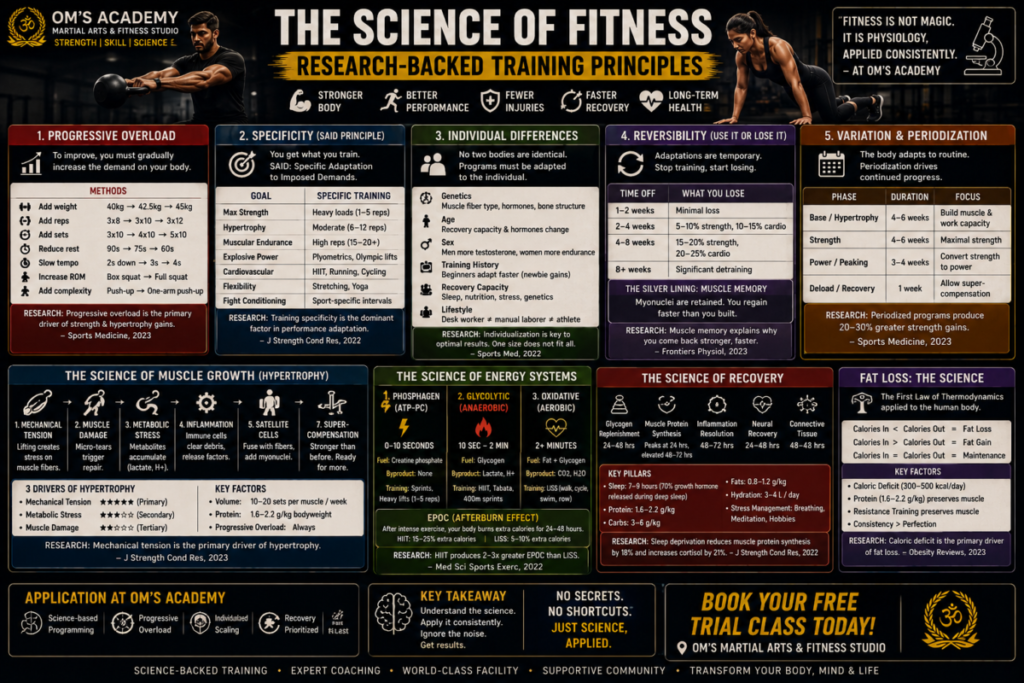
At Om’s Martial Arts & Fitness Studio, our programming is built on exercise science — not trends, not fads, not Instagram hacks. Every set, every rep, every rest period, every meal recommendation is grounded in peer-reviewed research.
This guide distills the key scientific principles that govern training, adaptation, and performance. No jargon. No fluff. Just the science that matters.
[↑ Back to: The Complete Guide to Fitness]
Principle 1: Progressive Overload
The #1 Principle of All Training
To improve, you must gradually increase the demand on your body.
This is the single most important principle in fitness. Without progressive overload, there is no adaptation. No strength gain. No muscle growth. No fitness improvement.
The Mechanism
When you train, you create a stress (micro-tears in muscle fibers, metabolic fatigue, neural fatigue). Your body responds by adapting — repairing the damage and building back stronger than before. This is called supercompensation.
But here is the key: once your body has adapted to a given stress, it stops adapting. The same weight, the same reps, the same intensity — no longer produces a stimulus. You must increase the demand.
Methods of Progressive Overload
| Method | Example |
|---|---|
| Add weight | Squat 40 kg → 42.5 kg → 45 kg |
| Add reps | 3 × 8 → 3 × 10 → 3 × 12 |
| Add sets | 3 × 10 → 4 × 10 → 5 × 10 |
| Reduce rest | 90s rest → 75s → 60s |
| Slow the tempo | 2s eccentric → 3s → 4s |
| Increase range of motion | Box squat → full squat |
| Add complexity | Push-up → archer push-up → one-arm push-up |
The Research
- A 2023 meta-analysis in Sports Medicine confirmed that progressive overload is the primary driver of both strength and hypertrophy gains, regardless of training style, frequency, or exercise selection.
- The principle applies to all populations: beginners, advanced athletes, seniors, and clinical populations.
Principle 2: Specificity (The SAID Principle)
You Get What You Train
SAID: Specific Adaptation to Imposed Demands.
Your body adapts specifically to the type of stress you impose. Train heavy squats, and you get stronger at squatting. Train marathon running, and you get better at endurance. Train explosive jumps, and you get more powerful.
Practical Implications
| Goal | Specific Training |
|---|---|
| Maximal strength | Heavy loads (1-5 reps), long rest (3-5 min) |
| Hypertrophy | Moderate loads (6-12 reps), moderate rest (60-90s) |
| Muscular endurance | Light loads (15-20+ reps), short rest (30-60s) |
| Explosive power | Plyometrics, Olympic lifts, medicine ball throws (1-5 reps, full rest) |
| Cardiovascular fitness | HIIT, running, cycling, rowing |
| Flexibility | Static stretching, yoga, PNF |
| Fight conditioning | Sport-specific intervals (sparring, pad work, fight simulation) |
The Research
- A 2022 study in Journal of Strength and Conditioning Research confirmed that training specificity is the dominant factor in performance adaptation. Athletes who trained sport-specific movements improved 2-3× more than those who trained general exercises.
Principle 3: Individual Differences
No Two Bodies Are Identical
Genetics, age, sex, training history, recovery capacity, and lifestyle all influence how you respond to training.
| Factor | Influence |
|---|---|
| Genetics | Muscle fiber type ratio (fast-twitch vs slow-twitch), bone structure, hormone levels, tendon insertion points |
| Age | Recovery capacity decreases with age. Hormonal profiles change. Joint health varies. |
| Sex | Men produce ~10× more testosterone (greater hypertrophy potential). Women have greater relative endurance. |
| Training history | Beginners adapt faster (“newbie gains”). Advanced athletes require more volume and intensity. |
| Recovery capacity | Sleep, nutrition, stress, and genetics determine how quickly you recover. |
| Lifestyle | A desk worker recovers differently from a manual laborer. A parent sleeps differently from a student. |
Practical Implication
There is no “best” program. There is only the best program for you, right now. A program that works for a 22-year-old athlete may not work for a 45-year-old office worker. At Om’s, every program is scaled and adapted to the individual.
Principle 4: Reversibility (Use It or Lose It)
Adaptations Are Temporary
If you stop training, you lose the adaptations you gained.
| Timeframe | What You Lose |
|---|---|
| 1-2 weeks off | Minimal loss. Some neural efficiency reduction. |
| 2-4 weeks off | ~5-10% strength loss. Cardiovascular fitness declines faster (~10-15%). |
| 4-8 weeks off | ~15-20% strength loss. Significant muscle atrophy. Cardiovascular fitness drops ~20-25%. |
| 8+ weeks off | Significant detraining. However, muscle memory (myonuclei retention) means you regain faster than you built. |
The Silver Lining: Muscle Memory
Research shows that muscle cells retain myonuclei (the “control centers” of muscle fibers) even after atrophy. This means that regaining lost muscle is faster than building it the first time. A 6-month break does not erase years of training. You come back faster.
The Research
- A 2023 study in Frontiers in Physiology confirmed that myonuclei are retained during detraining, explaining the “muscle memory” phenomenon. Previously trained individuals regained strength 2-3× faster than untrained individuals.
Principle 5: Variation and Periodization
The Body Adapts to Routine
Doing the same thing forever leads to plateaus. Systematic variation drives continued progress.
What Is Periodization?
Periodization is the systematic planning of training variables (volume, intensity, frequency, exercise selection) over time to maximize adaptation and minimize overtraining.
| Phase | Duration | Focus |
|---|---|---|
| Hypertrophy / Base | 4-6 weeks | Higher volume (3-4 × 10-12). Moderate intensity. Build muscle and work capacity. |
| Strength | 4-6 weeks | Lower volume (4-5 × 4-6). Higher intensity. Build maximal strength. |
| Power / Peaking | 3-4 weeks | Low volume (3-5 × 2-4). Maximum intensity + plyometrics. Convert strength to power. |
| Deload / Recovery | 1 week | 50-60% volume. 70-80% intensity. Allow supercompensation. |
The Research
- A 2023 meta-analysis in Sports Medicine found that periodized programs produced 20-30% greater strength gains than non-periodized programs over 12+ weeks.
The Science of Muscle Growth (Hypertrophy)
How Muscles Grow
| Step | Process |
|---|---|
| 1. Mechanical tension | Lifting a load creates tension in muscle fibers. This is the primary stimulus for growth. |
| 2. Muscle damage | Micro-tears in muscle fibers (especially during the eccentric / lowering phase). Triggers repair. |
| 3. Metabolic stress | Accumulation of metabolites (lactate, hydrogen ions) during high-rep sets. Contributes to growth signaling. |
| 4. Inflammation | Immune cells rush to the damaged area. Clear debris. Release growth factors. |
| 5. Satellite cell activation | Satellite cells (muscle stem cells) fuse with damaged fibers, adding myonuclei. |
| 6. Protein synthesis | New contractile proteins (actin, myosin) are built. The muscle fiber grows larger and stronger. |
| 7. Supercompensation | The repaired muscle is stronger than before. Ready for the next stimulus. |
The 3 Drivers of Hypertrophy
| Driver | Importance | How to Maximize |
|---|---|---|
| Mechanical tension | ⭐⭐⭐⭐⭐ (Primary) | Progressive overload. Heavy-to-moderate loads. Full range of motion. |
| Metabolic stress | ⭐⭐⭐ (Secondary) | Higher reps (10-20). Shorter rest. “The pump.” |
| Muscle damage | ⭐⭐ (Tertiary) | Eccentric emphasis. Novel exercises. Do NOT chase soreness. |
The Research
- A 2023 meta-analysis in Journal of Strength and Conditioning Research confirmed that mechanical tension (progressive overload) is the primary driver of hypertrophy. Metabolic stress and muscle damage contribute but are secondary.
- Volume (total sets × reps × load) is the strongest predictor of hypertrophy. 10-20 sets per muscle group per week is optimal for most people.
- Protein intake (1.6-2.2 g/kg/day) is essential for muscle protein synthesis. Without adequate protein, training stimulus is wasted.
The Science of Strength
Neural vs Structural Adaptations
| Phase | Timeframe | What Happens |
|---|---|---|
| Neural adaptation | Weeks 1-6 | Your nervous system learns to recruit more muscle fibers, fire them faster, and coordinate them better. Strength increases rapidly. No visible muscle growth. |
| Structural adaptation | Weeks 6+ | Muscle fibers grow larger (hypertrophy). Tendons and ligaments strengthen. Bone density increases. Strength continues to increase, but more slowly. |
The Research
- A 2022 study in European Journal of Applied Physiology confirmed that neural adaptations account for 60-70% of strength gains in the first 6-8 weeks of training. This is why beginners get stronger so fast without visible muscle growth.
The Science of Energy Systems
The 3 Energy Systems
| System | Duration | Fuel | Byproduct | Training Method |
|---|---|---|---|---|
| Phosphagen (ATP-PC) | 0-10 seconds | Creatine phosphate | None (anaerobic) | Maximal sprints, heavy lifts (1-5 reps) |
| Glycolytic (Anaerobic) | 10s – 2 min | Glycogen | Lactate, H⁺ ions | HIIT, Tabata, 400m sprints |
| Oxidative (Aerobic) | 2+ min | Fat + glycogen | CO₂, H₂O | Walking, jogging, cycling, swimming |
The EPOC (Afterburn) Effect
After intense exercise, your body consumes extra oxygen to restore homeostasis (replenish ATP, clear lactate, repair tissue, restore hormones). This elevated oxygen consumption burns additional calories for 24-48 hours post-exercise.
| Exercise Type | EPOC Duration | EPOC Magnitude |
|---|---|---|
| LISS (walking) | 2-4 hours | 5-10% of session calories |
| Moderate cardio | 6-12 hours | 10-15% of session calories |
| HIIT | 24-48 hours | 15-25% of session calories |
| Heavy strength training | 24-72 hours | 15-20% of session calories |
The Research
- A 2022 study in Medicine & Science in Sports & Exercise found that a 20-minute HIIT session produced an EPOC of ~100-150 additional calories over 24 hours — compared to ~30-50 calories for a 40-minute LISS session.
The Science of Recovery
What Happens During Recovery
| Process | Timeline |
|---|---|
| Glycogen replenishment | 24-48 hours (faster with carbohydrate intake) |
| Muscle protein synthesis | Peaks at 24 hours, elevated for 48-72 hours |
| Inflammation resolution | 48-72 hours |
| Neural recovery | 24-48 hours (central nervous system) |
| Connective tissue repair | 48-72 hours (tendons, ligaments recover slower than muscles) |
| Hormonal rebalancing | 24-48 hours (cortisol ↓, testosterone ↑) |
The Role of Sleep
- 70% of daily growth hormone is released during deep (slow-wave) sleep.
- Sleep deprivation (< 6 hours) reduces muscle protein synthesis by 18% and increases cortisol by 21% (2022, Journal of Strength and Conditioning Research).
- 7-9 hours of sleep is non-negotiable for optimal recovery.
The Role of Nutrition
| Nutrient | Role in Recovery |
|---|---|
| Protein (1.6-2.2 g/kg) | Provides amino acids for muscle repair and synthesis |
| Carbohydrates (3-6 g/kg) | Replenishes glycogen stores |
| Fats (0.8-1.2 g/kg) | Supports hormone production (testosterone, estrogen) |
| Water (3-4 L/day) | Hydration for cellular function, nutrient transport, waste removal |
| Micronutrients | Zinc, magnesium, vitamin D, iron — support recovery and immune function |
The Science of Fat Loss
The First Law of Thermodynamics
Energy cannot be created or destroyed. It can only be transferred.
Applied to the human body:
Calories In < Calories Out = Fat Loss
Calories In > Calories Out = Fat Gain
Calories In = Calories Out = Maintenance
No food “burns fat.” No exercise “targets belly fat.” No supplement “boosts metabolism” beyond a trivial amount. The caloric balance is the governing equation.
The Research
- A 2023 meta-analysis in Obesity Reviews confirmed that caloric deficit is the primary driver of fat loss, regardless of macronutrient composition, meal timing, or food choices.
- However, protein intake (1.6-2.2 g/kg) and resistance training are critical for preserving lean muscle mass during a caloric deficit. Without them, 25-50% of weight lost may be muscle.
Practical Application: The Om’s Framework
At Om’s Martial Arts & Fitness Studio, every program is built on these principles:
| Principle | How We Apply It |
|---|---|
| Progressive overload | Every student tracks their weights, reps, and sets. We add load systematically. |
| Specificity | Martial artists train power and conditioning. Office workers train posture and strength. Goals dictate programming. |
| Individual differences | Every movement is scaled. Every program is adapted. No cookie-cutter plans. |
| Reversibility | We emphasize consistency. Missing 1 week is fine. Missing 1 month is not. |
| Variation / Periodization | 4-week blocks. Deload weeks. Varied WODs. No plateaus. |
| Recovery | Rest days programmed. Sleep discussed. Nutrition guided. Deloads mandatory. |
| Science-based nutrition | Calorie targets. Macro splits. Indian meal plans. No fad diets. |
Frequently Asked Questions
Q: What is the most important training principle?
A: Progressive overload. Without it, there is no adaptation. Everything else (exercise selection, rep ranges, rest periods) is secondary to the principle of gradually increasing the demand on your body.
Q: How fast do muscles grow?
A: A natural (non-enhanced) male can gain approximately 0.5-1 kg of muscle per month in the first year. A natural female can gain approximately 0.25-0.5 kg per month. After the first year, gains slow significantly.
Q: Is soreness necessary for muscle growth?
A: No. Soreness (DOMS) indicates novel stimulus or muscle damage, not growth. You can build muscle without being sore. Chasing soreness leads to overtraining.
Q: Does cardio kill muscle gains?
A: Excessive cardio (> 60 min, 5+×/week) can interfere with muscle growth. Moderate cardio (2-3×/week, 20-30 min) does not. HIIT and strength training are compatible.
Q: How much protein do I really need?
A: 1.6-2.2 g per kg of bodyweight per day. More is not better (excess is excreted or stored as fat). Less is suboptimal (inadequate for muscle repair).
Q: Is the “anabolic window” real?
A: Partially. Post-workout nutrition matters, but the “window” is 4-6 hours, not 30 minutes. If you ate a protein-rich meal 2 hours before training, you do not need to slam a shake within 30 seconds of finishing.
Q: Can I build muscle and lose fat at the same time?
A: Yes, if you are a beginner, returning from a break, or overweight. This is called body recomposition. Advanced athletes typically need to alternate between bulking (surplus) and cutting (deficit) phases.
Q: What is the best rep range for muscle growth?
A: 6-12 reps is the traditional “hypertrophy range.” However, research shows that any rep range (5-30) can build muscle if taken close to failure. The key is progressive overload and sufficient volume, not a specific rep range.
[→ Full FAQ: 300+ Fitness Questions Answered]
Train With Science at Om’s
Fitness is not magic. It is not a secret. It is physiology, applied consistently.
At Om’s Martial Arts & Fitness Studio, every program is built on peer-reviewed exercise science — not trends, not fads, not Instagram hacks. Just proven principles, applied with coaching, community, and care.
[→ Book Your Free Functional Fitness Trial Class at Om’s Martial Arts & Fitness Studio]
[→ Read the Complete Guide to Fitness]
[→ Next: Fitness in India – The Growth Story & Future]
Om’s Martial Arts & Fitness Studio – No secrets. No shortcuts. Just science, applied. One rep at a time.