
The Uncomfortable Truth
You can train 6 days a week. You can squat, press, swing, and sprint until the floor is soaked with sweat.
But if your nutrition is wrong, your results will be half of what they could be.
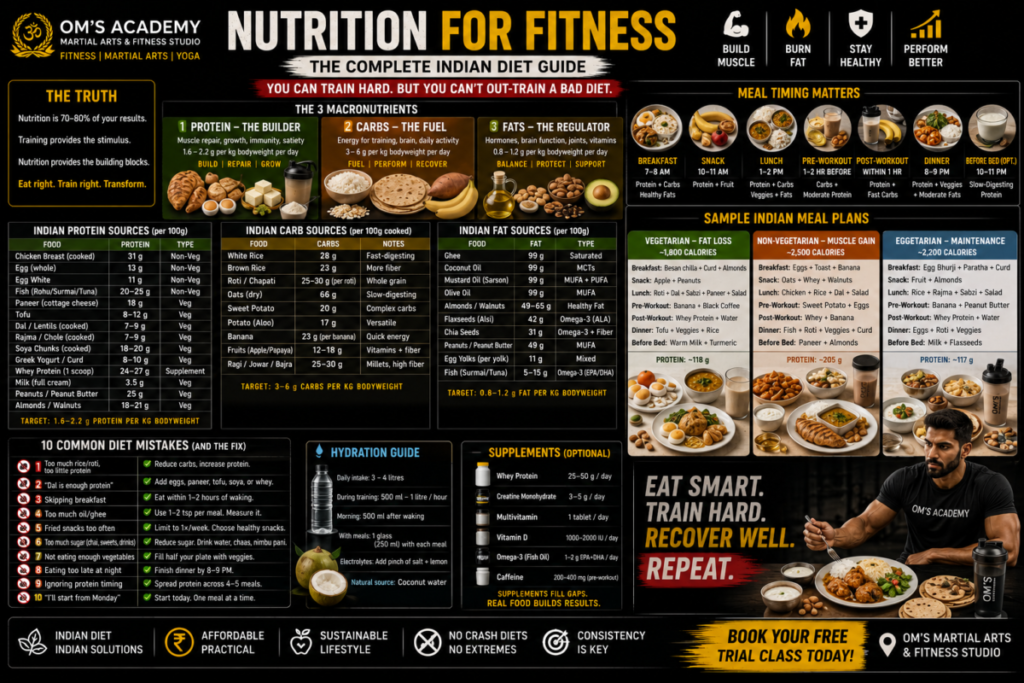
Nutrition is not 50% of the equation. It is 70-80%. Training provides the stimulus. Nutrition provides the building blocks. Without adequate protein, your muscles cannot repair. Without adequate carbohydrates, your training suffers. Without adequate fats, your hormones crash. Without adequate calories, nothing works.
And here is the specific challenge for Indian fitness enthusiasts: the traditional Indian diet is carbohydrate-dominant and protein-deficient. A typical Indian meal is 70-80% carbs (rice, roti), 10-15% fat (oil, ghee), and 5-10% protein (a small portion of dal or a piece of chicken). For fitness, you need to flip that ratio.
At Om’s Martial Arts & Fitness Studio, nutrition guidance is part of every student’s journey. This guide gives you the complete Indian-specific framework — vegetarian and non-vegetarian, fat loss and muscle gain, pre-workout and post-workout.
[↑ Back to: The Complete Guide to Fitness]
The 3 Macronutrients
1. Protein – The Builder
Role: Muscle repair, muscle growth, enzyme production, immune function, satiety.
How much: 1.6-2.2 g per kg of bodyweight per day (for active individuals).
| Bodyweight | Daily Protein Target |
|---|---|
| 50 kg | 80-110 g |
| 60 kg | 96-132 g |
| 70 kg | 112-154 g |
| 80 kg | 128-176 g |
| 90 kg | 144-198 g |
Indian Protein Sources
| Source | Protein per 100g | Type | Notes |
|---|---|---|---|
| Chicken breast (cooked) | 31 g | Non-veg | Lean, versatile, affordable |
| Eggs (whole, boiled) | 13 g | Non-veg (eggetarian) | Complete protein. 6-7 g per egg. |
| Egg whites | 11 g | Non-veg | Pure protein. No fat. |
| Fish (rohu, surmai, tuna) | 20-25 g | Non-veg | Omega-3 fatty acids (surmai, tuna) |
| Paneer (cottage cheese) | 18 g | Veg | High in casein (slow-digesting). Good before bed. |
| Tofu | 8-12 g | Veg | Plant-based complete protein. |
| Greek yogurt / Curd (dahi) | 8-10 g | Veg | Probiotics + protein. |
| Dal / Lentils (cooked) | 7-9 g | Veg | Incomplete protein (combine with rice/roti). |
| Rajma / Chole (cooked) | 7-9 g | Veg | Fiber + protein. |
| Soya chunks (cooked) | 18-20 g | Veg | Highest plant protein. |
| Whey protein (1 scoop) | 24-27 g | Supplement | Convenient. Fast-digesting. Post-workout. |
| Milk (full cream) | 3.5 g | Veg | 7-8 g per glass. |
| Peanuts / Peanut butter | 25 g | Veg | Also high in fat (calorie-dense). |
| Almonds / Walnuts | 18-21 g | Veg | Healthy fats + protein. |
The Indian Protein Problem (And the Fix)
| Problem | Fix |
|---|---|
| Dal is not enough protein | Dal has 7-9 g protein per 100g (cooked). You would need 1.5 kg of dal to hit 120 g protein. Add eggs, paneer, tofu, soya, or whey. |
| “I’m vegetarian” | Vegetarian protein is achievable: paneer + tofu + soya + curd + dal + whey. Plan it deliberately. |
| “I don’t eat eggs” | Paneer, tofu, soya chunks, curd, whey, and legumes can meet your target. |
| “Protein is expensive” | Eggs (₹6-8 each), soya chunks (₹40-60/200g), dal (₹80-120/kg), curd (₹40-60/500g) are affordable. Chicken breast (₹200-300/kg) is cost-effective per gram of protein. |
2. Carbohydrates – The Fuel
Role: Primary energy source for training. Fuels the brain. Spares protein (so protein is used for muscle, not energy).
How much: 3-6 g per kg of bodyweight per day (depending on activity level).
| Activity Level | Carbs per kg |
|---|---|
| Sedentary (desk job, no exercise) | 2-3 g/kg |
| Moderate (3×/week training) | 3-4 g/kg |
| Active (5-6×/week training) | 4-6 g/kg |
| Athlete / fighter (daily training) | 5-7 g/kg |
Indian Carbohydrate Sources
| Source | Carbs per 100g (cooked) | Notes |
|---|---|---|
| White rice | 28 g | Fast-digesting. Good post-workout. |
| Brown rice | 23 g | More fiber. Slower digestion. |
| Roti / Chapati (wheat) | 25-30 g (per roti) | Whole grain. Fiber + carbs. |
| Oats | 66 g (dry) | Slow-digesting. Good breakfast. |
| Sweet potato (shakarkandi) | 20 g | Complex carbs. Vitamin A. |
| Potato (aloo) | 17 g | Versatile. Fast-digesting. |
| Banana | 23 g (per banana) | Quick energy. Pre-workout. |
| Fruits (apple, mango, papaya) | 12-18 g | Vitamins + fiber + carbs. |
| Ragi / Jowar / Bajra | 25-30 g | Millets. High fiber. Gluten-free. |
The Indian Carb Advantage
Indian cuisine is naturally carbohydrate-rich. Rice, roti, dal, potatoes, fruits — these are staples. You do not need to “add” carbs. You need to moderate them and prioritize protein.
The fix: Reduce the rice/roti portion by 25-30%. Increase the protein portion by 100-200%. Fill the rest with vegetables.
3. Fats – The Regulator
Role: Hormone production (testosterone, estrogen), brain function, vitamin absorption (A, D, E, K), joint health, satiety.
How much: 0.8-1.2 g per kg of bodyweight per day. Do not go below 0.5 g/kg (hormonal crash).
Indian Fat Sources
| Source | Fat per 100g | Type | Notes |
|---|---|---|---|
| Ghee | 99 g | Saturated | Traditional. Good in moderation (1-2 tsp/day). |
| Coconut oil | 99 g | Saturated (MCTs) | Good for cooking. MCTs for energy. |
| Mustard oil (sarson) | 99 g | Monounsaturated + PUFA | Traditional North Indian cooking oil. |
| Olive oil | 99 g | Monounsaturated | Good for salads, low-heat cooking. |
| Almonds / Walnuts | 49-65 g | Monounsaturated + Omega-3 | Healthy fats + protein. |
| Flaxseeds (alsi) | 42 g | Omega-3 (ALA) | Plant-based omega-3. |
| Chia seeds | 31 g | Omega-3 + fiber | Soak before eating. |
| Peanuts / Peanut butter | 49 g | Monounsaturated | Affordable. Calorie-dense. |
| Egg yolks | 11 g (per yolk) | Mixed | Choline + healthy fats. Do not skip the yolk. |
| Fish (surmai, tuna, sardines) | 5-15 g | Omega-3 (EPA/DHA) | Best source of omega-3. |
Meal Timing
The Daily Structure
| Meal | Timing | Focus |
|---|---|---|
| Breakfast | 7-8 AM | Protein + complex carbs + healthy fats |
| Mid-morning snack | 10-11 AM | Protein + fruit |
| Lunch | 1-2 PM | Protein + carbs + vegetables + fats |
| Pre-workout | 4-5 PM (1-2 hours before training) | Carbs + moderate protein |
| Post-workout | 7-8 PM (within 1 hour after training) | Protein + fast carbs |
| Dinner | 8-9 PM | Protein + vegetables + moderate fats |
| Before bed (optional) | 10-11 PM | Slow-digesting protein (paneer, curd, casein) |
Pre-Workout Nutrition (1-2 Hours Before)
| Goal | Meal Example |
|---|---|
| Energy for training | 1 banana + 1 tbsp peanut butter |
| Sustained energy | 1 bowl oats + 1 scoop whey + 5 almonds |
| Quick energy (30 min before) | 1 banana + black coffee |
| Indian option | 1 sweet potato + 2 boiled eggs |
The rule: Carbs for fuel. Moderate protein. Low fat (fat slows digestion).
Post-Workout Nutrition (Within 1 Hour After)
| Goal | Meal Example |
|---|---|
| Muscle repair | 1 scoop whey + 1 banana |
| Muscle repair + carbs | 3 egg whites + 2 whole eggs + 1 bowl rice |
| Indian option (veg) | 100g paneer bhurji + 1 roti + salad |
| Indian option (non-veg) | 150g chicken breast + 1 bowl rice + vegetables |
The rule: Protein for repair (30-50 g). Fast carbs for glycogen replenishment. This is the most important meal of the day for recovery.
Sample Indian Meal Plans
Plan 1: Vegetarian (Fat Loss – ~1,800 calories)
| Meal | Menu | Calories | Protein |
|---|---|---|---|
| Breakfast | 2 besan chilla (chickpea flour) + 1 cup curd + 5 almonds | ~400 | 25 g |
| Mid-morning | 1 apple + 10 peanuts | ~150 | 5 g |
| Lunch | 1 roti + 1 bowl dal + 1 bowl sabzi + 100g paneer + salad | ~500 | 30 g |
| Pre-workout | 1 banana + black coffee | ~100 | 1 g |
| Post-workout | 1 scoop whey + water | ~120 | 25 g |
| Dinner | 100g tofu stir-fry + vegetables + 1 small bowl rice | ~400 | 25 g |
| Before bed | 1 cup warm milk + pinch of turmeric | ~130 | 7 g |
| Total | ~1,800 | ~118 g |
Plan 2: Non-Vegetarian (Muscle Gain – ~2,500 calories)
| Meal | Menu | Calories | Protein |
|---|---|---|---|
| Breakfast | 3 whole eggs + 2 egg whites (omelette) + 2 toast + 1 banana | ~550 | 35 g |
| Mid-morning | 1 bowl oats + 1 scoop whey + 5 walnuts | ~400 | 30 g |
| Lunch | 150g chicken breast + 1.5 bowls rice + 1 bowl dal + salad + 1 tsp ghee | ~700 | 50 g |
| Pre-workout | 1 sweet potato + 2 boiled eggs | ~300 | 14 g |
| Post-workout | 1 scoop whey + 1 banana | ~220 | 26 g |
| Dinner | 150g fish (surmai/rohu) + 1 roti + vegetables + curd | ~500 | 40 g |
| Before bed | 50g paneer + 5 almonds | ~150 | 10 g |
| Total | ~2,820 | ~205 g |
Plan 3: Eggetarian (Maintenance – ~2,200 calories)
| Meal | Menu | Calories | Protein |
|---|---|---|---|
| Breakfast | 3 egg bhurji + 1 paratha (less oil) + 1 cup curd | ~500 | 25 g |
| Mid-morning | 1 fruit + 10 almonds | ~150 | 4 g |
| Lunch | 1.5 bowls rice + 1 bowl rajma + 1 bowl sabzi + salad + 1 tsp ghee | ~600 | 20 g |
| Pre-workout | 1 banana + 1 tbsp peanut butter | ~200 | 5 g |
| Post-workout | 1 scoop whey + water | ~120 | 25 g |
| Dinner | 3 egg whites + 2 whole eggs + 1 roti + vegetables | ~450 | 30 g |
| Before bed | 1 cup milk + 1 tsp flaxseeds | ~150 | 8 g |
| Total | ~2,170 | ~117 g |
Hydration
| Guideline | Detail |
|---|---|
| Daily water intake | 3-4 liters (more in summer and on training days) |
| During training | 500 ml – 1 liter per hour of exercise |
| Morning | 500 ml water immediately after waking (rehydrate after sleep) |
| With meals | 1 glass (250 ml) with each meal |
| Signs of dehydration | Dark urine, headache, fatigue, reduced performance |
| Electrolytes | Add a pinch of salt + lemon to water during long/intense sessions. Coconut water (nariyal pani) is a natural electrolyte source. |
Supplements (Optional, Not Essential)
| Supplement | Purpose | Dose | Notes |
|---|---|---|---|
| Whey protein | Convenient protein source | 1-2 scoops/day (25-50 g) | Post-workout or between meals. Not magic — just food. |
| Creatine monohydrate | Strength, power, muscle volume | 3-5 g/day | The most researched supplement. Safe. Effective. Take daily. |
| Multivitamin | Micronutrient insurance | 1 tablet/day | Useful if diet lacks variety. Not a substitute for real food. |
| Vitamin D | Bone health, immunity, hormones | 1,000-2,000 IU/day | Most Indians are deficient (indoor lifestyle). Get bloodwork. |
| Omega-3 (fish oil) | Joint health, anti-inflammatory, brain | 1-2 g EPA+DHA/day | If you don’t eat fish 2-3×/week. |
| Caffeine | Performance, focus | 200-400 mg pre-workout | Black coffee (₹10-20) is the cheapest pre-workout. |
The rule: Supplements are supplements, not replacements. Get 90% of your nutrition from real food. Supplements fill the gaps.
Common Indian Diet Mistakes
| # | Mistake | Fix |
|---|---|---|
| 1 | Too much rice / roti, too little protein | Reduce rice/roti by 25-30%. Double the protein portion. |
| 2 | “Dal is enough protein” | Dal has 7-9 g protein per 100g. Add eggs, paneer, tofu, soya, or whey. |
| 3 | Skipping breakfast | Eat within 1-2 hours of waking. Protein + carbs. |
| 4 | Too much oil / ghee in cooking | Use 1-2 tsp per meal. Measure it. Do not pour freely. |
| 5 | Fried snacks (samosa, pakoda, bhajiya) | Limit to 1×/week. Replace with roasted chana, makhana, or fruit. |
| 6 | Too much sugar (chai, mithai, cold drinks) | Reduce sugar in chai (or go sugar-free). Replace cold drinks with water, nimbu pani, or buttermilk (chaas). |
| 7 | Not eating enough vegetables | Fill half your plate with vegetables (sabzi, salad, raita). |
| 8 | Eating too late at night | Finish dinner by 8-9 PM. Avoid heavy meals within 2 hours of sleep. |
| 9 | Ignoring protein timing | Spread protein across 4-5 meals (30-40 g per meal). Do not eat all protein at dinner. |
| 10 | “I’ll diet from Monday” | Start today. One meal at a time. Perfection is not required. Consistency is. |
Frequently Asked Questions
Q: How much protein do I need per day?
A: 1.6-2.2 g per kg of bodyweight. A 70 kg person needs 112-154 g. Spread across 4-5 meals (30-40 g per meal).
Q: Can I build muscle on a vegetarian Indian diet?
A: Yes. Paneer + tofu + soya chunks + curd + dal + whey + nuts can meet your protein target. It requires deliberate planning, but it is absolutely achievable.
Q: Is rice bad for fitness?
A: No. Rice is a clean, easily digestible carbohydrate source. The problem is portion size. 1-1.5 bowls of rice per meal is fine. 3-4 bowls is excessive.
Q: Should I avoid ghee?
A: No. Ghee is a healthy fat in moderation (1-2 tsp per day). It contains fat-soluble vitamins and butyric acid (gut health). The problem is excess (3-4 tbsp per meal).
Q: Is whey protein safe?
A: Yes. Whey protein is a food product (derived from milk). It is not a steroid. It is not harmful to kidneys in healthy individuals. It is simply a convenient protein source.
Q: Should I take creatine?
A: If you are serious about strength and power, yes. Creatine monohydrate (3-5 g/day) is the most researched, safest, and most effective supplement for strength and muscle. It is not a steroid. It is a naturally occurring compound found in meat.
Q: How do I lose fat without starving?
A: Eat a moderate caloric deficit (300-500 calories below TDEE). Prioritize protein (satiety + muscle preservation). Fill half your plate with vegetables (volume + fiber). Reduce (do not eliminate) carbs and fats.
Q: What should I eat before and after training?
A: Before (1-2 hours): Carbs + moderate protein (banana + peanut butter, oats + whey, sweet potato + eggs). After (within 1 hour): Protein + fast carbs (whey + banana, chicken + rice, paneer + roti).
[→ Full FAQ: 300+ Fitness Questions Answered]
Fuel Your Training at Om’s
Training without nutrition is like building a house without bricks. You can swing the hammer all day, but nothing gets built.
At Om’s Martial Arts & Fitness Studio, we provide nutrition guidance as part of every student’s journey — Indian-specific meal plans, protein targets, and practical tips that fit your lifestyle, your budget, and your food preferences.
[→ Book Your Free Functional Fitness Trial Class at Om’s Martial Arts & Fitness Studio]
[→ Read the Complete Guide to Fitness]
[→ Next: How to Calculate Your Calories – BMR & TDEE Explained]
Om’s Martial Arts & Fitness Studio – You cannot out-train a bad diet. Eat smart. Train hard. Recover well. Repeat.