
The Fighter’s Dilemma
You train martial arts 5-6 days a week. You hit pads. You spar. You drill techniques. You are skilled.
But you notice:
- Your punches lack power in the third round
- Your kicks lose height when you’re tired
- Your takedown defense crumbles under pressure
- You gas out in sparring while your opponent keeps coming
- You get injured — hamstring strains, shoulder tweaks, lower back niggles
- You are strong in technique but weak in body
The missing piece is not more technique. It is strength and conditioning (S&C).
S&C is the physical engine that powers your martial art. Without it, your technique is a Ferrari with a lawnmower engine. With it, your technique becomes a weapon.
At Om’s Martial Arts & Fitness Studio, our martial artists train Functional Fitness 2-3× per week as a mandatory complement to their skill training. The results: harder strikes, more stable stances, better grappling control, faster recovery, fewer injuries, and the conditioning to perform in the third round as well as the first.
[↑ Back to: The Complete Guide to Fitness]
Why Martial Artists Need S&C
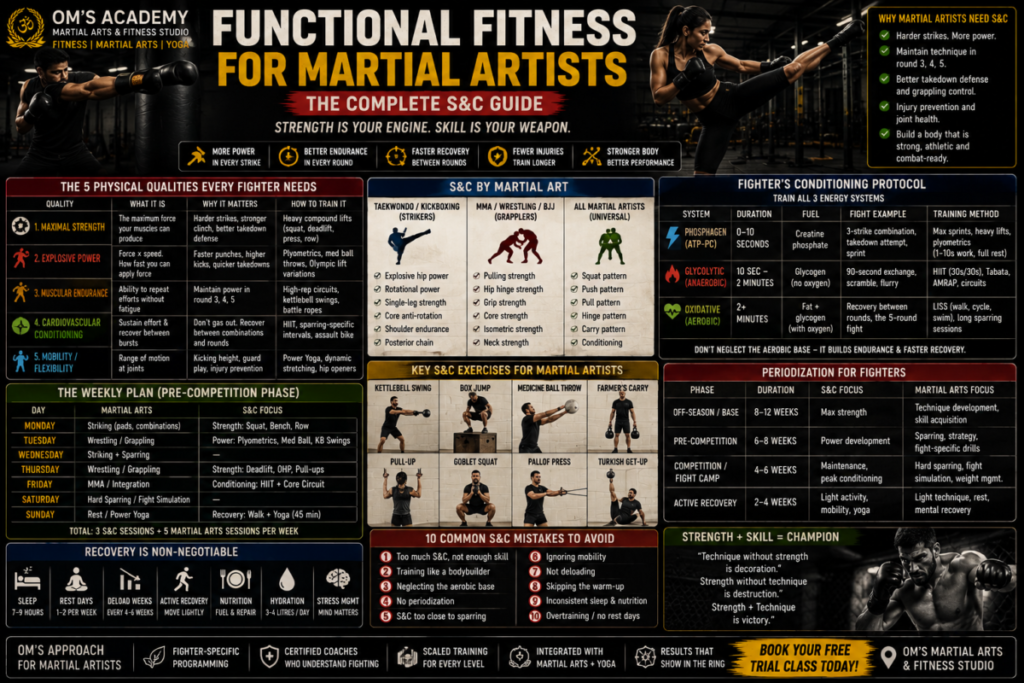
The 5 Physical Qualities Every Fighter Needs
| Quality | What It Is | Why It Matters | How to Train It |
|---|---|---|---|
| 1. Maximal Strength | The maximum force your muscles can produce | Harder strikes, stronger clinch, better takedown defense | Heavy compound lifts (squat, deadlift, press, row) |
| 2. Explosive Power | Force × Speed. How fast you can apply force | Faster punches, higher kicks, quicker takedowns | Plyometrics, medicine ball throws, Olympic lift variations |
| 3. Muscular Endurance | The ability to repeat efforts without fatigue | Maintaining power in round 3, 4, 5 | High-rep circuits, kettlebell swings, battle ropes |
| 4. Cardiovascular Conditioning | The ability to sustain effort and recover between bursts | Not gassing out. Recovering between combinations. | HIIT, sparring-specific intervals, assault bike |
| 5. Mobility / Flexibility | Range of motion at joints | Kicking height, guard play, injury prevention | Power Yoga, dynamic stretching, hip openers |
Most martial artists train qualities 3, 4, and 5 (through sparring, pad work, and stretching). They neglect qualities 1 and 2 (maximal strength and explosive power). This is the gap. And the gap is where fights are lost.
S&C by Martial Art
For Taekwondo / Kickboxing (Strikers)
| Priority | Exercise | Why |
|---|---|---|
| Explosive hip power | Kettlebell swings, box jumps, medicine ball throws | Kicking power comes from the hips |
| Rotational power | Medicine ball rotational throws, cable woodchops | Hook and roundhouse power |
| Single-leg strength | Bulgarian split squats, single-leg RDLs | Kicking stability, balance |
| Core anti-rotation | Pallof press, plank with shoulder tap | Resisting off-balancing, force transfer |
| Shoulder endurance | Battle ropes, light dumbbell punches | Guard maintenance, punch volume |
| Posterior chain | Romanian deadlifts, glute bridges | Hamstring health, hip extension power |
For MMA / Wrestling / BJJ (Grapplers)
| Priority | Exercise | Why |
|---|---|---|
| Pulling strength | Pull-ups, rows, farmer’s carries | Clinch control, takedowns, guard retention |
| Hip hinge strength | Deadlifts, kettlebell swings | Takedown power, hip escapes |
| Grip strength | Farmer’s carries, dead hangs, towel pull-ups | Gi grips, wrist control, submissions |
| Core strength | Planks, hanging leg raises, Turkish get-ups | Guard retention, sweeps, escapes |
| Isometric strength | Wall sits, plank holds, bear hug holds | Clinch endurance, pinning, holding position |
| Neck strength | Neck bridges, band resistance | Injury prevention (whiplash, concussions) |
For All Martial Artists (Universal)
| Priority | Exercise | Why |
|---|---|---|
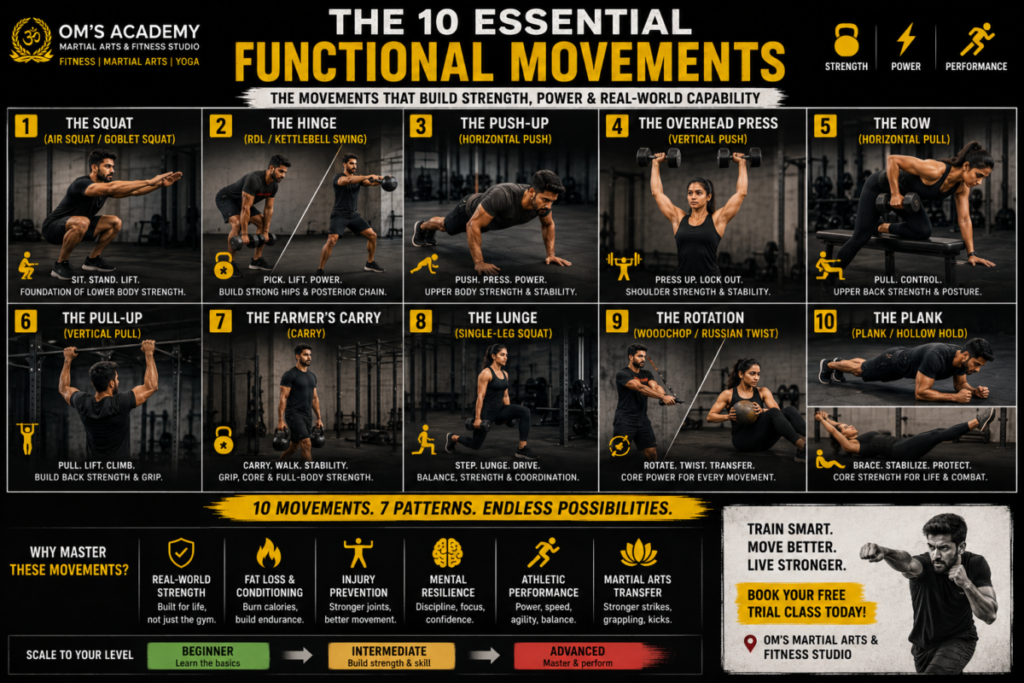
| Squat pattern | Goblet squat, front squat, back squat | Leg strength, stance stability, kicking power |
| Push pattern | Push-up, overhead press, bench press | Punching power, framing, pushing |
| Pull pattern | Row, pull-up, chin-up | Grappling, clinch, pulling |
| Hinge pattern | Deadlift, kettlebell swing, RDL | Hip power, posterior chain, injury prevention |
| Carry pattern | Farmer’s carry, suitcase carry | Grip, core, full-body stability |
| Conditioning | HIIT, assault bike, battle ropes | Fight-specific energy systems |
The Energy Systems
The 3 Energy Systems in Fighting
| System | Duration | Fuel | Fight Example | Training Method |
|---|---|---|---|---|
| Phosphagen (ATP-PC) | 0-10 seconds | Creatine phosphate | A 3-strike combination. A takedown attempt. A sprint. | Maximal effort sprints, heavy lifts, plyometrics (1-10s work, full rest) |
| Glycolytic (Anaerobic) | 10 seconds – 2 minutes | Glycogen (no oxygen) | A 90-second exchange. A scrambling sequence. | HIIT intervals (30s work / 30s rest), Tabata, AMRAP |
| Oxidative (Aerobic) | 2+ minutes | Fat + glycogen (with oxygen) | Recovery between rounds. The 5-round fight. | LISS (walking, cycling, swimming), long sparring sessions |
The Fighter’s Conditioning Protocol
| Day | Energy System | Method | Duration |
|---|---|---|---|
| Monday | Phosphagen + Glycolytic | HIIT: 10s all-out / 50s rest × 10 (assault bike or sprints) | 10 min |
| Wednesday | Glycolytic | AMRAP: 15-min fight-specific circuit (strikes, sprawls, swings, burpees) | 15 min |
| Friday | Oxidative | LISS: 30-40 min walk, cycle, or swim (conversational pace) | 30-40 min |
The rule: Train all three energy systems. Most fighters over-train the glycolytic (HIIT) and under-train the oxidative (aerobic base). The aerobic base is what allows you to recover between rounds. Do not neglect it.
Periodization for Fighters
The Annual Plan
| Phase | Duration | S&C Focus | Martial Arts Focus |
|---|---|---|---|
| Off-Season / Base | 8-12 weeks | Maximal strength (heavy lifts, low reps). Build the engine. | Technique development. Skill acquisition. |
| Pre-Competition | 6-8 weeks | Power (plyometrics, Olympic lift variations). Convert strength to speed. | Sparring. Strategy. Fight-specific drills. |
| Competition / Fight Camp | 4-6 weeks | Maintenance (reduce volume, maintain intensity). Peak conditioning. | Hard sparring. Fight simulation. Weight management. |
| Active Recovery | 2-4 weeks | Light activity. Yoga. Walking. No heavy lifting. | Light technique. Rest. Mental recovery. |
The Weekly Plan (Pre-Competition Phase)
| Day | Martial Arts | S&C |
|---|---|---|
| Monday | Striking (pads, combinations) | Strength: Squat 4×5, Bench 4×5, Row 4×5 |
| Tuesday | Wrestling / Grappling | Power: Box jumps 4×5, Med ball throws 4×8, Kettlebell swings 4×12 |
| Wednesday | Striking + Sparring | — |
| Thursday | Wrestling / Grappling | Strength: Deadlift 4×5, Overhead press 4×5, Pull-ups 4×6 |
| Friday | MMA / Integration | Conditioning: HIIT (assault bike 30/30 × 10) + Core circuit |
| Saturday | Hard Sparring / Fight Simulation | — |
| Sunday | Rest / Yoga | Recovery: Walk + Power Yoga (45 min) |
Total: 3 S&C sessions + 5 martial arts sessions per week.
Fight Camp S&C (4 Weeks Before Competition)
The Taper
| Week | S&C Volume | S&C Intensity | Martial Arts |
|---|---|---|---|
| Week 4 out | 80% | 85% | Hard sparring, fight simulation |
| Week 3 out | 60% | 80% | Moderate sparring, strategy |
| Week 2 out | 40% | 70% | Light sparring, technique, timing |
| Fight week | 20% | 50% | Light movement, visualization, rest |
Fight Week Schedule
| Day | Activity |
|---|---|
| Monday | Light technique review (30 min). No S&C. |
| Tuesday | Light pad work + mobility (45 min). |
| Wednesday | Weigh-in. Rest. Hydrate. |
| Thursday | Light movement, visualization, breathing. |
| Friday | FIGHT DAY. Warm-up, fight, cool-down. |
| Saturday | Rest. Celebrate. Recover. |
| Sunday | Light walk. Reflect. Plan next camp. |
Common S&C Mistakes for Fighters
| # | Mistake | Correction |
|---|---|---|
| 1 | Too much S&C, not enough skill | S&C is the complement, not the replacement. 2-3 S&C sessions + 4-5 skill sessions per week. |
| 2 | Training like a bodybuilder | Fighters need power and conditioning, not maximum hypertrophy. Focus on compound lifts, plyometrics, and HIIT. |
| 3 | Neglecting the aerobic base | HIIT is important, but the aerobic base (walking, cycling, swimming) is what allows you to recover between rounds. Do 1-2 LISS sessions per week. |
| 4 | No periodization | You cannot train at maximum intensity year-round. Periodize: base → power → peak → recovery. |
| 5 | S&C too close to sparring | Do S&C on separate days from hard sparring, or at least 6 hours apart. Fatigued muscles = poor technique = injuries. |
| 6 | Ignoring mobility | Strength without flexibility = injury. Add Power Yoga 2×/week. |
| 7 | Not deloading | Every 4-6 weeks, reduce S&C volume by 40-50%. Your body needs it. |
| 8 | Skipping the warm-up | 10 minutes of dynamic movement before every S&C session. Cold muscles tear. |
Frequently Asked Questions
Q: How often should a martial artist do S&C?
A: 2-3× per week alongside 4-5 martial arts sessions. More than 3 S&C sessions can interfere with skill training and recovery.
Q: Will lifting weights make me slow?
A: No. Properly programmed strength training (heavy compound lifts + plyometrics) makes you faster and more powerful. The “weights make you slow” myth comes from bodybuilding-style training (high volume, isolation). Fighter S&C is different: low reps, heavy weight, explosive intent.
Q: What is the best exercise for punching power?
A: Medicine ball rotational throws (mimics the punching rotation) + bench press / push-ups (upper body pushing strength) + core anti-rotation (Pallof press, planks). Power comes from the hips → core → shoulder → fist kinetic chain.
Q: What is the best exercise for kicking power?
A: Kettlebell swings (hip hinge power) + Bulgarian split squats (single-leg strength) + box jumps (explosive hip extension). Kicking power comes from the hips and posterior chain.
Q: Should I do S&C before or after martial arts training?
A: Separate days is ideal. If you must combine, do martial arts first (skill when fresh), then S&C. Never do heavy S&C immediately before sparring.
Q: How do I build fight-specific conditioning?
A: Train the 3 energy systems: phosphagen (sprints, heavy lifts), glycolytic (HIIT, Tabata, AMRAP), and oxidative (LISS, long sparring). The most fight-specific conditioning is sparring itself — but S&C builds the engine that powers the sparring.
Q: Can I do S&C and Power Yoga?
A: Yes, and you should. S&C builds strength and power. Yoga builds flexibility, balance, and recovery. Together, they build a complete fighter. At Om’s, martial artists train both.
Q: What supplements should a fighter take?
A: Creatine (3-5 g/day) for power and muscle. Whey protein (if protein intake is insufficient). Omega-3 (if not eating fish 2-3×/week). Vitamin D (most Indians are deficient). No magic powders. No fat burners. No pre-workouts with 400 mg caffeine.
Q: How do I peak for a fight?
A: Periodize. Build strength in the off-season. Convert to power in pre-competition. Taper in fight week (reduce volume, maintain intensity). Sleep 8-9 hours. Hydrate. Visualize. Trust your training.
[→ Full FAQ: 300+ Fitness Questions Answered]
Build Your Engine at Om’s
Your technique is the car. S&C is the engine. Without the engine, the car doesn’t move.
At Om’s Martial Arts & Fitness Studio, our Functional Fitness program is designed for martial artists — power development, fight-specific conditioning, injury prevention, and periodized programming that complements your skill training.
[→ Book Your Free Functional Fitness Trial Class at Om’s Martial Arts & Fitness Studio]
[→ Read the Complete Guide to Fitness]
[→ Next: Functional Fitness for Office Workers – Fix Your Body, Fix Your Life]
Om’s Martial Arts & Fitness Studio – Technique wins rounds. Conditioning wins fights. Build both.