
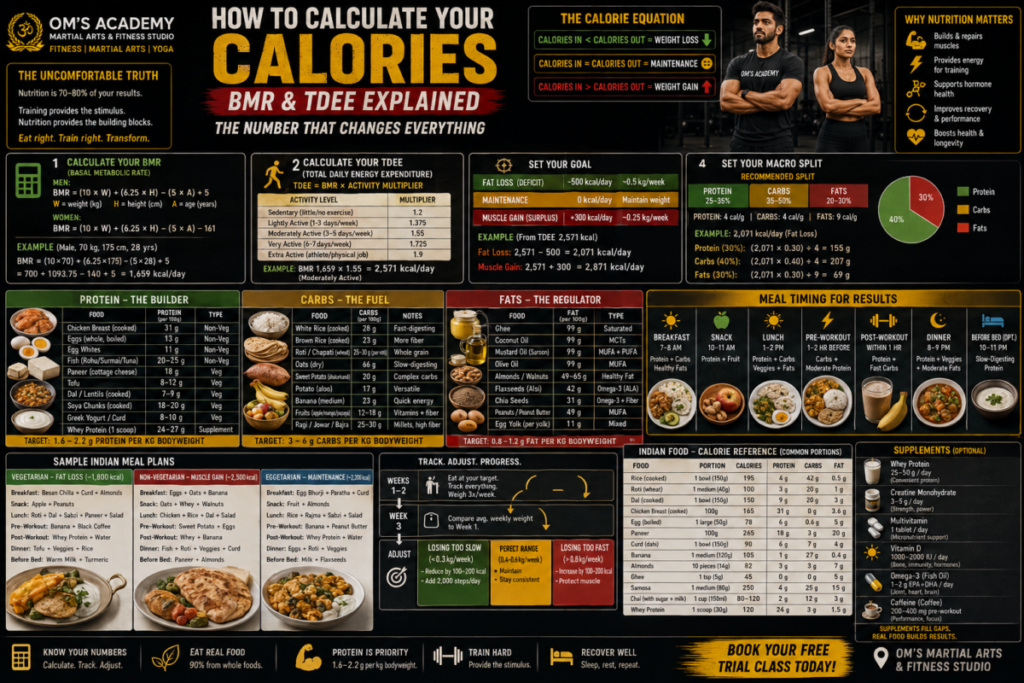

The Number That Changes Everything
Weight loss. Weight gain. Muscle building. Fat burning. Maintenance.
Every single one of these goals comes down to one number: your daily caloric intake relative to your daily caloric expenditure.
Calories In < Calories Out = Weight Loss
Calories In > Calories Out = Weight Gain
Calories In = Calories Out = Maintenance
This is not a theory. It is the First Law of Thermodynamics applied to the human body. No amount of “fat-burning foods,” “detox teas,” or “metabolism-boosting supplements” overrides this equation.
But here is the problem: most people do not know their number. They do not know how many calories they burn. They do not know how many they eat. They guess. And guessing is why most diets fail.
This guide teaches you to calculate your number — precisely, practically, and with Indian food examples.
At Om’s Martial Arts & Fitness Studio, every student who has a body composition goal (fat loss, muscle gain, recomposition) learns to calculate and track their calories. Because you cannot manage what you do not measure.
[↑ Back to: The Complete Guide to Fitness]
Step 1: Calculate Your BMR
What Is BMR?
BMR (Basal Metabolic Rate) is the number of calories your body burns at complete rest — just to keep your heart beating, your lungs breathing, your brain thinking, and your cells functioning. It is the energy cost of being alive.
BMR accounts for approximately 60-70% of your total daily calorie burn.
The Mifflin-St Jeor Equation (Most Accurate)
For Men:
BMR = (10 × weight in kg) + (6.25 × height in cm) − (5 × age in years) + 5
For Women:
BMR = (10 × weight in kg) + (6.25 × height in cm) − (5 × age in years) − 161
Example Calculations
Example 1: Male, 70 kg, 175 cm, 28 years old
BMR = (10 × 70) + (6.25 × 175) − (5 × 28) + 5
BMR = 700 + 1,093.75 − 140 + 5
BMR = 1,659 calories/day
Example 2: Female, 55 kg, 160 cm, 32 years old
BMR = (10 × 55) + (6.25 × 160) − (5 × 32) − 161
BMR = 550 + 1,000 − 160 − 161
BMR = 1,229 calories/day
Step 2: Calculate Your TDEE
What Is TDEE?
TDEE (Total Daily Energy Expenditure) is your BMR multiplied by an activity factor. It represents the total calories you burn in a day, including exercise, walking, fidgeting, and digesting food.
Activity Multipliers
| Activity Level | Multiplier | Description |
|---|---|---|
| Sedentary | BMR × 1.2 | Desk job. Little or no exercise. |
| Lightly active | BMR × 1.375 | Light exercise 1-3 days/week. Walking. |
| Moderately active | BMR × 1.55 | Moderate exercise 3-5 days/week. |
| Very active | BMR × 1.725 | Hard exercise 6-7 days/week. Physical job. |
| Extra active | BMR × 1.9 | Very hard exercise. Athlete. Physical labor. |
Example Calculations (Continued)
Example 1: Male, 70 kg, BMR 1,659, moderately active (trains 4×/week)
TDEE = 1,659 × 1.55 = 2,571 calories/day
Example 2: Female, 55 kg, BMR 1,229, lightly active (trains 2×/week)
TDEE = 1,229 × 1.375 = 1,690 calories/day
Step 3: Set Your Goal
Fat Loss (Caloric Deficit)
To lose fat, eat below your TDEE.
| Deficit | Rate of Loss | Best For |
|---|---|---|
| 250-300 calories/day | ~0.25 kg/week | Slow, sustainable. Minimal muscle loss. |
| 500 calories/day | ~0.5 kg/week | Recommended. Sustainable. Good muscle preservation. |
| 750-1,000 calories/day | ~0.75-1 kg/week | Aggressive. Higher muscle loss risk. Short-term only. |
Example 1 (Male, TDEE 2,571):
- 500-calorie deficit → 2,071 calories/day → ~0.5 kg/week fat loss
Example 2 (Female, TDEE 1,690):
- 400-calorie deficit → 1,290 calories/day → ~0.4 kg/week fat loss
Important: Do not go below 1,200 calories/day (women) or 1,500 calories/day (men) without medical supervision. Extreme deficits cause muscle loss, hormonal disruption, and metabolic adaptation.
Muscle Gain (Caloric Surplus)
To gain muscle, eat above your TDEE.
| Surplus | Rate of Gain | Best For |
|---|---|---|
| 200-300 calories/day | ~0.25 kg/week | Lean bulk. Minimal fat gain. Recommended for most. |
| 500 calories/day | ~0.5 kg/week | Moderate bulk. Some fat gain. |
| 750+ calories/day | ~0.75+ kg/week | Aggressive bulk. Significant fat gain. Advanced only. |
Example 1 (Male, TDEE 2,571):
- 300-calorie surplus → 2,871 calories/day → ~0.25-0.3 kg/week muscle gain
Example 2 (Female, TDEE 1,690):
- 200-calorie surplus → 1,890 calories/day → ~0.2 kg/week muscle gain
Important: Muscle gain is slow. A natural (non-enhanced) male can gain approximately 0.5-1 kg of muscle per month in the first year. A natural female can gain approximately 0.25-0.5 kg per month. Anything faster is likely fat.
Maintenance
To maintain your current weight, eat at your TDEE.
Example 1: 2,571 calories/day
Example 2: 1,690 calories/day
Step 4: Set Your Macro Split
Once you know your calories, divide them into protein, carbohydrates, and fats.
The Recommended Split
| Macro | Calories per gram | Recommended % | How to calculate |
|---|---|---|---|
| Protein | 4 cal/g | 25-35% | (Total calories × 0.30) ÷ 4 |
| Carbohydrates | 4 cal/g | 35-50% | (Total calories × 0.40) ÷ 4 |
| Fats | 9 cal/g | 20-30% | (Total calories × 0.25) ÷ 9 |
Example: Male, 2,071 calories (fat loss)
| Macro | Calculation | Grams |
|---|---|---|
| Protein (30%) | (2,071 × 0.30) ÷ 4 | 155 g |
| Carbs (40%) | (2,071 × 0.40) ÷ 4 | 207 g |
| Fats (30%) | (2,071 × 0.30) ÷ 9 | 69 g |
Example: Female, 1,890 calories (muscle gain)
| Macro | Calculation | Grams |
|---|---|---|
| Protein (30%) | (1,890 × 0.30) ÷ 4 | 142 g |
| Carbs (45%) | (1,890 × 0.45) ÷ 4 | 213 g |
| Fats (25%) | (1,890 × 0.25) ÷ 9 | 53 g |
The Protein Priority
Regardless of the split, protein is non-negotiable. Aim for 1.6-2.2 g/kg minimum. If your calculated protein from the split is below this, increase protein and reduce carbs or fats.
Step 5: Track and Adjust
How to Track
| Method | Tool | Accuracy |
|---|---|---|
| Food diary app | HealthifyMe (Indian foods), MyFitnessPal, Cronometer | ⭐⭐⭐⭐ |
| Kitchen scale | Weigh ingredients in grams | ⭐⭐⭐⭐⭐ |
| Visual estimation | Hand portions (palm = protein, fist = carbs, thumb = fats) | ⭐⭐ |
| Meal prep | Prepare meals in advance with known macros | ⭐⭐⭐⭐⭐ |
The Adjustment Protocol
Your calculated TDEE is an estimate. Your actual TDEE may be 10-15% higher or lower. You must adjust based on results.
| Timeframe | Action |
|---|---|
| Weeks 1-2 | Eat at your calculated target. Track daily. Weigh yourself 3×/week (morning, after bathroom, before eating). |
| Week 3 | Calculate your average weekly weight. Compare to Week 1. |
| If losing 0.4-0.6 kg/week | Perfect. Maintain the deficit. |
| If losing < 0.3 kg/week | Reduce calories by 100-200. Or add 2,000 steps/day. |
| If losing > 0.8 kg/week | Increase calories by 100-200. You are losing too fast (muscle loss risk). |
| If gaining (muscle gain goal) 0.2-0.3 kg/week | Perfect. Maintain the surplus. |
| If gaining > 0.5 kg/week | Reduce surplus by 100-200. You are gaining too much fat. |
| Every 4 weeks | Recalculate TDEE (your weight has changed). Adjust calories. |
The Plateau
After 4-8 weeks, weight loss may stall. This is normal. Causes:
- Metabolic adaptation (your body burns fewer calories as you lose weight)
- Water retention (stress, sodium, hormonal fluctuations)
- Inconsistent tracking (portion creep, untracked snacks)
The fix: Recalculate your TDEE at your new weight. Reduce calories by 100-200. Add 2,000-3,000 steps/day. Take a diet break (eat at maintenance for 1-2 weeks) to reset hormones and adherence.
Indian Calorie Reference (Common Foods)
| Food | Portion | Calories | Protein | Carbs | Fat |
|---|---|---|---|---|---|
| Rice (cooked) | 1 bowl (150g) | 195 | 4 g | 42 g | 0.5 g |
| Roti (wheat) | 1 medium (40g) | 100 | 3 g | 20 g | 1 g |
| Dal (cooked) | 1 bowl (150g) | 150 | 9 g | 20 g | 3 g |
| Chicken breast (cooked) | 100g | 165 | 31 g | 0 g | 3.6 g |
| Egg (boiled) | 1 large (50g) | 78 | 6 g | 0.6 g | 5 g |
| Paneer | 100g | 265 | 18 g | 3 g | 20 g |
| Curd (dahi) | 1 bowl (150g) | 90 | 6 g | 7 g | 4 g |
| Banana | 1 medium (120g) | 105 | 1 g | 27 g | 0.4 g |
| Almonds | 10 pieces (14g) | 82 | 3 g | 3 g | 7 g |
| Ghee | 1 tsp (5g) | 45 | 0 g | 0 g | 5 g |
| Samosa | 1 medium (80g) | 250 | 4 g | 25 g | 15 g |
| Chai (with sugar + milk) | 1 cup (150ml) | 80-120 | 2 g | 12 g | 3 g |
| Whey protein | 1 scoop (30g) | 120 | 24 g | 3 g | 1.5 g |
Frequently Asked Questions
Q: How many calories should I eat to lose weight?
A: Eat 300-500 calories below your TDEE. This produces a sustainable loss of 0.3-0.5 kg per week. Calculate your TDEE using the steps above.
Q: How many calories should I eat to gain muscle?
A: Eat 200-300 calories above your TDEE. This produces a lean gain of 0.2-0.3 kg per week. Prioritize protein (1.6-2.2 g/kg).
Q: Is calorie counting necessary?
A: Not forever. Calorie counting is a learning tool. Track for 4-6 weeks to understand portion sizes and caloric density. After that, you can estimate using hand portions and visual cues. But for the first 4-6 weeks, track everything.
Q: Are all calories equal?
A: Thermodynamically, yes. Practically, no. 100 calories of chicken (protein) is more satiating, more muscle-preserving, and more thermogenic than 100 calories of sugar. The source of the calorie matters for hunger, hormones, and body composition.
Q: Will eating after 8 PM make me fat?
A: No. Total daily calories matter, not timing. Eating at 9 PM does not cause more fat gain than eating at 6 PM — if the total calories are the same. However, eating late may affect sleep quality, which indirectly affects recovery and hormones.
Q: How accurate are calorie calculators?
A: BMR/TDEE calculators are estimates (±10-15%). They are a starting point. You must adjust based on actual results (weekly weigh-ins, progress photos, measurements).
Q: Should I use HealthifyMe or MyFitnessPal?
A: HealthifyMe has a better Indian food database (dal, roti, sabzi, paneer, etc.). MyFitnessPal has a larger global database. Either works. The key is consistency, not the app.
Q: What if I’m not losing weight despite a deficit?
A: (1) You may be underestimating your intake (untracked snacks, cooking oil, “just one bite”). (2) You may be overestimating your TDEE (recalculate). (3) You may be retaining water (stress, sodium, hormonal). Track for 2 weeks. Adjust.
Q: Do I need to count calories forever?
A: No. Track for 4-6 weeks to learn portion sizes. After that, use hand portions (palm = protein, fist = carbs, thumb = fats) and visual cues. Revisit tracking periodically (every 3-6 months) to recalibrate.
[→ Full FAQ: 300+ Fitness Questions Answered]
Know Your Number at Om’s
You cannot manage what you do not measure. And you cannot measure what you do not calculate.
At Om’s Martial Arts & Fitness Studio, every student with a body composition goal learns to calculate their BMR, TDEE, and macro targets — and how to adjust based on results. No guesswork. No fad diets. Just math, food, and consistency.
[→ Book Your Free Functional Fitness Trial Class at Om’s Martial Arts & Fitness Studio]
[→ Read the Complete Guide to Fitness]
[→ Next: Recovery – The Complete Guide to Rest, Sleep & Muscle Repair]
Om’s Martial Arts & Fitness Studio – The math is simple. The discipline is hard. The results are worth it.