
The Paradox
India is a country of contradictions when it comes to fitness.
On one hand, India has a 5,000-year tradition of physical culture — yoga, kushti (wrestling), akhara training, dand-baithak (Hindu push-ups and squats), mallakhamb (pole gymnastics), and martial arts like Kalaripayattu and Gatka. Physical training was woven into the fabric of Indian civilization.
On the other hand, modern India is in the grip of a sedentary epidemic:
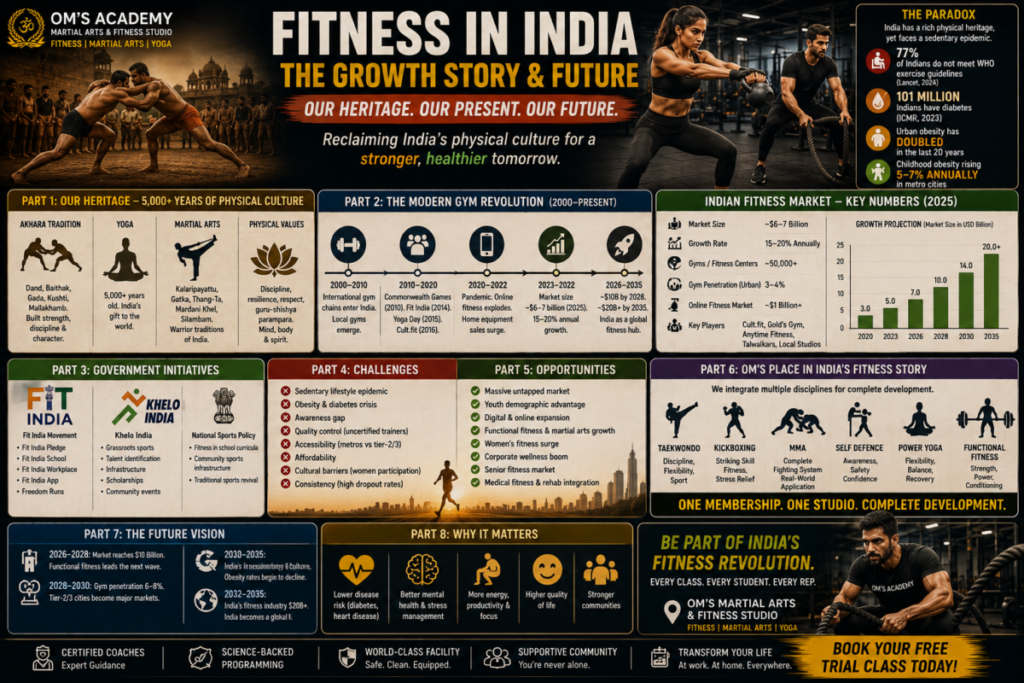
- 77% of Indians do not meet the WHO’s recommended 150 minutes of moderate exercise per week (Lancet, 2024)
- India is the “diabetes capital of the world” — 101 million diabetics (ICMR, 2023)
- Urban obesity has doubled in the last 20 years
- Childhood obesity is rising at 5-7% annually in metro cities
- Sedentary office jobs have replaced active agricultural and manual labor
The gap between India’s physical heritage and its sedentary present is the defining fitness challenge of our time.
At Om’s Martial Arts & Fitness Studio, we are part of the solution. Every student who walks through our doors — whether for Taekwondo, Kickboxing, MMA, Yoga, Self Defence, or Functional Fitness — is reclaiming a piece of India’s physical heritage. This guide tells the story of fitness in India — where it came from, where it is, and where it is going.
[↑ Back to: The Complete Guide to Fitness]
Part 1: The Traditional Heritage
The Akhara Tradition
The akhara (wrestling gym) is India’s original fitness institution. For 500+ years, akhadas have trained wrestlers (pehlwans) in:
| Practice | Description |
|---|---|
| Dand (Hindu push-up) | Full-body dynamic push-up. Sweeping motion from downward dog to cobra. Builds chest, shoulders, core, and spine. |
| Baithak (Hindu squat) | High-rep bodyweight squat. Builds legs, glutes, and cardiovascular endurance. |
| Gada (mace training) | Swinging a heavy mace. Builds rotational core strength, shoulders, and grip. |
| Mallakhamb (pole gymnastics) | Acrobatic exercises on a wooden pole. Builds full-body strength, flexibility, and balance. |
| Kushti (mud wrestling) | Grappling on an earthen floor. Builds functional strength, endurance, and technique. |
| Jor (partner exercises) | Partner resistance drills. Builds functional strength and coordination. |
The akhara tradition is the cultural ancestor of India’s modern fitness culture. The discipline, the guru-shishya (teacher-student) relationship, the emphasis on functional strength and endurance — all of it carries forward.
Yoga
India’s most significant contribution to global fitness. 5,000+ years old. Practiced by 300+ million people worldwide. Recognized by UNESCO as India’s Intangible Cultural Heritage.
[→ Related: The History of Yoga – From Ancient India to Modern Studios]
Martial Arts
| Art | Region | Period |
|---|---|---|
| Kalaripayattu | Kerala | ~3,000+ years |
| Gatka | Punjab | Medieval |
| Thang-Ta | Manipur | Ancient |
| Mardani Khel | Maharashtra | Medieval |
| Silambam | Tamil Nadu | Ancient |
India’s martial arts heritage is among the oldest in the world. At Om’s, we teach Taekwondo, Kickboxing, and MMA — modern combat sports that carry the spirit of India’s warrior traditions.
Part 2: The Modern Gym Revolution (2000–Present)
The First Wave (2000–2010)
| Period | Development |
|---|---|
| 2000s | International gym chains enter India. Gold’s Gym (2002), Fitness First (2005). Metro cities only. Premium pricing. |
| 2005-2010 | Indian gym chains emerge. Talwalkars, Fitness First India, local gyms. Still concentrated in metros. |
| 2008 | Commonwealth Games announced for Delhi (2010). Sparks fitness awareness. |
The Growth Phase (2010–2020)
| Period | Development |
|---|---|
| 2010 | Commonwealth Games, Delhi. India’s sporting consciousness rises. |
| 2014 | Fit India Movement launched by PM Narendra Modi. National fitness awareness campaign. |
| 2015 | International Day of Yoga (June 21). 35,985 people at Rajpath. Guinness World Record. |
| 2016 | Cult.fit (formerly Cure.fit) launches. Tech-enabled fitness. Affordable. Multi-city. |
| 2017-2020 | Gym industry grows at 15-20% annually. Tier-2 cities emerge. Budget gyms proliferate. |
| 2018 | Anytime Fitness expands aggressively in India. 24/7 access model. |
| 2019 | Indian fitness market reaches ~$4 billion. |
The Pandemic Acceleration (2020–2022)
| Period | Development |
|---|---|
| 2020 | Lockdown. Gyms close. Online fitness explodes. YouTube, Instagram, Zoom classes. |
| 2021 | Home fitness equipment sales surge 300%+. Dumbbells, kettlebells, resistance bands sell out. |
| 2022 | Gyms reopen. Hybrid model emerges (in-person + online). People return to gyms with renewed appreciation. |
The Current Landscape (2023–2026)
| Metric | Data |
|---|---|
| Indian fitness market size | ~$6-7 billion (2025 estimate) |
| Growth rate | 15-20% annually |
| Number of gyms / fitness centers | ~50,000+ (organized + unorganized) |
| Gym membership penetration | ~3-4% of urban population (vs 15-20% in the US) |
| Online fitness market | ~$1 billion+ (2025) |
| Key players | Cult.fit, Gold’s Gym, Anytime Fitness, Talwalkars, local studios |
| Emerging trends | Functional fitness, HIIT, martial arts, yoga, hybrid models, AI coaching |
Part 3: Government Initiatives
Fit India Movement (2019)
Launched by PM Narendra Modi on August 29, 2019 (National Sports Day).
| Initiative | Detail |
|---|---|
| Fit India Pledge | Citizens pledge to incorporate fitness into daily life. |
| Fit India School | Schools rated on fitness infrastructure and programs. |
| Fit India Workplace | Corporates encouraged to provide fitness facilities. |
| Fit India Mobile App | Free workout plans, step tracking, fitness challenges. |
| Fit India Freedom Runs | Community running events across India. |
| Fit India Youth | College and university fitness programs. |
Khelo India (2018)
A national sports development program aimed at grassroots sports participation:
- Talent identification and development
- Infrastructure building (sports complexes, training centers)
- Scholarships for young athletes
- Community sports events
National Sports Policy
- Integration of fitness into school curricula (physical education mandatory)
- Support for community sports infrastructure (parks, playgrounds, walking tracks)
- Promotion of traditional sports (yoga, kushti, kabaddi, kho-kho)
Part 4: The Corporate Wellness Revolution
The Business Case
| Benefit | Impact |
|---|---|
| Reduced absenteeism | Fit employees take 20-30% fewer sick days |
| Improved productivity | 15-20% increase in afternoon productivity |
| Reduced healthcare costs | Lower incidence of diabetes, hypertension, obesity |
| Employee retention | Wellness programs improve job satisfaction and loyalty |
| Team building | Group fitness activities build camaraderie |
Corporate Fitness in India
| Company | Initiative |
|---|---|
| Infosys | On-campus gyms, yoga sessions, sports facilities for 300,000+ employees |
| TCS | “Fit for Life” program. Walking challenges. Health screenings. |
| Wipro | On-site fitness centers. Stress management workshops. |
| Google India | Yoga, mindfulness, ergonomic workstations, healthy cafeterias |
| Startups | Cult.fit partnerships, gym reimbursements, wellness stipends |
At Om’s, we offer corporate fitness programs — on-site functional fitness sessions, yoga classes, and martial arts workshops for companies in the area.
Part 5: The Online Fitness Revolution
The Shift
| Platform | Role |
|---|---|
| YouTube | Free workout videos. Indian fitness influencers (Jeet Selal, Gaurav Taneja, Yasmin Karachiwala). |
| Fitness content, transformation stories, community building. | |
| Cult.fit app | Structured programs, live classes, nutrition tracking. |
| HealthifyMe | Calorie tracking, Indian food database, coaching. |
| Zoom / Google Meet | Live online classes (pandemic-accelerated). |
| Dedicated apps | Down Dog (yoga), Nike Training Club, FitOn. |
The Hybrid Model
Post-pandemic, the most successful fitness businesses use a hybrid model:
- In-person classes (community, coaching, accountability)
- Online classes (convenience, accessibility, flexibility)
- App-based tracking (nutrition, progress, programming)
- Community (WhatsApp groups, social media, events)
At Om’s, we are building a hybrid model — in-person classes at the studio, with online resources, programming guides, and community support.
Part 6: Challenges
| Challenge | Detail |
|---|---|
| Sedentary lifestyle | 77% of Indians do not meet WHO exercise guidelines. Office jobs, screen time, urbanization. |
| Obesity and diabetes | 101 million diabetics. Rising childhood obesity. The “diabetes capital.” |
| Awareness gap | Many Indians still view fitness as “bodybuilding” or “weight loss.” Functional fitness, mobility, and strength are underappreciated. |
| Quality control | Many uncertified trainers. Poor programming. Injury risk. |
| Accessibility | Quality fitness instruction concentrated in metro cities. Tier-2/3 and rural access limited. |
| Affordability | Premium gyms are expensive. Budget options lack quality. |
| Cultural barriers | Women’s participation limited in some communities. “Gym is for men” stereotype. |
| Consistency | High dropout rates. “January joiners” who quit by March. |
Part 7: Opportunities
| Opportunity | Detail |
|---|---|
| Massive untapped market | Only 3-4% gym penetration in urban India (vs 15-20% in the US). Enormous growth potential. |
| Youth demographic | India’s median age is 28. A young, aspirational, fitness-conscious population. |
| Digital expansion | Online fitness reaching tier-2/3 cities and rural India. |
| Functional fitness | Growing demand for functional training, HIIT, martial arts, and yoga (beyond bodybuilding). |
| Women’s fitness | Rapidly growing segment. Women-only gyms, self-defence, prenatal/postnatal fitness. |
| Corporate wellness | Companies investing in employee fitness. B2B opportunities. |
| Senior fitness | Aging population. Demand for mobility, balance, and functional independence training. |
| Traditional sports revival | Yoga, kushti, kabaddi, kho-kho gaining mainstream attention. |
| Medical fitness | Exercise as medicine. Diabetes management, cardiac rehab, physiotherapy integration. |
Part 8: The Future (2026–2035)
| Timeframe | Prediction |
|---|---|
| 2026-2028 | Fitness market reaches $10 billion. Functional fitness and martial arts grow faster than traditional gyms. Hybrid models dominate. |
| 2028-2030 | Gym penetration in urban India reaches 6-8%. Tier-2 cities become major markets. AI-assisted coaching emerges. |
| 2030-2032 | Fit India Movement matures. Fitness integrated into school and workplace culture. Obesity rates begin to decline. |
| 2032-2035 | India’s fitness industry reaches $20 billion+. India becomes a global fitness hub (yoga, martial arts, functional training). |
Part 9: Om’s Place in India’s Fitness Story
At Om’s Martial Arts & Fitness Studio, we are part of India’s fitness revolution. But we are not a “gym.” We are a multi-discipline training studio that integrates:
| Discipline | Role |
|---|---|
| Taekwondo | Discipline, flexibility, sport, character |
| Kickboxing | Striking skill, fitness, stress relief |
| MMA | Complete fighting system, functional strength |
| Self Defence | Awareness, legal rights, practical safety |
| Power Yoga | Flexibility, balance, stress relief, recovery |
| Functional Fitness | Strength, power, conditioning, real-world capability |
One membership. One studio. Complete development.
We are building the kind of fitness culture India needs — not just “six-pack abs” and “weight loss,” but functional capability, mental resilience, self-defence preparedness, and lifelong health.
Frequently Asked Questions
Q: How big is the fitness industry in India?
A: The Indian fitness market is estimated at $6-7 billion (2025), growing at 15-20% annually. It includes gyms, yoga studios, martial arts academies, online fitness, corporate wellness, and fitness equipment.
Q: What is the Fit India Movement?
A: A national fitness awareness campaign launched by PM Narendra Modi in 2019. It promotes daily physical activity, school fitness programs, workplace wellness, and community sports events.
Q: Is gym culture growing in India?
A: Yes, rapidly. Gym penetration in urban India has grown from ~1% (2010) to ~3-4% (2025). The growth is driven by rising health awareness, disposable income, social media influence, and corporate wellness programs.
Q: What is the most popular form of fitness in India?
A: Yoga remains the most widely practiced form of fitness in India (50+ million practitioners). However, functional fitness, HIIT, martial arts, and CrossFit-style training are the fastest-growing segments in urban areas.
Q: Is fitness accessible in tier-2 and tier-3 cities?
A: Increasingly, yes. Budget gym chains, online fitness platforms, and government initiatives (Fit India, Khelo India) are expanding access. However, quality coaching and infrastructure remain concentrated in metro cities.
Q: What is the future of fitness in India?
A: Massive growth. With only 3-4% gym penetration (vs 15-20% in the US), the Indian fitness market has enormous headroom. Functional fitness, martial arts, yoga, and digital fitness will lead the next wave of growth.
Q: How is Om’s different from a regular gym?
A: Om’s is a multi-discipline training studio, not a gym. We integrate martial arts (Taekwondo, Kickboxing, MMA), self-defence, Power Yoga, and Functional Fitness under one roof. One membership. Complete development. No other studio in the area offers this integration.
[→ Full FAQ: 300+ Fitness Questions Answered]
Be Part of India’s Fitness Story
India’s fitness revolution is not about six-pack abs. It is not about Instagram transformations. It is not about “getting shredded for summer.”
It is about a nation of 1.4 billion people reclaiming their physical heritage. About office workers who can climb stairs without gasping. About children who play outside instead of scrolling. About women who feel strong and safe. About seniors who can pick up their grandchildren.
At Om’s Martial Arts & Fitness Studio, we are writing our chapter of this story. Every class. Every student. Every rep.
[→ Book Your Free Trial Class at Om’s Martial Arts & Fitness Studio]
[→ Explore All Our Programs – Taekwondo, Kickboxing, MMA, Yoga, Fitness, Self Defence]
[→ Read the Complete Guide to Fitness]
Om’s Martial Arts & Fitness Studio – India’s fitness future. One studio. One student. One rep at a time.