
What Is Taekwondo Sparring?
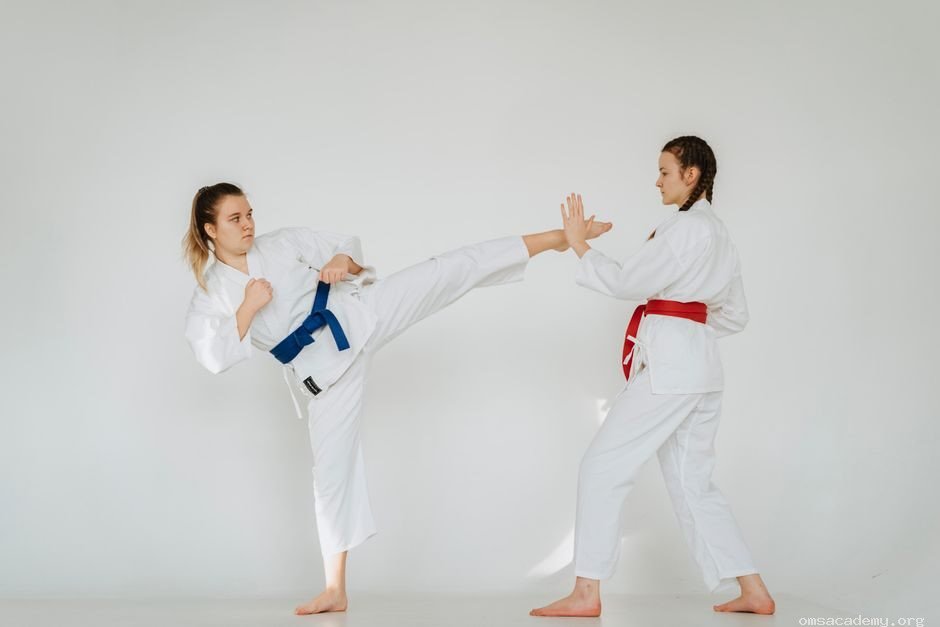
Sparring (겨루기 – Gyeorugi) is the live, dynamic application of everything you train in Taekwondo — stances, kicks, punches, blocks, footwork, timing, and strategy — against a resisting opponent in a controlled environment.
It is where theory becomes reality. A perfect roundhouse kick on a pad means nothing if you cannot land it on a moving, countering, unpredictable opponent.
At Om’s Martial Arts & Fitness Studio, sparring is introduced progressively:
| Stage | Belt Level | Type | Contact |
|---|---|---|---|
| Pre-arranged drills | White-Yellow | One-step sparring (hanbon gyeorugi) | No contact |
| Controlled sparring | Green | Light technical sparring | Light contact |
| Semi-free sparring | Blue | Conditional sparring (specific attacks only) | Moderate contact |
| Free sparring | Red-Black | Open sparring with full rules | Full contact (with gear) |
| Competition sparring | Red-Black+ | Tournament simulation | Full contact (WT rules) |
No student at Om’s is thrown into free sparring before the coach determines readiness. Safety, control, and progressive skill development are non-negotiable.
[↑ Back to: The Complete Guide to Taekwondo]
The Sparring Stance
The sparring stance is different from the poomsae stance. It is optimized for mobility, defense, and rapid attack.
Key Features
| Element | Description |
|---|---|
| Feet | Shoulder-width apart, lead foot pointing slightly inward, rear foot at 45° |
| Weight distribution | Approximately 60% on the rear leg, 40% on the lead leg |
| Knees | Slightly bent, springy, ready to move |
| Hands | Lead hand extended forward (jab hand), rear hand at chin height (guard) |
| Elbows | Tucked in, protecting the ribs |
| Chin | Tucked down, behind the lead shoulder |
| Eyes | On the opponent’s chest/shoulders (not their hands or feet — the torso telegraphs everything) |
| Body angle | Slightly bladed (not fully square, not fully side-on) |
Orthodox vs Southpaw
| Stance | Lead Foot | Lead Hand | Notes |
|---|---|---|---|
| Orthodox | Left | Left | Right-handed fighters typically use this |
| Southpaw | Right | Right | Left-handed fighters typically use this |
At Om’s, students train in both stances from green belt onward. Being comfortable in both makes you unpredictable and adaptable.
Footwork – The Foundation of Sparring
Footwork wins fights. A fighter with average kicks but excellent footwork will outperform a fighter with spectacular kicks who cannot manage distance.
Core Footwork Patterns
| Movement | Execution | Purpose |
|---|---|---|
| Step forward | Lead foot steps forward, rear foot follows | Closing distance, attacking |
| Step backward | Rear foot steps back, lead foot follows | Creating distance, defending |
| Lateral shuffle (left) | Both feet slide left simultaneously | Circling, angle creation |
| Lateral shuffle (right) | Both feet slide right simultaneously | Circling, angle creation |
| Switch | Jump-switch feet (orthodox ↔ southpaw) | Changing angle, setting up rear-leg kicks |
| Bounce / Rhythm step | Light bouncing on the balls of the feet | Staying mobile, unpredictable |
| Pivot | Rotate on the lead foot | Creating angles for spinning kicks |
| Cut step | Quick forward step with the lead foot, cutting off the opponent’s retreat | Trapping, pressure |
Footwork Drills at Om’s
- Ladder drills – Quick feet, coordination
- Cone drills – Directional changes, agility
- Mirror drills – Partner moves, you mirror (reaction + footwork)
- Shadow sparring – Move and strike without a partner (visualization + movement)
- Sparring-specific rounds – 2-minute rounds of footwork-only sparring (no strikes)
[→ Related: Taekwondo Footwork – The Complete Movement Guide]
Attack Techniques
Primary Kicks in Sparring
| Kick | Korean | Target | Points (WT) | Usage |
|---|---|---|---|---|
| Roundhouse kick | Dollyo Chagi | Body / Head | 2 / 3 | The workhorse. 70%+ of scored techniques. |
| Front kick / Push kick | Ap Chagi | Body | 2 | Distance management, disruption |
| Side kick | Yeop Chagi | Body | 2 | Power, stopping an advancing opponent |
| Axe kick | Naeryo Chagi | Head / Shoulder | 3 | Over the guard, surprise |
| Spinning hook kick | Dwit Huryeo Chagi | Head | 5 | High-risk, high-reward. Knockout weapon. |
| Spinning back kick | Dwit Chagi | Body / Head | 4 / 5 | Counter-attack, devastating power |
| Crescent kick | Bandal Chagi | Head | 3 | Over the guard, inside line |
| Fast roundhouse (lead leg) | Dollyo Chagi | Body | 2 | Quick point-scorer, setup |
Punches in Sparring
| Punch | Target | Points (WT) | Usage |
|---|---|---|---|
| Straight punch (rear hand) | Body (chest protector) | 1 | Close range, after kick exchanges |
| Jab (lead hand) | Body | 1 | Disruption, setup, range-finding |
Note: In WT sparring, punches score only to the trunk protector (hogu), not the head. Punches are less emphasized than kicks but are valuable for close-range disruption and combination setup.
Attack Combinations
| Combination | Sequence | Purpose |
|---|---|---|
| Double roundhouse | Lead leg roundhouse → Rear leg roundhouse | Overwhelm the guard, score twice |
| Push → roundhouse | Front kick (push) → Rear roundhouse to head | Create distance, then attack high |
| Low → high | Roundhouse to body → Roundhouse to head | Level change, draw guard down then go over |
| Punch → kick | Straight punch → Rear roundhouse | Close the distance, then strike |
| Switch → roundhouse | Switch stance → Rear roundhouse | Change angle, attack from unexpected side |
| Feint → axe kick | Fake roundhouse → Axe kick over the guard | Draw reaction, exploit the opening |
| Cut → spinning back kick | Step in (cut) → Spinning back kick | Aggressive entry, power finish |
[→ Full Library: 50 Taekwondo Sparring Combinations]
Defense Techniques
Defensive Categories
| Category | Techniques | When to Use |
|---|---|---|
| Evasion | Step back, lateral movement, lean, duck | When you can avoid the attack entirely |
| Blocking | Forearm block, shin check, parry | When evasion is not possible |
| Clashing | Meeting the kick with your own kick | When you want to stop the attack and counter simultaneously |
| Absorbing | Taking the hit on the hogu (chest protector) and countering | When the attack is not powerful enough to score cleanly |
Key Defensive Techniques
| Technique | Execution | Against |
|---|---|---|
| Step back | Rear foot steps back, creating distance | Any kick |
| Lateral escape | Slide sideways off the center line | Linear attacks (front kick, side kick) |
| Shin check | Lift the lead knee, blocking the roundhouse with the shin | Roundhouse kick to the body |
| Forearm block | Drop the forearm to block the body kick | Roundhouse to the ribs |
| High block | Raise the forearm above the head | Axe kick, high roundhouse |
| Parry | Push the incoming kick aside with the hand | Front kick, push kick |
| Lean back | Shift the upper body backward, letting the kick pass | Head kick |
| Duck / Drop | Lower the body, letting a high kick pass over | Head kick |
| Clash | Throw your own kick simultaneously, meeting the opponent’s kick | Any kick (advanced timing) |
The Art of the Counter
Counter-attacks are the highest-percentage scoring strategy in WT sparring. A well-timed counter scores more often than a lead attack because:
- The opponent is committed to their attack (off-balance, guard open)
- The electronic scoring system registers the counter cleanly
- The opponent cannot defend while attacking
| Counter | Setup | Execution |
|---|---|---|
| Step-back roundhouse | Opponent attacks → you step back → their kick falls short → you counter with roundhouse | Timing + distance |
| Spinning back kick | Opponent attacks → you turn → spinning back kick to the body | Reaction + power |
| Cut kick | Opponent steps in → you intercept with a front kick or side kick | Anticipation |
| Check → roundhouse | Opponent roundhouses → you check with shin → immediately counter roundhouse | Block + counter |
| Duck → axe kick | Opponent throws high kick → you duck → counter with axe kick over their guard | Evasion + counter |
[→ Related: Counter-Attacking in Taekwondo – The Complete Guide]
Strategy by Level
Beginner Strategy (Green Belt)
- Focus on distance management. Stay at a range where you can kick but they cannot reach you.
- Use your rear-leg roundhouse. It is your most reliable weapon.
- Do not over-commit. One kick, then reset. Do not throw wild combinations.
- Keep your hands up. Beginners drop their hands when they kick. Drill this habit.
- Breathe. Exhale on every technique. Do not hold your breath.
Intermediate Strategy (Blue Belt)
- Add the lead-leg roundhouse. It is faster and scores well.
- Use level changes. Body kick → head kick. Draw the guard down, then go over.
- Develop counters. Step-back roundhouse, check-and-counter.
- Use footwork to create angles. Do not fight in a straight line. Circle, pivot, switch.
- Manage the clock. If you are ahead on points, control distance. If behind, increase pressure.
Advanced / Competition Strategy (Red-Black Belt)
- Feints are essential. Fake the body, go head. Fake the kick, punch. Draw reactions.
- Exploit patterns. Watch your opponent for 30 seconds. What do they do under pressure? What is their go-to counter? Exploit it.
- Use the octagon. Cut off the ring. Force your opponent to the edge. Limit their escape routes.
- Manage penalties. Avoid passivity (gam-jeom). Stay active. Throw techniques even if they don’t land.
- Condition for 3 rounds. The third round is where fights are won and lost. If your cardio fails, your technique fails.
- Adapt between rounds. Listen to your coach. If Round 1 didn’t work, change the plan for Round 2.
[→ Related: Competition Strategy – How to Win Taekwondo Matches]
Sparring Etiquette & Safety at Om’s
Rules of the Dojang
- Bow to your partner before and after every sparring round.
- Control your power at the level appropriate for your partner’s experience.
- No sparring without full protective gear (head guard, hogu, shin guards, forearm guards, mouthguard, groin guard).
- Stop immediately when the coach calls “Kal-yeo!” (break).
- No strikes after the stop command. This is a safety violation and a respect violation.
- Tap your partner’s shoulder to acknowledge a good technique. Sportsmanship is mandatory.
- Report injuries immediately. Do not “tough it out.” Your health matters more than your ego.
- Senior belts protect junior belts. If you are sparring a less experienced partner, your job is to help them learn, not to dominate them.
Protective Gear (Mandatory for All Sparring)
| Gear | Purpose |
|---|---|
| Head guard | Protects the skull, ears, and temples |
| Chest protector (hogu) | Protects the torso; contains electronic sensors (WT) |
| Forearm guards | Protects the forearms during blocks |
| Shin guards | Protects the shins during kicks and checks |
| Mouthguard | Protects teeth, jaw, and reduces concussion risk |
| Groin guard (men) / Chest guard (women) | Protects sensitive areas |
| Gloves (WT-style) | Protects the hands; allows punch scoring |
| Foot protectors (WT competition) | Contains electronic sensors for kick scoring |
[→ Full Guide: Taekwondo Equipment – Complete Buying Guide]
Training Sparring vs Competition Sparring
| Feature | Training Sparring (at Om’s) | Competition Sparring (WT) |
|---|---|---|
| Purpose | Skill development, learning, experimentation | Winning, scoring, performance |
| Intensity | Controlled, scaled to partner | Full intensity |
| Contact | Light to moderate (coach-directed) | Full contact |
| Gear | Full protective gear | Full protective gear + electronic PSS |
| Rounds | Flexible (1-3 min, coach-directed) | 3 × 2 min (best of 3) |
| Referee | Coach supervises | Certified referee |
| Scoring | Coach feedback, no formal scoring | Electronic + judges |
| Mistakes | Encouraged (learning opportunity) | Penalized |
| Mindset | Growth, exploration, fun | Focus, execution, competitiveness |
Both are essential. Training sparring builds the skills. Competition sparring tests them. At Om’s, students transition from training to competition sparring only when the coach determines readiness — typically at red belt level or above.
Frequently Asked Questions
Q: When do I start sparring at Om’s?
A: Light, controlled sparring begins at approximately green belt (~6 months). Free sparring begins at blue-red belt (~12+ months). Competition sparring is for red-black belt students who have been cleared by the coach.
Q: Will I get hurt?
A: With full protective gear and coach supervision, the injury risk is low. Minor bruises (shins, forearms) are common and normal. Serious injuries are rare. At Om’s, safety protocols are strictly enforced.
Q: I’m scared of sparring. Is that normal?
A: Completely normal. Every fighter, including Olympians, felt fear before their first sparring session. The fear diminishes rapidly with experience. At Om’s, we start with pre-arranged drills (no free contact) so you build confidence progressively.
Q: How do I get better at sparring?
A: 1) Drill footwork daily. 2) Practice combinations on pads until they are automatic. 3) Spar regularly (2-3× per week). 4) Watch competition footage (WT Grand Prix, Olympics). 5) Get coach feedback after every session. 6) Improve your cardio (sparring is exhausting).
Q: What is the electronic scoring system?
A: WT uses the PSS (Protector and Scoring System) — sensors embedded in the chest protector (hogu) and foot protectors register valid strikes electronically. This reduces judging bias and rewards clean, powerful techniques.
[→ Full FAQ: 500+ Taekwondo Questions Answered]
Develop Your Sparring Game at Om’s
Sparring is where Taekwondo comes alive. It is where you learn timing, distance, courage, and adaptability — qualities that no pad drill can fully teach.
At Om’s Martial Arts & Fitness Studio, sparring is taught progressively, supervised constantly, and integrated with technique training, fitness conditioning, and competition preparation.
[→ Book Your Free Trial Class at Om’s Martial Arts & Fitness Studio]
[→ Read the Complete Guide to Taekwondo]
[→ Next: WT Taekwondo Competition Rules 2026]
Om’s Martial Arts & Fitness Studio – Spar smart. Spar safe. Spar to grow.