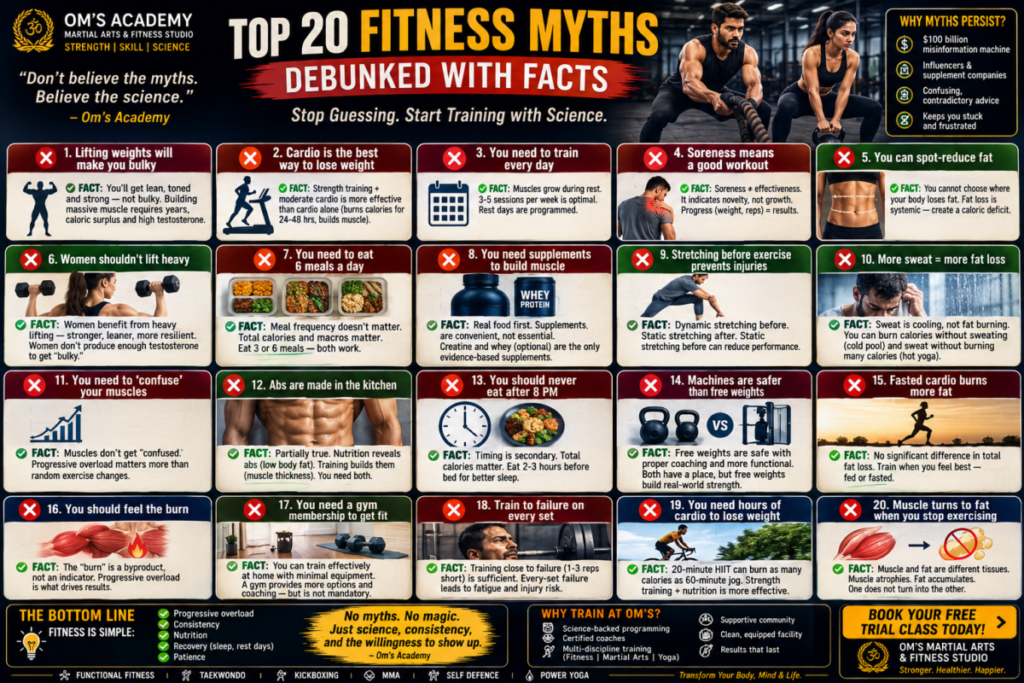

Why Myths Persist
The fitness industry is a $100 billion misinformation machine. Every supplement company, every influencer, every “guru” has a secret to sell. And the myths they propagate keep people confused, frustrated, and stuck.
At Om’s Martial Arts & Fitness Studio, we hear these myths every week. From prospective students, from skeptical friends, from people who tried “that one trick” and got nowhere. So we decided to address all 20 in one place — honestly, with science, and without judgment.
[↑ Back to: The Complete Guide to Fitness]
The Myths
Myth 1: “Lifting weights will make you bulky.”
The Myth: If you lift, you’ll look like a bodybuilder. Especially women.
The Fact: Building significant muscle mass requires a caloric surplus, years of dedicated training, and (for men) high testosterone levels. Women produce approximately 1/10th the testosterone of men. Lifting weights makes you lean, toned, and strong — not bulky.
The “bulky” look you see in bodybuilding magazines is the result of years of extreme training, precise nutrition, and often performance-enhancing drugs. You will not accidentally look like that.
Verdict: Complete myth. Lifting makes you lean and strong, not bulky.
Myth 2: “Cardio is the best way to lose weight.”
The Myth: Run for an hour. Burn the fat.
The Fact: Cardio burns calories during the session. Strength training burns calories during the session AND for 24-48 hours after (EPOC / afterburn). Strength training also builds muscle, which increases your resting metabolic rate (you burn more calories at rest).
A 2023 meta-analysis in Obesity Reviews confirmed that combining strength training with moderate cardio produces superior fat loss compared to cardio alone.
Verdict: Myth. Strength training + moderate cardio is more effective than cardio alone.
Myth 3: “You need to train every day.”
The Myth: More is better. Rest is for the weak.
The Fact: Muscles grow during rest, not during training. Training breaks muscle tissue down. Recovery builds it back stronger. Without rest days, you accumulate fatigue, increase injury risk, and plateau or regress.
3-5 sessions per week is optimal for most people. Rest days are not optional. They are programmed.
Verdict: Myth. Rest is when the growth happens.
Myth 4: “Soreness means a good workout.”
The Myth: If you’re not sore the next day, you didn’t train hard enough.
The Fact: Soreness (DOMS – Delayed Onset Muscle Soreness) indicates novel stimulus or muscle damage, not effectiveness. You can have an extremely effective workout without being sore. And you can be extremely sore from a poorly designed workout.
As you adapt to a program, soreness decreases. This does not mean the workout is less effective. It means your body has adapted.
Verdict: Myth. Soreness ≠ effectiveness. Progress (weight, reps, performance) = effectiveness.
Myth 5: “You can spot-reduce fat.”
The Myth: Do 100 crunches a day and lose belly fat.
The Fact: You cannot choose where your body loses fat. Fat loss is systemic — your body draws from fat stores across the entire body, in a pattern determined by genetics and hormones. Crunches strengthen the abdominal muscles, but they do not “burn belly fat.”
The only way to lose belly fat is a caloric deficit (eat fewer calories than you burn). The abs will reveal themselves as overall body fat decreases.
Verdict: Complete myth. Spot reduction is physiologically impossible.
Myth 6: “Women shouldn’t lift heavy.”
The Myth: Heavy weights are for men. Women should do light weights and high reps.
The Fact: Women benefit from heavy lifting exactly as men do — increased strength, bone density, metabolic rate, and lean muscle. Women do not produce enough testosterone for significant hypertrophy. Heavy lifting makes women stronger, leaner, and more resilient — not “manly.”
The “light weights, high reps” approach is less effective for strength and body composition than progressive overload with moderate-to-heavy loads.
Verdict: Complete myth. Women should lift heavy.
Myth 7: “You need to eat 6 meals a day.”
The Myth: Eating frequently “boosts your metabolism.”
The Fact: Meal frequency has no significant effect on metabolic rate or fat loss. Total daily calories and macronutrients matter. Whether you eat 3 meals or 6 meals, the metabolic effect is the same.
Eat the number of meals that fits your lifestyle, hunger, and adherence. Some people thrive on 3 meals. Others prefer 5-6. Neither is superior.
Verdict: Myth. Total calories and macros matter, not meal frequency.
Myth 8: “You need supplements to build muscle.”
The Myth: Without protein powder, creatine, and BCAAs, you can’t grow.
The Fact: Supplements are convenient, not essential. You can build muscle with real food (eggs, chicken, paneer, dal, tofu, curd). Supplements fill gaps — they do not create results.
The only supplements with strong evidence are creatine (3-5 g/day) and whey protein (if dietary protein is insufficient). Everything else is marketing.
Verdict: Myth. Real food first. Supplements are optional.
Myth 9: “Stretching before exercise prevents injuries.”
The Myth: Static stretching before a workout protects you.
The Fact: Static stretching before exercise does NOT reduce injury risk (2023 meta-analysis, British Journal of Sports Medicine). In fact, prolonged static stretching before strength or power activities can temporarily reduce performance.
Dynamic stretching (leg swings, arm circles, hip rotations) before exercise is effective. Static stretching after exercise (cool-down) is beneficial for flexibility.
Verdict: Partially true. Dynamic stretching before. Static stretching after. Not the other way around.
Myth 10: “More sweat = more fat loss.”
The Myth: If you’re drenched in sweat, you’re burning more fat.
The Fact: Sweat is your body’s cooling mechanism, not a fat-loss indicator. You sweat more in hot environments, with more clothing, and with higher humidity. None of these increase fat loss.
You can burn significant calories in a cold swimming pool (minimal sweat) and burn minimal calories in a hot yoga class (maximum sweat). Sweat ≠ calorie burn.
Verdict: Complete myth. Sweat is cooling, not fat burning.
Myth 11: “You need to ‘confuse’ your muscles.”
The Myth: Change your exercises every week or your muscles “adapt” and stop growing.
The Fact: Muscles do not get “confused.” They respond to progressive overload — gradually increasing the demand. Changing exercises randomly disrupts progressive overload and slows progress.
Variation is useful (every 4-6 weeks, in a periodized plan). Random, frequent changes are counterproductive.
Verdict: Myth. Progressive overload matters more than exercise variation.
Myth 12: “Abs are made in the kitchen.”
The Myth: You only need diet for visible abs. Training is irrelevant.
The Fact: Partially true. Visible abs require low body fat (achieved through nutrition). But ab training (planks, hanging leg raises, dead bugs) builds the muscle thickness that makes abs visible at higher body fat percentages.
You need both: nutrition (to reduce body fat) AND training (to build the muscle).
Verdict: Partially true. Nutrition reveals abs. Training builds them. You need both.
Myth 13: “You should never eat after 8 PM.”
The Myth: Late-night eating causes fat gain.
The Fact: Total daily calories determine fat gain or loss, not the time you eat. Eating at 9 PM does not cause more fat gain than eating at 6 PM — if the total calories are the same.
However, eating late may affect sleep quality (digestion disrupts sleep), which indirectly affects recovery and hormones. Finish dinner 2-3 hours before bed for optimal sleep.
Verdict: Myth. Timing is secondary. Total calories are primary.
Myth 14: “Machines are safer than free weights.”
The Myth: Machines guide your movement, so you can’t get hurt.
The Fact: Machines isolate muscles and remove stabilizer engagement. This can create muscle imbalances and does not train the functional movement patterns your body uses in daily life. Free weights (dumbbells, kettlebells, barbells) train stabilizers, coordination, and functional strength.
Both have a place. But for functional fitness, free weights are superior. With proper coaching, free weights are safe.
Verdict: Myth. Free weights are safe with proper coaching and more functional than machines.
Myth 15: “You need to do cardio on an empty stomach to burn fat.”
The Myth: “Fasted cardio” burns more fat.
The Fact: Fasted cardio may burn slightly more fat during the session, but total daily fat loss is determined by caloric balance, not fasting status. A 2023 meta-analysis in Journal of the International Society of Sports Nutrition found no significant difference in fat loss between fasted and fed cardio over 4+ weeks.
Train when you feel best. If you perform better after eating, eat. If you prefer fasted, go fasted. The difference is negligible.
Verdict: Myth. Total caloric balance matters, not fasting status.
Myth 16: “You should feel the burn in the muscle you’re training.”
The Myth: If you don’t “feel it” in the target muscle, the exercise isn’t working.
The Fact: The “burn” (lactic acid accumulation) is a metabolic byproduct, not an indicator of muscle activation. You can have an effective set without feeling a burn. And you can feel a burn in the wrong muscle (compensation).
Progressive overload and proper form are the indicators of effectiveness, not the burn sensation.
Verdict: Myth. The burn is not the goal. Progressive overload is.
Myth 17: “You need a gym membership to get fit.”
The Myth: Without a gym, you can’t train effectively.
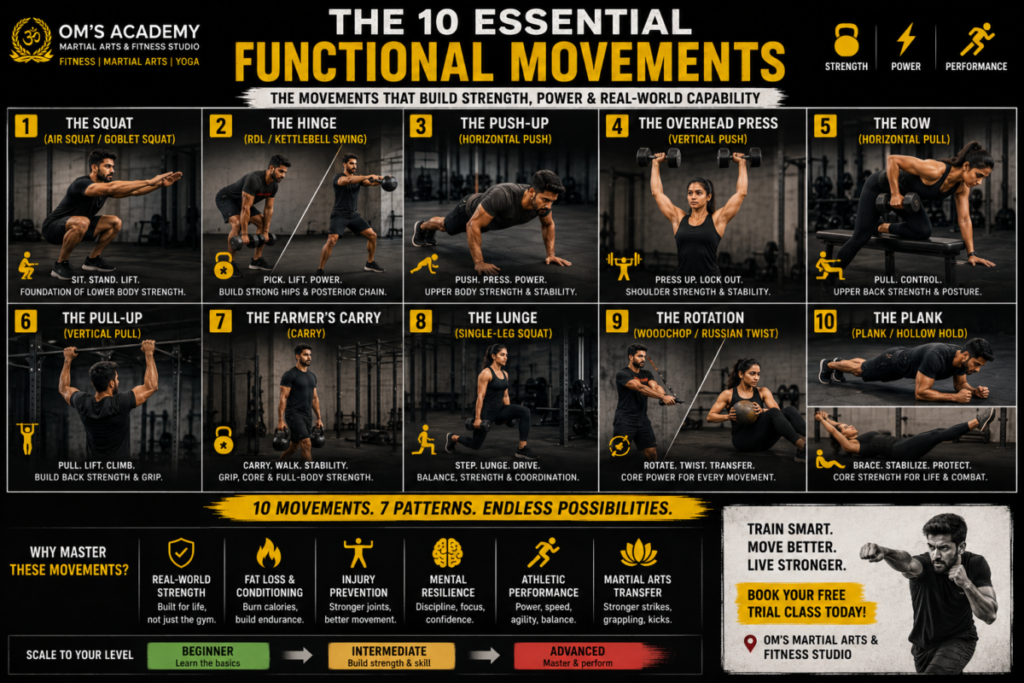
The Fact: You can build a complete fitness program with minimal equipment: a pair of adjustable dumbbells, a kettlebell, a pull-up bar, a mat, and your bodyweight. Push-ups, squats, lunges, planks, rows, and carries require no gym.
A gym provides more equipment and coaching. But it is not a prerequisite for fitness.
Verdict: Myth. You can train effectively at home, in a park, or at a studio like Om’s.
Myth 18: “You should train to failure on every set.”
The Myth: If you can do one more rep, the set didn’t count.
The Fact: Training to failure (the point where you cannot complete another rep with good form) is effective but not necessary for every set. Research shows that training 1-3 reps short of failure produces similar hypertrophy with less fatigue and lower injury risk.
Training to failure on every set leads to excessive fatigue, longer recovery, and higher injury risk. Use it sparingly (last set of an exercise, occasionally).
Verdict: Myth. Training close to failure is sufficient. Every-set failure is counterproductive.
Myth 19: “You need to do hours of cardio to lose weight.”
The Myth: 60 minutes on the treadmill, 5 days a week.
The Fact: A 20-minute HIIT session can burn as many calories (and more afterburn) as a 60-minute jog. Combined with strength training and proper nutrition, you can lose fat with 30-45 minutes of exercise, 3-4× per week.
Hours of cardio are unnecessary, time-consuming, and can lead to overuse injuries and muscle loss.
Verdict: Myth. Short, intense sessions + strength training + nutrition = effective fat loss.
Myth 20: “Once you stop exercising, muscle turns to fat.”
The Myth: If you quit the gym, your muscles become fat.
The Fact: Muscle and fat are two different tissues. One does not “turn into” the other. When you stop training, muscle atrophies (shrinks) due to disuse. If you continue eating the same calories (without the exercise to burn them), you may gain fat. But the muscle did not “become” fat. They are separate processes.
Verdict: Complete myth. Muscle atrophies. Fat accumulates. They are independent.
The Bottom Line
Fitness is not complicated. The principles are simple:
- Progressive overload (gradually increase the demand)
- Consistency (show up, 3-5× per week)
- Nutrition (adequate protein, caloric balance)
- Recovery (sleep, rest days, deloads)
- Patience (results take weeks and months, not days)
Everything else is noise. Ignore the myths. Trust the science. Show up. Do the work.
[→ Book Your Free Functional Fitness Trial Class at Om’s Martial Arts & Fitness Studio]
[→ Read the Complete Guide to Fitness]
[→ Explore All Our Programs – Taekwondo, Kickboxing, MMA, Yoga, Fitness, Self Defence]
Om’s Martial Arts & Fitness Studio – No myths. No magic. Just science, consistency, and the willingness to show up.