
The Missing Half of Training
Here is the truth that most fitness programs will not tell you:
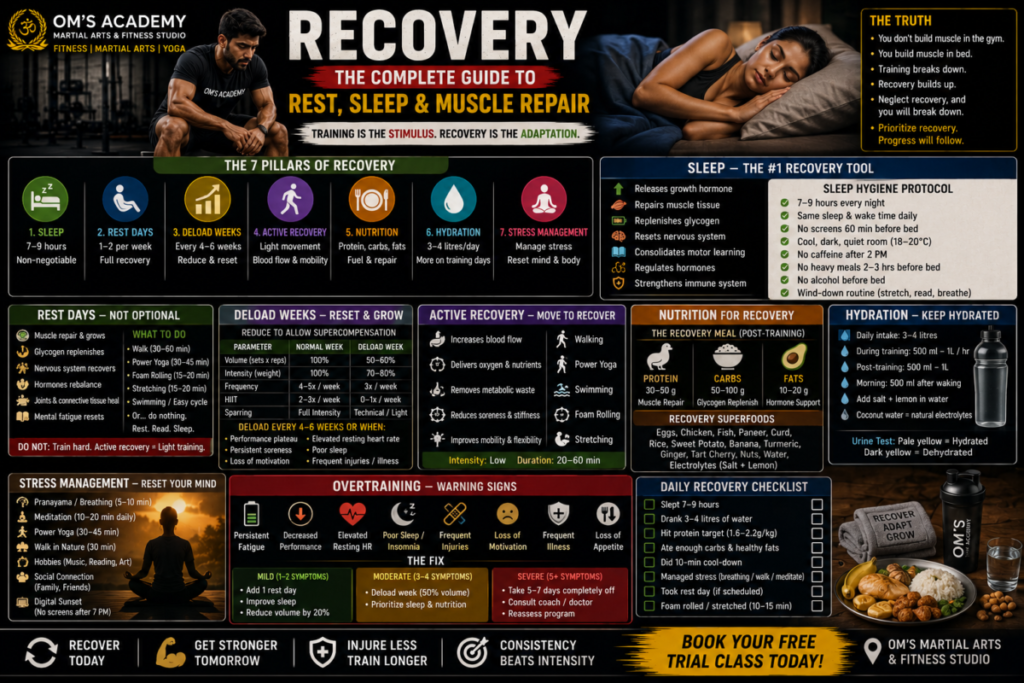
You do not build muscle in the gym. You build muscle in bed.
Training is the stimulus. It breaks muscle tissue down. It depletes glycogen. It creates micro-tears in muscle fibers. It stresses the nervous system. It elevates cortisol.
Recovery is where the repair happens. Where the muscle grows back stronger. Where the glycogen is replenished. Where the nervous system resets. Where the adaptation occurs.
Training without recovery is like digging a hole and never filling it back in. You just keep digging. Deeper. Until you collapse.
At Om’s Martial Arts & Fitness Studio, recovery is not an afterthought. It is a programmed component of every training plan. Rest days are scheduled. Deload weeks are mandatory. Sleep is discussed. Nutrition for recovery is taught. Because the student who recovers well progresses faster, injures less, and trains longer.
[↑ Back to: The Complete Guide to Fitness]
The 7 Pillars of Recovery
| Pillar | Contribution |
|---|---|
| 1. Sleep | 7-9 hours. The #1 recovery tool. Non-negotiable. |
| 2. Rest days | 1-2 per week. No training. Full recovery. |
| 3. Deload weeks | Every 4-6 weeks. Reduce volume by 40-50%. |
| 4. Active recovery | Light movement on rest days (walk, yoga, swimming). |
| 5. Nutrition | Protein for repair. Carbs for glycogen. Fats for hormones. |
| 6. Hydration | 3-4 liters/day. More on training days. |
| 7. Stress management | Meditation, breathing, hobbies, social connection. |
Neglect any one of these, and your recovery is compromised. Neglect all of them, and you are heading for overtraining, injury, and burnout.
Pillar 1: Sleep – The #1 Recovery Tool
Why Sleep Matters
During sleep, your body:
- Releases growth hormone (70% of daily GH is released during deep sleep)
- Repairs muscle tissue (protein synthesis peaks during sleep)
- Replenishes glycogen (muscle energy stores)
- Resets the nervous system (central fatigue recovery)
- Consolidates motor learning (the techniques you drilled today are “saved” during sleep)
- Regulates hormones (testosterone, cortisol, insulin, leptin, ghrelin)
- Strengthens the immune system
The Research
- A 2023 study in Sleep Medicine Reviews found that athletes sleeping < 7 hours had 1.7× higher injury risk than those sleeping 8+ hours.
- A 2022 study in Journal of Strength and Conditioning Research found that sleep deprivation (< 6 hours) reduced muscle protein synthesis by 18% and increased cortisol by 21%.
- A 2021 study in Cell Metabolism found that even one night of poor sleep reduced insulin sensitivity by 25% and increased hunger hormones.
Sleep Hygiene Protocol
| Rule | Detail |
|---|---|
| 7-9 hours per night | Non-negotiable. Aim for 8. |
| Fixed schedule | Same bedtime and wake time every day (±30 min). Even on weekends. |
| No screens 60 min before bed | Blue light suppresses melatonin. Read a book. Stretch. Breathe. |
| Cool, dark, quiet room | 18-20°C. Blackout curtains. Earplugs if needed. |
| No caffeine after 2 PM | Caffeine has a 6-hour half-life. A 4 PM coffee is still 50% active at 10 PM. |
| No heavy meals 2-3 hours before bed | Digestion disrupts sleep. Eat dinner by 8-9 PM. |
| No alcohol before bed | Alcohol fragments sleep architecture. You fall asleep faster but sleep worse. |
| Wind-down routine | 10 min stretching, breathing (4-7-8), or reading. Signal to your brain: “It’s time to sleep.” |
Sleep for Martial Artists
Fighters need more sleep than the average person. Training stresses the nervous system. Sparring creates cognitive fatigue. Weight cutting disrupts sleep.
The rule: 8-9 hours on training days. 9+ hours during fight camp. Naps (20-30 min) are acceptable and beneficial.
Pillar 2: Rest Days
Why Rest Days Are Not Optional
| What Happens on Rest Days | Why It Matters |
|---|---|
| Muscle protein synthesis peaks | Muscles repair and grow |
| Glycogen stores replenish | Energy for the next session |
| Nervous system recovers | Central fatigue dissipates |
| Joints and connective tissue heal | Tendons and ligaments recover slower than muscles |
| Hormones rebalance | Cortisol drops. Testosterone rises. |
| Mental fatigue resets | Motivation and focus return |
How Many Rest Days?
| Level | Rest Days per Week |
|---|---|
| Beginner | 2-3 (train 3-4×/week) |
| Intermediate | 1-2 (train 4-5×/week) |
| Advanced | 1 (train 5-6×/week) |
| Competition / fight camp | 1 (but with reduced intensity on some days) |
What to Do on Rest Days
| Activity | Purpose |
|---|---|
| Walk (30-60 min) | Active recovery. Blood flow. Mental reset. |
| Power Yoga (30-45 min) | Flexibility, mobility, parasympathetic activation. |
| Foam rolling (15-20 min) | Myofascial release. Reduce muscle tension. |
| Stretching (15-20 min) | Maintain range of motion. |
| Swimming (30 min) | Low-impact cardio. Joint-friendly. |
| Nothing | Sometimes the best recovery is doing nothing. Rest. Read. Sleep. |
Do NOT: Train hard. “Active recovery” does not mean “light training.” It means genuine recovery.
Pillar 3: Deload Weeks
What Is a Deload?
A deload week is a planned reduction in training volume and intensity, typically every 4-6 weeks. It allows accumulated fatigue to dissipate and supercompensation to occur.
How to Deload
| Parameter | Normal Week | Deload Week |
|---|---|---|
| Volume (sets × reps) | 100% | 50-60% |
| Intensity (weight) | 100% | 70-80% |
| Frequency | 4-5×/week | 3×/week |
| HIIT | 2-3×/week | 0-1×/week |
| Sparring | Full intensity | Technical / light only |
Example Deload (Strength Training)
| Exercise | Normal Week | Deload Week |
|---|---|---|
| Goblet Squat | 4 × 10 @ 20 kg | 3 × 8 @ 14 kg |
| Push-Up | 4 × 12 | 3 × 8 |
| Dumbbell Row | 4 × 10 @ 16 kg | 3 × 8 @ 12 kg |
| Kettlebell Swing | 4 × 15 @ 16 kg | 3 × 10 @ 12 kg |
When to Deload
| Signal | Action |
|---|---|
| Every 4-6 weeks (scheduled) | Deload regardless of how you feel. Prevention. |
| Performance plateau (no progress for 2+ weeks) | Deload. You may be accumulated-fatigued. |
| Persistent soreness (3+ days after training) | Deload. You are not recovering. |
| Decreased motivation | Deload. Mental fatigue is real. |
| Elevated resting heart rate (+5-10 bpm above normal) | Deload. Your nervous system is stressed. |
| Poor sleep (despite good hygiene) | Deload. Overtraining disrupts sleep. |
Pillar 4: Active Recovery
What Is Active Recovery?
Light movement that increases blood flow without creating additional training stress. It accelerates recovery by delivering oxygen and nutrients to damaged muscles and removing metabolic waste.
Active Recovery Options
| Activity | Duration | Intensity |
|---|---|---|
| Walking | 30-60 min | Low (conversational pace) |
| Power Yoga (gentle) | 30-45 min | Low-moderate |
| Swimming | 20-30 min | Low |
| Cycling (easy) | 20-30 min | Low |
| Foam rolling | 15-20 min | Low |
| Stretching | 15-20 min | Low |
The 10-Minute Post-Training Cool-Down
| Exercise | Duration | Purpose |
|---|---|---|
| Walk (slow) | 3 min | Bring heart rate down gradually |
| Hamstring stretch (standing) | 1 min | Release hamstrings |
| Hip flexor stretch (low lunge) | 1 min/side | Release hip flexors |
| Shoulder stretch (cross-body) | 30s/side | Release shoulders |
| Child’s Pose | 1 min | Release lower back, shoulders |
| Savasana (lie still, breathe) | 2 min | Parasympathetic activation |
Do this after every training session. It takes 10 minutes. It reduces soreness by 20-30%.
Pillar 5: Nutrition for Recovery
The Recovery Meal (Post-Training)
| Component | Amount | Purpose |
|---|---|---|
| Protein | 30-50 g | Muscle repair and synthesis |
| Carbohydrates | 50-100 g | Glycogen replenishment |
| Fats | Moderate (10-20 g) | Hormone support. Keep low post-workout (slows digestion). |
Recovery Foods (Indian)
| Food | Recovery Benefit |
|---|---|
| Eggs | Complete protein. Leucine (triggers muscle synthesis). |
| Chicken / Fish | High-quality protein. Omega-3 (fish) reduces inflammation. |
| Paneer / Curd | Casein (slow-digesting protein). Probiotics (curd). |
| Rice / Roti | Fast carbs for glycogen replenishment. |
| Banana | Quick carbs. Potassium (electrolyte). |
| Sweet potato | Complex carbs. Vitamin A. Anti-inflammatory. |
| Turmeric (haldi) | Curcumin — powerful anti-inflammatory. Add to milk (haldi doodh) or food. |
| Ginger (adrak) | Anti-inflammatory. Reduces muscle soreness. |
| Tart cherry juice | Reduces muscle damage and soreness (research-supported). |
| Water + electrolytes | Rehydration. Add a pinch of salt + lemon. |
Anti-Inflammatory Foods
| Food | Active Compound |
|---|---|
| Turmeric | Curcumin |
| Ginger | Gingerol |
| Fatty fish (surmai, tuna, sardines) | Omega-3 (EPA/DHA) |
| Walnuts / Flaxseeds | Omega-3 (ALA) |
| Berries (amla, jamun, strawberry) | Antioxidants |
| Green tea | EGCG (catechins) |
| Dark chocolate (70%+) | Flavonoids |
Pillar 6: Hydration
| Guideline | Detail |
|---|---|
| Daily intake | 3-4 liters (more in summer and on training days) |
| During training | 500 ml – 1 liter per hour |
| Post-training | 500 ml – 1 liter within 30 minutes |
| Morning | 500 ml immediately after waking |
| Electrolytes | Add a pinch of salt + lemon during long/intense sessions. Coconut water (nariyal pani) is a natural source. |
| Urine test | Pale yellow = hydrated. Dark yellow = dehydrated. |
Pillar 7: Stress Management
Why Stress Matters for Recovery
Psychological stress (work, relationships, finances) elevates cortisol — the same hormone that training elevates. If you train hard AND have high life stress, your total cortisol load is excessive. This leads to:
- Impaired muscle recovery
- Disrupted sleep
- Increased fat storage (especially abdominal)
- Suppressed immune function
- Decreased motivation
Stress Management Tools
| Tool | How |
|---|---|
| Pranayama (breathing) | Nadi Shodhana (5 rounds), 4-7-8 breathing (4 rounds). 5 minutes daily. |
| Meditation | 10-20 minutes daily. Apps: Headspace, Calm, Insight Timer. |
| Power Yoga | 30-45 minutes. Activates the parasympathetic nervous system. |
| Walking in nature | 30 minutes. Reduces cortisol by 15-20% (research-supported). |
| Hobbies | Music, reading, cooking, art. Anything that takes your mind off stress. |
| Social connection | Time with family and friends. Reduces stress. Increases oxytocin. |
| Digital sunset | No work emails / social media after 7 PM. Protect your evening. |
Overtraining: The Warning Signs
| Symptom | What It Means |
|---|---|
| Persistent fatigue (not just post-training) | You are not recovering. Reduce volume. |
| Decreased performance (slower, weaker) | Accumulated fatigue. Deload. |
| Elevated resting heart rate (+5-10 bpm) | Nervous system stress. Rest. |
| Poor sleep / insomnia | Overtraining disrupts sleep. Reduce intensity. |
| Frequent injuries (niggles, strains) | Tissue is not recovering. Add rest days. |
| Loss of motivation / irritability | Mental fatigue. Take 3-5 days off. |
| Frequent illness (colds, infections) | Immune suppression. Rest. Eat. Sleep. |
| Loss of appetite | Hormonal disruption. Consult a doctor if persistent. |
| Plateau or regression | You need a deload or a break. |
The Fix
| Severity | Action |
|---|---|
| Mild (1-2 symptoms) | Add 1 rest day. Improve sleep. Reduce volume by 20%. |
| Moderate (3-4 symptoms) | Deload week (50% volume). Prioritize sleep and nutrition. |
| Severe (5+ symptoms) | Take 5-7 days completely off. Consult a coach or doctor. Reassess your program. |
The Recovery Checklist (Daily)
| Item | Done? |
|---|---|
| Slept 7-9 hours | ☐ |
| Drank 3-4 liters of water | ☐ |
| Ate adequate protein (1.6-2.2 g/kg) | ☐ |
| Ate adequate carbs (for training fuel) | ☐ |
| Did a 10-min cool-down after training | ☐ |
| Managed stress (breathing, walking, hobbies) | ☐ |
| Took a rest day (if scheduled) | ☐ |
| Foam rolled or stretched (10-15 min) | ☐ |
Frequently Asked Questions
Q: How many rest days do I need?
A: Beginners: 2-3 per week. Intermediate: 1-2 per week. Advanced: 1 per week. Rest days are not “wasted.” They are when the adaptation happens.
Q: What is a deload week?
A: A planned week of reduced training volume (50-60%) and intensity (70-80%), every 4-6 weeks. It allows accumulated fatigue to dissipate and supercompensation to occur.
Q: How much sleep do I need?
A: 7-9 hours per night. Athletes and fighters may need 8-9+ hours. Sleep is the #1 recovery tool. No supplement, no ice bath, no gadget replaces it.
Q: Should I foam roll every day?
A: Yes, ideally. 10-15 minutes daily (or after every training session). Focus on quads, hamstrings, glutes, upper back, and calves. Foam rolling reduces muscle tension and improves range of motion.
Q: Is soreness a sign of a good workout?
A: Not necessarily. Soreness (DOMS – Delayed Onset Muscle Soreness) indicates novel stimulus or muscle damage. It decreases as you adapt. You can have an effective workout without being sore. Chasing soreness leads to overtraining.
Q: Can I train on a rest day?
A: Light movement is fine (walking, gentle yoga, swimming). Hard training is not. The purpose of a rest day is recovery. If you train hard on a rest day, you are not resting.
Q: How do I know if I’m overtraining?
A: Persistent fatigue, decreased performance, elevated resting heart rate, poor sleep, frequent injuries, loss of motivation, and frequent illness. If you have 3+ of these, deload or take a break.
Q: Do ice baths help recovery?
A: The evidence is mixed. Ice baths may reduce soreness but may also blunt muscle adaptation (by reducing inflammation, which is part of the repair signal). Use them sparingly (post-competition, not post-training). Contrast showers (hot-cold) may be more beneficial.
Q: What should I eat for recovery?
A: Protein (30-50 g post-training) for muscle repair. Carbs (50-100 g) for glycogen replenishment. Anti-inflammatory foods (turmeric, ginger, fatty fish, berries). Hydration (water + electrolytes).
[→ Full FAQ: 300+ Fitness Questions Answered]
Recover Smarter at Om’s
Training is the stimulus. Recovery is the adaptation. Without recovery, training is just damage.
At Om’s Martial Arts & Fitness Studio, recovery is programmed into every training plan — rest days, deload weeks, cool-downs, and nutrition guidance. Because the student who recovers well is the student who progresses faster, injures less, and trains longer.
[→ Book Your Free Functional Fitness Trial Class at Om’s Martial Arts & Fitness Studio]
[→ Read the Complete Guide to Fitness]
[→ Next Batch: For Beginners / For Martial Artists / For Office Workers]
Om’s Martial Arts & Fitness Studio – Train hard. Recover harder. The growth happens in the rest.