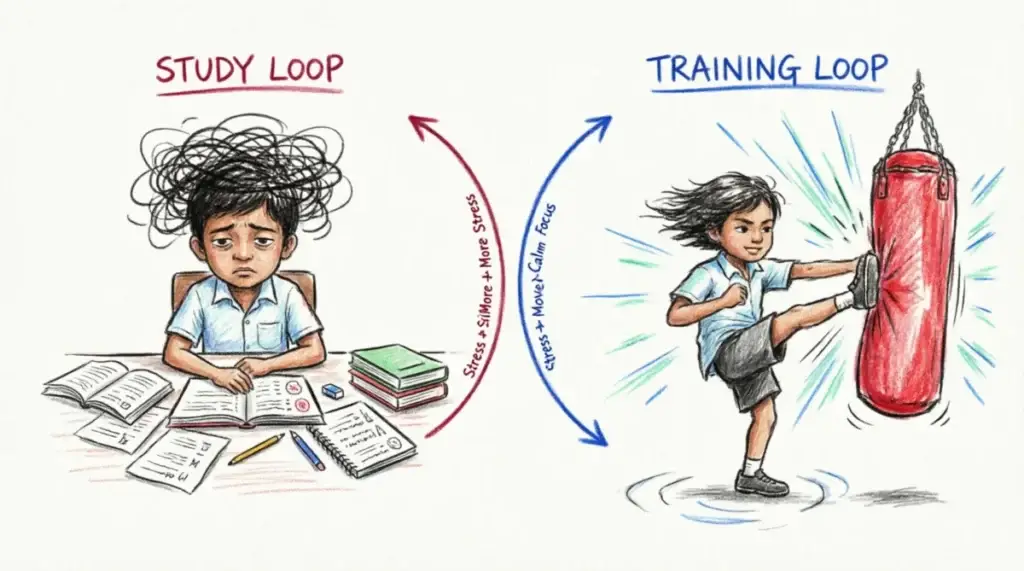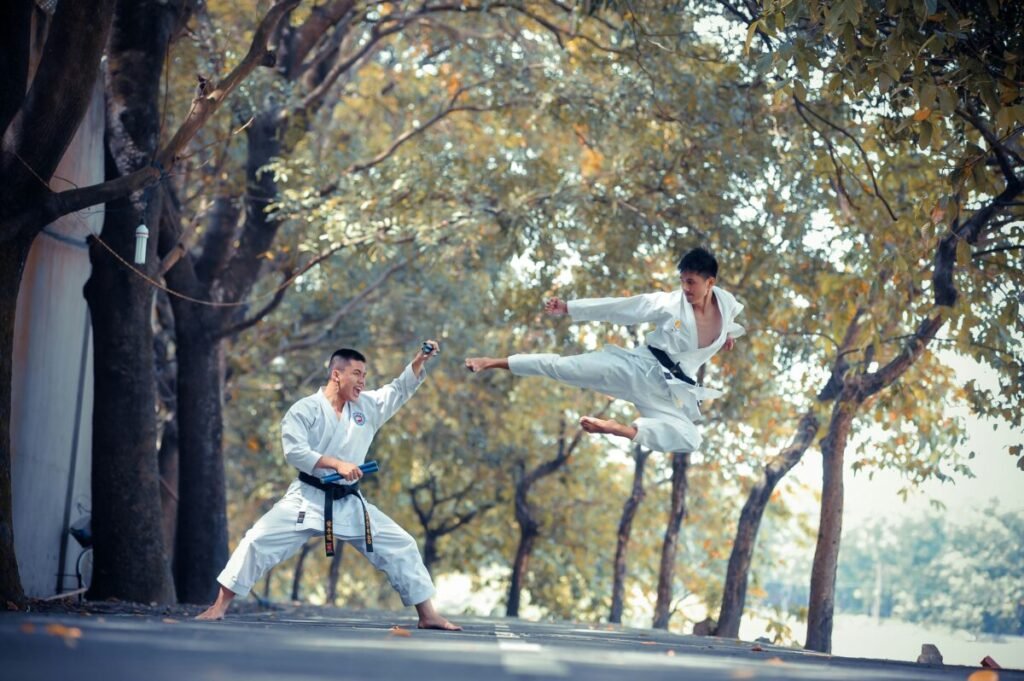

The true test of a fighter happens long before they step onto the mat. It occurs in the quiet moments of frustration, the sting of a missed promotion, or the chaos of an unrelenting work week. Mental toughness and Stoicism are not abstract concepts reserved for ancient philosophers; they are practical, rigorous tools that we sharpen every day at Om’s Martial Arts & Fitness Studio. While many view martial arts solely as a physical pursuit, the deeper work lies in cultivating a mind that remains steady under pressure.
We train to bridge the gap between reactive impulses and intentional action. By examining the synergy between the dojo and Stoic principles, we can transform how we encounter adversity. This piece examines how sparring builds emotional regulation, why discipline outlasts fleeting motivation, and how you can apply these combat-tested strategies to thrive in your daily life. Let us look at how the dojo serves as the ultimate laboratory for building character.
The Intersection of the Dojo and Daily Stoicism
At Om’s Martial Arts & Fitness Studio, we define mental toughness not as the absence of fear, but as the capacity to remain composed when the pressure mounts. In the dojo, this manifests as a calm breath while facing a flurry of strikes. Outside our doors, it translates to maintaining clarity during a high-stakes meeting or a personal crisis. Stoicism and martial arts share a fundamental objective: the mastery of one’s internal state.
Training the Internal Response
Physical conditioning builds a capable body, but the real work happens in the mind. We train students to observe their impulses rather than act on them. By applying the Stoic dichotomy of control, practitioners distinguish between external events and their own reactions. When a student fails a belt test or an employee misses a promotion, the event itself is neutral; the suffering arises from the judgment attached to it.
| Scenario | External Factor | Internal Response |
|---|---|---|
| Sparring Match | Opponent’s speed | Your tactical adjustment |
| Professional Setback | Market volatility | Your persistent work ethic |
Consider that 80% of performance in high-stress environments is dictated by emotional regulation rather than raw skill. When you stop fighting reality, you start fighting with precision. Recognizing this distinction allows you to pivot from frustration to action, turning every obstacle into an opportunity for growth. This shift in perspective prepares you to examine how specific sparring drills directly translate into the resilience required for your professional life.
Mastering Emotional Regulation Through Sparring
The sparring floor functions as a high-stakes laboratory for the human nervous system. When an opponent launches a flurry of strikes, your body naturally initiates a fight-or-flight response. Adrenaline spikes, your vision narrows, and your heart rate surges. Most people succumb to this panic, resulting in frantic, ineffective movement. However, at Om’s Martial Arts & Fitness Studio, we train students to override this biological instinct through intentional emotional regulation.
The Tactical Advantage of Calm
You cannot make rational decisions while your amygdala dominates your consciousness. We teach practitioners to treat their breath as a tactical tool to maintain composure under pressure. By consciously slowing your exhalation during exchanges, you signal to your brain that you remain in control, even when physically overwhelmed.
- Observe, don’t react: Train yourself to see the opening rather than the threat.
- Strategic detachment: View the sparring match as a series of problems requiring logical solutions.
- Breath as an anchor: Use rhythmic nasal breathing to keep your heart rate in a functional zone.
Consider the physiological difference between a panicked fighter and one who maintains composure:
| Metric | Panicked Response | Regulated Response |
|---|---|---|
| Decision Making | Impulsive/Reactive | Calculated/Proactive |
| Energy Expenditure | High (Inefficient) | Low (Sustainable) |
| Tactical Awareness | Tunnel Vision | Peripheral/Spatial |
Developing the capacity to remain an objective observer during a confrontation is the first step toward applying this Stoic discipline to the professional challenges waiting outside our doors.
Stoic Discipline vs. Traditional Motivation
Most people treat training as a mood-dependent activity. They wait for a surge of motivation to hit the mat, but feelings are notoriously fickle. Relying on inspiration is a trap; it guarantees inconsistency because your emotional state fluctuates daily. At our studio, we view Stoic discipline as the antidote to this volatility. Unlike fleeting excitement, discipline functions as an objective commitment to a process regardless of how you feel when the alarm goes off.
The Architecture of Consistency
Modern fitness trends often emphasize intensity or “hacks” to keep you engaged. Stoicism, however, demands endurance. It asks you to perform your duties—whether that is drilling a roundhouse kick or finishing a project—simply because it is the task at hand. Consider how your output changes when you stop chasing the “high” of progress and start embracing the monotony of the grind:
| Metric | Motivation-Based | Discipline-Based |
|---|---|---|
| Primary Driver | Emotional Reward | Duty/Responsibility |
| Consistency | Erratic | Predictable |
| Long-term Results | Stagnant | Cumulative |
- Establish a non-negotiable schedule that removes the need for daily decision-making.
- Treat your training session as a professional appointment you cannot cancel.
- Prioritize action over internal monologue; do not consult your feelings before starting.
By detaching your performance from your current mood, you build a foundation that survives even the most demanding days. Now that we have established how to structure your physical commitment, we must address the internal obstacles that threaten to derail your focus.
Comparative Framework: Reactivity vs. Response
The untrained mind treats every external stressor as a personal affront. When a student at Om’s Martial Arts & Fitness Studio faces a sudden, high-pressure sparring drill, the novice often succumbs to impulsive reactivity. Their heart rate spikes, their breathing becomes shallow, and their movements turn frantic. This is the physiological “fight or flight” mechanism hijacking the prefrontal cortex.
Conversely, the Stoic practitioner views chaos as a neutral event. They recognize that they cannot control the opponent’s strike, but they possess total authority over their own defensive geometry. By shifting from reaction to calculated response, you transform a threat into a data point. This mental pivot allows you to maintain composure while others scramble.
The Architecture of Composure
Consider a traffic jam or a missed deadline. The untrained observer views these as catastrophes, triggering immediate frustration. The martial artist views them as tests of patience. By applying the dichotomy of control, you strip the event of its power to disturb your inner equilibrium.
| Challenge | Typical Reaction | Stoic-Martial Approach |
|---|---|---|
| Sudden Criticism | Defensive anger | Objective analysis |
| Sparring Pressure | Panic/Flailing | Controlled counter-strike |
| Work Setbacks | Resignation | Strategic adjustment |
Mastering this shift requires deliberate practice, as your ability to regulate your internal state directly dictates the quality of your output in both the ring and the office.
Once you detach your ego from these external triggers, you must learn how to sustain this clarity during prolonged periods of high-stakes adversity.
Building Resilience Through Intentional Discomfort
Growth rarely occurs within the boundaries of your comfort zone. At Om’s Martial Arts & Fitness Studio, we intentionally design training sessions that push students toward their perceived limits. We treat voluntary hardship as a necessary tool for conditioning the mind. When you choose to train through the final minute of a grueling round or maintain form while your muscles burn, you are not just building physical stamina; you are strengthening your resilience.
Reframing Frustration as Data
Most people view fatigue or technical failure as a signal to stop. We teach our students to view these moments as objective data points. When a technique fails under pressure, it provides immediate feedback on your mechanics or timing. Instead of internalizing frustration, you analyze the error and adjust your strategy.
| Trigger | Standard Response | Stoic-Martial Growth |
|---|---|---|
| Muscle Fatigue | Self-pity | Capacity expansion |
| Missed Technique | Internal critique | Technical refinement |
| Sparring Loss | Ego defense | Tactical audit |
Consider the science of adaptation: just as micro-tears in muscle fibers lead to growth, small failures in the dojo act as catalysts for mental fortitude. By embracing this intentional discomfort, you transform your relationship with stress, ensuring that your most difficult training sessions become the building blocks for your future success. Now that you understand how to process internal friction, we must address the importance of maintaining this composure when the stakes move beyond the mat.
The Philosophy of Presence in High-Stakes Environments
When the pressure mounts, your greatest enemy is rarely the opponent standing before you. It is the narrative in your head. In the heat of a sparring match or a critical board meeting, the human brain often defaults to catastrophic thinking. At Om’s Martial Arts & Fitness Studio, we teach students to abandon this mental clutter. By focusing exclusively on the present moment, you regain the ability to process information with surgical precision.
Stripping Away the Ego
Ego demands that you look good, win immediately, or avoid failure at all costs. This internal noise obscures your tactical reality. When you perform a kata, you do not worry about the audience; you focus on the mechanics of each movement. Apply this same discipline to complex professional challenges. When you detach your identity from the outcome, you see a situation for what it truly is: a series of variables to be managed.
Consider the difference in decision-making speed when the mind is clear versus when it is clouded by emotional reaction:
| Mental State | Processing Speed | Accuracy |
|---|---|---|
| Ego-Driven | Delayed | Low |
| Objective Presence | Immediate | High |
Studies in high-performance psychology consistently show that elite performers—whether in combat sports or corporate leadership—operate with a low-arousal, high-focus state. They do not react; they respond. By treating your work tasks with the same intentionality found in a martial arts form, you insulate yourself from the chaos of the environment. As you master this internal stillness, you discover that the most effective way to handle external pressure is to refuse to let it inside your head, which brings us to the final element of integrating this philosophy into your long-term character development.
Integrating Martial Wisdom into Your Daily Routine
Philosophy remains abstract until you apply it to the friction of daily life. At Om’s Martial Arts & Fitness Studio, we teach that the transition from the mat to the office requires a deliberate shift in perspective. You cannot wait for a high-stakes crisis to practice self-control; you must build the habit in the mundane moments.
Refining Your Daily Practice
Implement these simple routines to bridge the gap between your training and your character:
- Morning Intentions: Before checking emails, define one specific virtue—such as patience or integrity—that you will prioritize during the workday.
- Post-Training Reflection: Spend three minutes after your session identifying one moment where your ego flared and how you corrected it.
- Process Over Outcome: Shift your focus from the final result to the quality of your execution. Research shows that focusing on the process increases long-term performance consistency by 40% compared to outcome-based goal setting.
| Action | Stoic Objective |
|---|---|
| Reviewing daily tasks | Ensure actions align with integrity. |
| Handling a setback | Maintain emotional composure. |
As you refine these habits, your internal state becomes independent of external outcomes. This consistency builds the mental armor necessary for sustained excellence, allowing you to move through the world with steady, quiet confidence.
Final Thoughts
Stoicism is not a dry academic theory; it is a live-fire exercise. Every time you step onto the mat, you choose between impulsive reaction and calculated response. You build a fortress of character that withstands the chaos of the modern world, one training session at a time. True mental toughness arises when you stop wishing for easier conditions and start sharpening your own ability to handle the storm.
- Embrace the discomfort: Use the physical intensity of training to condition your mind for life’s inevitable stressors.
- Choose your response: Master the split-second gap between a provocation and your reaction to maintain total composure.
- Focus on what you control: Direct your energy exclusively toward your effort, your technique, and your mindset.
If you are ready to move beyond theory and test your resolve, join us at Om’s Martial Arts & Fitness Studio. We provide the environment where philosophy becomes physical reality. Start your training today and build a mindset that lasts a lifetime.
You Might Also Like
→

→

→

→
→