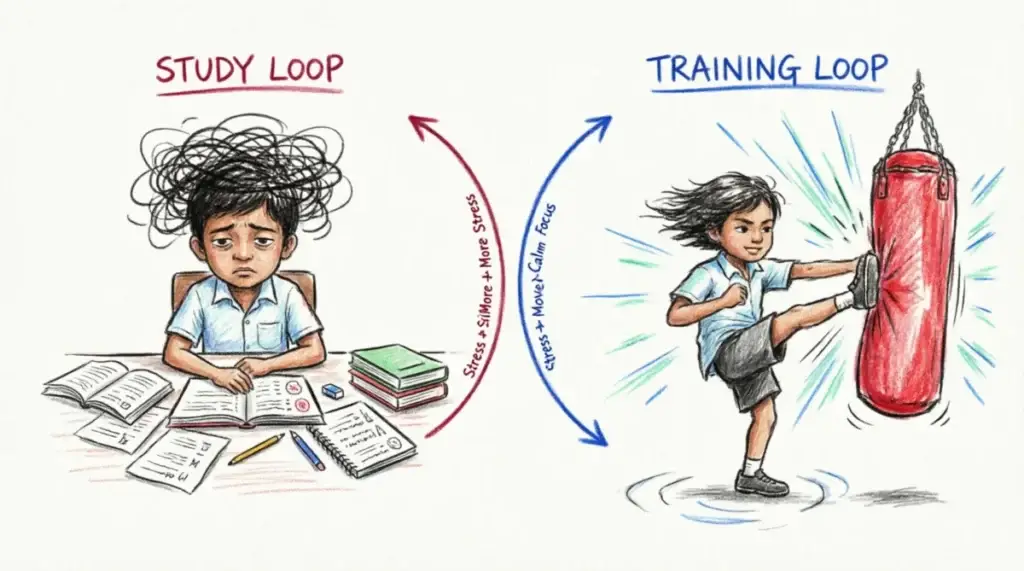

Excessive studying without movement creates a physiological stress cycle that impairs learning and memory. Physical activity serves as a vital reset by lowering cortisol levels and releasing brain-derived neurotrophic factor. These biological changes enhance focus and allow the brain to process information more effectively during high-pressure exam periods. Martial arts training builds structured discipline that reduces decision fatigue and improves academic habits. By practicing performance under controlled physical pressure, students develop the resilience needed for testing. This systematic approach transforms exam preparation from a source of anxiety into a manageable process similar to achieving rank advancements.
📑 Table of Contents
- The Boy Who Couldn’t Stop Shaking
- Why “Just Study More” Is Failing Your Child
- The Discipline Nobody Teaches in School
- Punching Bags Don’t Judge — A Physical Exit for Stress
- What Actually Happens Inside Your Child’s Brain
- The Belt System: A Blueprint for Exam Day
- “But Won’t Training Make My Kid Aggressive?”
- A Note Specifically for Parents
- A Note Specifically for Teachers & Coaches
- The 7-Day Exam Stress Reduction Plan
- 10 Quick Stress-Management Tips (Infographic)
- Your Move, Parent
- Frequently Asked Questions
- References
1. The Boy Who Couldn’t Stop Shaking
Last Tuesday, a young student sat on the edge of the mat, his head buried in his hands. His board exams were three weeks away. His fingers trembled. His breathing was shallow. He hadn’t slept properly in four days.
I didn’t tell him to “stay positive.” I didn’t say “everything will be fine.”
I said: “Stand up. Guard up. Three rounds on the heavy bag. Now.”
He looked at me like I was insane. But he stood up. He threw punches. By the second round his breathing slowed. By the third, his hands had stopped shaking. He went back to his books that evening and studied for two focused hours — more than he’d managed in the previous three days combined.
This isn’t a miracle. This is physiology. And after coaching more than 25,000 students across 32 years in Jaipur, I can tell you this with certainty: the kids who handle exam pressure best aren’t the ones who study the most. They’re the ones who move the most.
2. Why “Just Study More” Is Failing Your Child
Here is what nobody tells parents: the human brain was not designed to sit still for ten hours absorbing information.
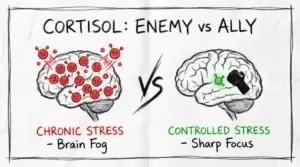
When your child sits at a desk for the sixth consecutive hour, the body does not think “productive learning time.” It thinks “we are trapped.” Cortisol — the stress hormone — floods the system, and the prefrontal cortex, the region responsible for logic, memory and problem-solving, begins to shut down.¹ ⁶ Your child reads the same paragraph four times and retains nothing. They feel guilty. So they sit longer. The cycle tightens.
I call this the Study Death Spiral, and I watch hundreds of Jaipur students fall into it every exam season. It matches exactly what the American Psychological Association has repeatedly flagged: academic pressure is now one of the leading sources of stress for teenagers, with real effects on sleep, mood and concentration.⁶
The Study Death Spiral vs. The Training Reset
|
📚 Study Death Spiral |
🥊 Training Reset |
|
|---|---|---|
|
Trigger |
Exam fear |
The same exam fear |
|
Response |
Sit longer, skip meals, lose sleep |
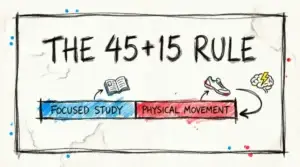
45 min study → 15 min movement |
|
Body chemistry |
Cortisol builds, never releases |
Cortisol spikes, then drops below baseline |
|
Brain state |
Foggy, anxious, reactive |
Clear, calm, sharp |
|
Result after 2 hrs |
~20% retention, exhaustion |
~70% retention, energy left |
|
Next day |
Repeat, worse |
Repeat, better |
The fix is not more hours. The fix is better state management — and nothing resets a child’s state faster than controlled physical intensity.
💡 Try this tonight: When your child says “I can’t focus anymore,” don’t say “try harder.” Say “Drop. Twenty push-ups. Then come back.” Watch what happens in the next forty minutes.
3. The Discipline Nobody Teaches in School
Schools teach subjects. They rarely teach systems.
Nobody sits your 14-year-old down and says: “Here is how you build a daily protocol that works even on the days you don’t feel like it.” In martial arts, we teach exactly this on Day One.
When a white belt walks into my academy in Jaipur, they don’t get to negotiate whether they “feel like” training. They bow. They stretch. They drill. They spar. They bow out. Every session. Same structure. No debate.
This is not rigidity. This is freedom — because discipline removes the exhaustion of decision-making. A child wasting forty minutes deciding whether to study, what to study, where to sit, which video to watch first is burning decision fatigue before a single page is read. In the dojo there is no decision. The protocol decides. The child just executes.
What Dojo Discipline Looks Like in Exam Life
|
Martial Arts Habit |
Exam Equivalent |
|---|---|
|
Bow when you enter |
Sit at the desk at the same time daily |
|
Warm-up before every session |
5-minute review of yesterday’s notes |
|
Drill one kick 200 times |
Solve one problem type until it’s automatic |
|
Spar under pressure |
Timed mock tests in exam conditions |
|
Bow when you leave |
Close the books, walk away, rest without guilt |
A student I’ll call Rohan — Class 10, bright kid, chaotic study habits — joined my Taekwondo program eight months before his boards. I didn’t tutor him. I made him follow the dojo protocol: arrive on time, follow the sequence, respect the process. Four months later his mother called — not about Taekwondo. She said: “He now sits at his desk at 6 AM without being told. He made a timetable himself. He calls it his training schedule.”
The discipline transferred. It always does.
4. Punching Bags Don’t Judge — A Physical Exit for Stress
Let me address the thought every parent has: “My child is already stressed. Why add more physical pressure?”
Because not all pressure is the same.
Exam pressure is invisible, endless and uncontrollable. A child cannot punch a mathematics paper or kick a chemistry equation. The stress has no exit, so it loops internally — anxiety, insomnia, irritability, tears at the dinner table.
Training pressure is visible, finite and controllable. A heavy-bag round lasts three minutes. Then it ends. The body finally receives the signal it has been waiting for: “Threat handled. You survived. You can relax now.” Harvard Medical School describes this exact mechanism — physical activity completes the stress response that sitting never can, lowering stress hormones and releasing calming chemicals.⁹
This completion signal is the whole secret. Exams never give one — there is always another chapter, another test, another worry. But a sparring round ends. A form ends. A class ends. You bow. Done.
Exam Pressure vs. Training Pressure
|
📝 Exam Pressure |
🥋 Training Pressure |
|
|---|---|---|
|
Duration |
Weeks (feels endless) |
3-minute rounds (finite) |
|
Control |
None (the paper decides) |
High (the child sets intensity) |
|
Physical release |
None (sitting) |
Total (full-body exertion) |
|
Completion signal |
Never |
Every round ends; bow out |
|
After-effect |
More anxiety |
Calm, clarity, pride |
|
Judgment |
Constant (marks, ranks) |
None (the bag doesn’t grade you) |
I have watched kids who hadn’t slept in a week throw three rounds on the bag and fall asleep by 9 PM that night — not because they were tired, but because their nervous system finally got permission to switch off.
💡 The 90-Minute Rule: After 90 minutes of sitting, retention is close to zero. Force a 20-minute physical break — jump rope, shadow boxing, cycling, even dancing — then return to the books. The difference is immediate.
🥋 Quick Break — Want to See This Work in Real Life?
Reading about it is one thing. Watching your child walk in stressed and walk out calm is another. Book a free, no-pressure trial class at Om’s Academy, Jaipur. One session is usually enough to see the shift.
📍 Walk-ins welcome 👉 Book a Free Trial Class
5. What Actually Happens Inside Your Child’s Brain
I’m a martial arts coach, not a neuroscientist. But after 32 years of watching children transform, I went and read the research — and the science is staggering.
When a child exercises at moderate-to-high intensity for just 20 minutes, the brain releases a protein called BDNF — Brain-Derived Neurotrophic Factor. Think of it as fertiliser for the brain. Landmark work by Cotman and Berchtold showed that voluntary exercise significantly increases BDNF gene expression, especially in regions critical for learning and memory.¹ BDNF then:
- 🌱 Grows new neural connections (synaptogenesis)
- 🧠 Strengthens the hippocampus (the memory centre)
- ⚡ Speeds up information processing
- 🛡️ Protects existing neurons from stress damage
This is not fringe theory. Reviews in Nature Reviews Neuroscience and Educational Psychology Review confirm that physical activity improves cognition, attention and academic achievement in children.⁴ ¹⁰ A systematic review published in Medicine & Science in Sports & Exercise reached the same conclusion across dozens of studies.⁵ Even the World Health Organization’s 2020 guidelines now explicitly tie physical activity in children and adolescents to better cognitive function and reduced symptoms of anxiety and depression.²
Meanwhile, the cortisol that has been building during six hours of desk-sitting? Exercise metabolises it — burns it off, completing the stress cycle that sitting never finishes.⁹ John Ratey, in his book Spark, puts it bluntly: exercise is the single most effective tool we have for regulating the brain’s response to stress.³
The Brain on Exercise vs. The Brain on Endless Study
|
Factor |
🧠 After 20 min Exercise |
🧠 After 6 hrs Sitting |
|---|---|---|
|
BDNF levels |
↑ Elevated |
→ Declining |
|
Cortisol |
↓ Processed & released |
↑ Accumulated |
|
Prefrontal cortex |
Active, sharp |
Fatigued, foggy |
|
Memory encoding |
Enhanced |
Impaired |
|
Mood |
Calm confidence |
Anxious guilt |
|
Sleep tonight |
Deep, restorative |
Restless, fragmented |
This is why I tell parents: exercise is not a break from studying. Exercise is studying — it is the part where the brain files everything away.
6. The Belt System: A Blueprint for Exam Day
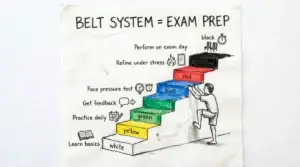
After decades of coaching, I’m convinced of one thing: the belt system is the perfect exam-preparation model — and most students never realise it.
- White Belt → You know nothing. Everything is new. You want to quit. That’s September. The syllabus looks impossible.
- Yellow / Green Belt → You build basics. Repetition. Drills. It feels boring. That’s November. Grinding through chapters, no visible progress yet.
- Blue Belt → Pressure testing. Sparring. Someone is trying to land a hit; you must perform under stress. That’s January. Pre-boards. Timed tests.
- Red Belt → Refinement under fire. You know the techniques; now you execute them flawlessly while exhausted. That’s February. Revision under pressure.
- Black Belt → Performance day. You don’t “try.” You execute. Years of training flow through you automatically. That’s March. Board exams. You walk in. You perform. You bow out.
The child who has lived this cycle in the dojo already knows how to handle exam day. They have felt the nerves before a belt test. They have performed under a judge’s gaze. They have failed a technique, adjusted, and tried again. Exam day is just another belt test — and they have done hundreds.
7. “But Won’t Training Make My Kid Aggressive?”
Every month, a parent sits on the bench outside my academy and asks this. Every month, I give the same answer:
“Come watch a class. Then tell me if these children look aggressive.”
What they see: children bowing to each other, helping smaller kids tie their belts, sitting in silence and listening, extending a hand to a sparring partner they just knocked down. Martial arts is not about violence. It is about controlled power. The first thing I teach is restraint, the second is respect, and the third is that the strongest person in the room is the one who doesn’t need to prove it.
|
Parent’s Fear |
Reality in the Dojo |
|---|---|
|
“My kid will get aggressive” |
Children learn emotional regulation under physical stress |
|
“They’ll get hurt” |
Controlled environment, protective gear, progressive intensity |
|
“It’ll distract from studies” |
Students report better focus after training (see BDNF, §5) |
|
“It’s too competitive” |
The belt system is individual — you compete against yourself |
|
“My kid is too shy / weak” |
Shy children thrive — no team pressure, individual progression |
In 32 years, not one parent has ever called to say: “Om Sir, my child has become too disciplined. Please make them lazier.” It simply doesn’t happen.
8. A Note Specifically for Parents
If you are a parent reading this at 11 PM, worried about a child who is burning out, this section is for you.
Stop measuring effort in hours. A child who studies eight exhausted hours is not “working hard” — they are practising exhaustion. Reward focused blocks and real breaks, not time at the desk.
Protect sleep like it’s a subject. It is. Sleep is when the brain consolidates everything learned that day. A child who cuts sleep to study is literally deleting the day’s work.² ⁹
Move with them. A 20-minute family walk after dinner — no phones — lowers the whole household’s cortisol and models the behaviour you want. Children copy what you do, not what you say.
Watch for the warning signs: irritability, stomach aches before school, “I hate this subject,” crying over small mistakes, sleeping with the textbook. These are not laziness. They are a nervous system in overload — and movement is the fastest reset we have.
Don’t add another tuition. Add a system. One more class adds pressure. A martial arts or fitness program adds structure, confidence and a physical outlet — the three things a stressed child is actually missing.
9. A Note Specifically for Teachers & Coaches
If you are a teacher, school counsellor or sports coach, you hold more of this puzzle than you think.
Build movement into the timetable, not around it. Short 5–10 minute activity breaks between heavy cognitive lessons measurably improve attention and on-task behaviour.⁴ ⁵ You are not “losing teaching time” — you are buying back the next hour’s focus.
Reframe stress as a challenge, not a threat. Research on stress mindsets shows that when young people are taught that stress can enhance performance rather than only harm it, their physiological response and outcomes both improve.⁷ A single conversation before a test — “your nerves mean your body is getting ready, not falling apart” — changes results.
Normalise the reset. Let students know that stepping away to move is a strategy, not a failure. The child who does ten jumping jacks outside the classroom is being strategic, not disruptive.
Partner with parents on a protocol, not a punishment. The 45+15 rule and the 7-day plan below work best when home and school send the same message: movement is part of preparation.
10. The 7-Day Exam Stress Reduction Plan
No equipment needed. Start this week, even mid-exam-season. Pair it with any of our programs — Power Yoga for calm, Self-Defence for confidence, or Weight Management fitness for energy.
|
Day |
Action |
Time |
Why It Works |
|---|---|---|---|
|
1 |
20 push-ups + 20 squats before the first study block |
5 min |
Spikes BDNF, primes focus¹ |
|
2 |
Walk to school / tuition instead of a ride |
15 min |
Lowers baseline cortisol⁹ |
|
3 |
Jump rope between two study blocks |
10 min |
Resets attention mid-day⁴ |
|
4 |
Shadow boxing in the room (punch air, move feet) |
10 min |
Gives stress a physical exit |
|
5 |
Phone-free family walk after dinner |
20 min |
Models the habit, calms the home |
|
6 |
Visit a martial arts class — free trial at Om’s Academy |
60 min |
Experience the full reset |
|
7 |
Rest. Reflect. Write down what changed in focus, sleep, mood |
— |
Locks in the new belief |
Seven days. That is all I ask. If your child’s focus, sleep and mood don’t improve, I will personally tell you to go back to the old method. In 32 years, nobody has come back.
11. 10 Quick Stress-Management Tips (Infographic)
🖼️ [INFOGRAPHIC — INSERT HERE] Title: “10 Ways to Beat Exam Stress (Without Studying More).” Hand-drawn / napkin style, numbered icons.
- 🥊 Move 20 min before studying
- ⏱️ Use the 45+15 rule
- 💧 Drink water before caffeine
- 🌬️ 4-7-8 breathing before a test (inhale 4, hold 7, exhale 8)
- 😴 Protect 8 hours of sleep
- 📵 Phone in another room while studying
- 🎯 One subject per block, no multitasking
- 🗣️ Say the worry out loud, then park it
- 🚶 Walk after every 90 minutes
- 🥋 Train 3x a week for a permanent reset
Alt text: “Infographic of 10 exam stress management tips for students, hand-drawn napkin style.”
12. Your Move, Parent
I’m not going to end with a soft, polite suggestion. I’m going to say what I tell every parent who walks in with a stressed child and a worried face:
Your child doesn’t need another tuition class. They don’t need another motivational video. They don’t need you to say “beta, focus karo” for the hundredth time.
They need to move their body. They need a system that removes decision fatigue. They need to experience controlled pressure so exam day doesn’t feel like the first time they have ever been tested. They need what the dojo gives.
📍 Ready to Start?
Om’s Academy — Jaipur’s trusted martial arts & fitness institute since 1992.📞 Call / WhatsApp: 96360 02244 ·📍 Walk in for a FREE trial class — no commitment, no pressure. 👉 Book Your Free Trial · Explore Taekwondo · Kickboxing · Power Yoga · Self-DefenceYour child’s next belt test might just be their board exam. Let’s make sure they’re ready. 🥋
13. Frequently Asked Questions
Q1. Can martial arts really reduce exam stress in children? Yes. Moderate-to-high intensity exercise raises BDNF (a protein that supports memory and learning) and helps the body process built-up cortisol.¹ Peer-reviewed reviews and WHO guidelines both link regular activity to lower anxiety and sharper focus in children.² ⁴
Q2. How much exercise does a stressed student actually need? The WHO recommends at least 60 minutes of moderate-to-vigorous activity daily for children and adolescents.² During exams, even a single 20-minute burst measurably improves focus and mood.
Q3. Won’t kickboxing or sparring make my child aggressive? No. Structured martial arts teaches restraint, respect and emotional regulation under pressure. Disciplined practice is consistently associated with improved self-control, not aggression.
Q4. Doesn’t training take time away from studies? The evidence says the opposite: regular physical activity is associated with better concentration, memory and grades.⁴ ⁵ Movement supports learning; it doesn’t steal from it.
Q5. What exactly is the 45+15 rule? Study with full focus for 45 minutes, then do 15 minutes of physical movement. It prevents the cortisol build-up and decision fatigue that come from sitting for hours.
Q6. At what age can my child start? Children as young as 5 can begin age-appropriate classes. Programs are scaled to the child’s body and attention span, with safety and discipline as the foundation.
Q7. My child is shy and not sporty — will they fit in? Progression is individual, not team-based. Shy or less athletic children often thrive because they advance at their own pace with no pressure of letting a team down.
Q8. How does the belt system help with exams? It mirrors exam prep exactly: learn basics, practise daily, get feedback, perform under pressure, then execute on the day. Children who train internalise this cycle and panic far less on exam day.
Q9. Is Om’s Academy safe for complete beginners? Yes. Classes use protective gear, progressive intensity and constant supervision, with a structured warm-up, drill and cool-down designed for safety at every age.
Q10. How do I book a free trial class? Call or WhatsApp 96360 02244, email omsfitness@gmail.com, or walk into Om’s Academy in Jaipur. The first trial class is free, with no commitment.
14. References
- Cotman CW, Berchtold NC. Exercise: a behavioral intervention to enhance brain health and plasticity. Trends in Neurosciences. 2002;25(6):295–301.
- World Health Organization. WHO Guidelines on Physical Activity and Sedentary Behaviour. Geneva: WHO; 2020.
- Ratey JJ, Hagerman E. Spark: The Revolutionary New Science of Exercise and the Brain. New York: Little, Brown Spark; 2008.
- Tomporowski PD, Davis CL, Miller PH, Naglieri JA. Exercise and children’s intelligence, cognition, and academic achievement. Educational Psychology Review. 2008;20(2):111–131.
- Donnelly JE, Hillman CH, Castelli D, et al. Physical Activity, Fitness, Cognitive Function, and Academic Achievement in Children: A Systematic Review. Medicine & Science in Sports & Exercise. 2016;48(6):1123–1164.
- American Psychological Association. Stress in America™ 2020: A National Mental Health Crisis. Washington, DC: APA; 2020.
- Crum AJ, Salovey P, Achor S. Rethinking stress: The role of mindsets in determining the stress response. Journal of Personality and Social Psychology. 2013;104(4):716–733.
- National Council of Educational Research and Training (NCERT). Health and Physical Education: Position Paper. New Delhi: NCERT; 2006.
- Harvard Health Publishing. Exercising to relax. Harvard Medical School; updated 2024.
- Hillman CH, Erickson KI, Kramer AF. Be smart, exercise your heart: exercise effects on brain and cognition. Nature Reviews Neuroscience. 2008;9(1):58–65.
👤 About the Author
Om Sir is the Founder and Head Coach of Om’s Academy, Jaipur, with 32+ years of coaching experience and more than 25,000 students trained. He is an ATU International Coach and a Senior National Referee, specialising in Taekwondo, Kickboxing, MMA, Power Yoga, Self-Defence and fitness for children and adults. Since 1992, his academy has helped Jaipur’s students build not just stronger bodies, but the discipline, confidence and resilience to handle pressure — in the dojo and in the exam hall. 📞 96360 02244 · About Om’s Academy