

The Combat Reset: Why Your Desk Job is Sabotaging Your Health (And How 45 Minutes on the Mat Fixes It)
A few weeks ago, a senior project manager from one of Jaipur’s biggest IT parks walked into Om’s Martial Arts & Fitness Studio. He was wiping sweat from his forehead, but it wasn’t just from the workout; it was the physical release of ten hours of pure corporate stress. He looked at me, caught his breath, and said, “Om Sir, I didn’t think forty-five minutes could actually quiet my brain.” I looked him in the eye and told him the truth: the heavy bag doesn’t care about your inbox, and it certainly doesn’t care about your Q3 deadlines.
I have watched thousands of professionals walk through our doors carrying the weight of the corporate world on their shoulders, only to leave with their heads held high and their stress left on the mats. You spend eight, maybe ten hours a day glued to a chair, staring at a screen that demands everything from you. By the time you navigate the Tonk Road traffic to get home, your brain is fried, your shoulders are tight, and your patience is paper-thin. You think you need more sleep or another cup of coffee, but what you actually need is a combat reset.
Over my 32 years on the mat, training more than 25,000 students here in Jaipur—from kids learning their first Taekwondo kicks to executives looking for a way to survive the grind—I’ve learned what actually works. Early in my career, I made the mistake of thinking everyone needed two-hour grueling sessions. I was wrong. I burned out my best students. Now, I know better. You don’t need to live in the gym to build a warrior’s mindset. You need a focused, efficient protocol that respects your time while demanding your absolute best effort.
If you think you are too busy to train, you are exactly the person who needs to be here. We aren’t just talking about burning calories at a weight management gym; we are talking about using Kickboxing Training Jaipur style to reclaim your internal authority. Whether you are interested in our MMA Academy Jaipur programs, Women Self Defense Classes Jaipur, or finding balance through Power Yoga Jaipur, the philosophy remains the same: discipline beats motivation every single time.
In the next few minutes, I am going to show you how to structure your training so that it integrates into your professional life. Let’s look at why your desk job is currently winning, and how we are going to change that starting today.
Why Your Desk Job Needs a Combat Reset
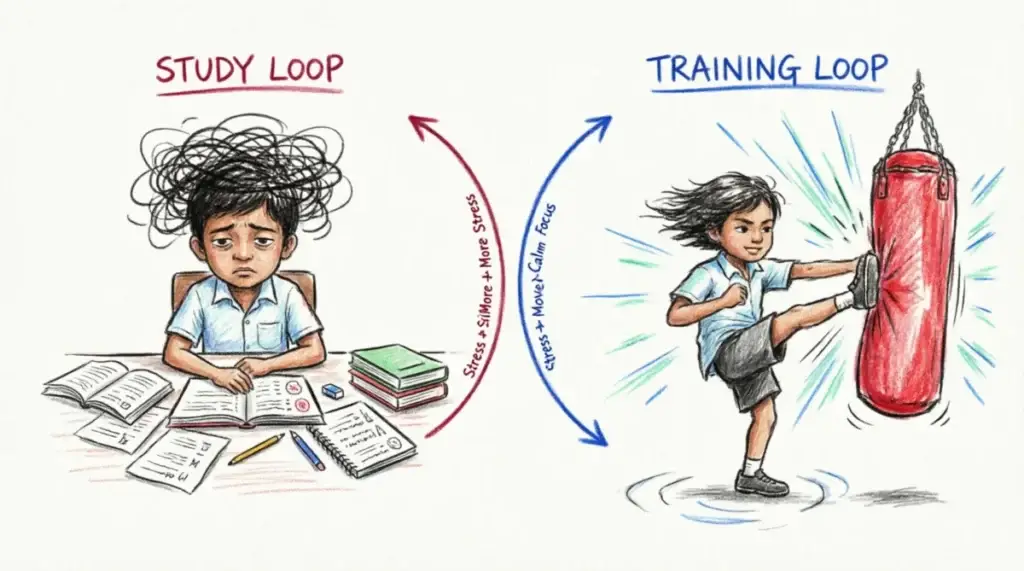
I see this pattern every single day. A professional walks in, sits on the bench to wrap their hands, and their shoulders are rounded forward like a question mark. Their hips are tight from sitting, and their cortisol levels are spiking every time their phone buzzes. You think you’re just “tired” from work. You’re not just tired; you’re stagnant. Your body is holding onto that stress because you haven’t given it a physical reason to let go.
Physical tension from desk work isn’t just about a sore lower back. When you sit with your neck craned forward—what kinesiologists call “Upper Crossed Syndrome”—you are physically signaling to your nervous system that you are in a defensive, closed-off posture. Your body thinks it’s under attack, so it floods your system with stress hormones. You aren’t running from a predator, but your nervous system reacts like you are.
The Neuroscience of the Punch
Why does hitting a bag fix this? It’s about the flow state. When you are learning a combination—jab, cross, hook, roundhouse—your brain cannot afford to worry about a client email. You have to be present. You have to time your breath. High-intensity movement acts as a circuit breaker for the amygdala (the brain’s fear center). When you focus on the snap of a punch, you force your brain to exit the “stress loop” that keeps you anxious. You are trading internal rumination for external precision.
| The Desk Pattern | The Combat Reset |
|---|---|
| Rounded shoulders / collapsed chest | Thoracic extension and core engagement |
| Constant cortisol spike (low-grade anxiety) | High-intensity release (cathartic flow) |
| Fragmented, reactive attention | Singular, rhythmic focus |
Debunking the Burnout Myth
I hear this excuse every week: “Om Sir, I’m too exhausted from work to train. If I come in and kick for forty-five minutes, I’ll be finished for the week.”
That is a lie your mental fatigue tells you to keep you on the couch. Think about the last time you spent eight hours in back-to-back meetings. Did you feel energized when you got home? No. You felt drained, heavy, and irritable. That is “decision fatigue” combined with physical lethargy. Real recovery isn’t just sitting still. A 45-minute kickboxing session forces blood flow into the muscles that have been starved of oxygen all day. It flushes the stagnant energy out of your joints. You don’t leave the studio more tired; you leave more capable.
Coach Om’s Quick Fixes for the Mat:
- Drop the phone: Stop looking at your screen during rest periods. Use that minute to breathe and reset your posture.
- Focus on the snap: Precision kills stress faster than raw force. Don’t just push the bag; snap your strikes.
- Ground your feet: If you’re wobbling, you’re not using your core, and you’re missing the chance to release tension from your hips.
Look at your shoulders right now. Are they up by your ears? Drop them. Relax your jaw. You’ve been holding that tension since your first morning coffee, haven’t you? How much longer are you going to let your desk job dictate how your body feels?
The 45-Minute Efficiency Protocol
People often ask me if 45 minutes is really enough to undo the damage of a ten-hour desk shift. I tell them the truth: if you are sitting on a stationary bike reading a magazine for an hour, you are wasting your time. If you are on my mat for 45 minutes, you are changing your chemistry.
Most people confuse duration with intensity. When you train with us, we don’t have time for fluff. We use a high-density protocol designed to spike your heart rate and trigger Excess Post-exercise Oxygen Consumption (EPOC). You keep burning fuel long after you’ve left the studio and gone back to your family.
The Architecture of a High-Intensity Session
You might look at a professional fighter’s training camp and think that is the standard. It isn’t. A fighter needs hours of technical sparring because their body is their weapon for a living. You need to clear your head and build a body that doesn’t quit when the workload gets heavy. For you, 45 minutes is the sweet spot.
| Phase | Duration | Focus |
|---|---|---|
| Dynamic Warm-Up | 5 Minutes | Mobility and Heart Rate Prep |
| Technical Drills | 10 Minutes | Form, Precision, and Footwork |
| Interval Bag Work | 25 Minutes | High-Intensity Anaerobic Output |
| Cooldown & Recovery | 5 Minutes | Heart Rate Normalization |
Why Intervals Beat Steady-State Cardio
Life is an interval. You have high-pressure meetings, then lulls, then sudden deadlines. Your training should reflect that. When you hit the bag for three minutes at 85% of your maximum heart rate, you force your body to adapt. You aren’t just jogging in place; you are teaching your cardiovascular system to recover under pressure.
How I want you to work during those 25 minutes of bag time:
- Rounds 1-3 (Speed): Throw combinations with 80% power but 100% velocity.
- Recovery: 60 seconds of active recovery. Don’t sit down. Move your feet, breathe through your nose.
- Rounds 4-6 (Power): Every strike should sound like a crack against the bag. This is where you release the frustration of the day.
- Rounds 7-8 (Burnout): Empty the tank. If you have anything left in your gas pedal, use it now.
I see students try to pace themselves to survive the round. Do not do that. If you are pacing, you are robbing yourself of the metabolic benefits. Discipline over motivation—that is the Om’s philosophy. You don’t need to feel like doing it, but you do need to commit to the intensity once you step on the mat.
Comparing Fitness Modalities for Busy Schedules
I often get professionals walking in from commercial gyms around Malviya Nagar or Mansarovar, telling me they feel strong, but their mind is still stuck in the spreadsheets they left at the office. That’s the trap. You can build muscle in a gym, but you rarely build peace.
When we look at how you spend your limited time, we have to talk about the difference between mechanical movement and functional engagement. If your goal is pure hypertrophy—adding raw mass—then yes, a barbell is your best friend. But for the professional who has forty-five minutes to burn off a day of high-pressure meetings, traditional weightlifting often requires too much downtime. You spend three minutes resting between sets, checking your phone, and losing the intensity that actually burns off stress.
The Mental Engagement Factor
Think about the last time you ran on a treadmill. You probably put on a podcast or watched the news because the physical act didn’t require any thought. That’s “mindless fatigue.” Your body is working, but your brain is still ruminating on your stressors. Combat sports demand total presence. You cannot think about your mortgage when you are timing a roundhouse kick. This is why combat-themed workouts are so effective for adults aged 26 to 45. People aren’t just looking for a calorie burn; they are looking for an escape that actually works.
| Metric | Traditional Weightlifting | 45-Minute Kickboxing |
|---|---|---|
| Primary Focus | Muscle Hypertrophy | Stress Relief & Agility |
| Mental Engagement | Low (Repetitive) | High (Reactive) |
| Time Efficiency | Moderate (Rest-heavy) | High (Continuous) |
| Emotional Release | Minimal | Significant |
When you train with us at the studio, you aren’t just moving weight; you are learning to control your breath under pressure. That habit of showing up and pushing through a high-intensity round when your lungs are burning? That is what carries over into your professional life.
Building Resilience Beyond the Bag
When you keep your hands up even when your shoulders are screaming, you are training your brain to stay calm when a client screams at you over a conference call. You aren’t just learning to strike; you are learning to regulate your nervous system under load.
In my decades of teaching, I’ve watched students develop genuine assertiveness—not the aggressive kind that burns bridges, but the quiet, steady kind that commands respect. You stop apologizing for taking up space. You stop stuttering when you deliver bad news. You stand your ground because you know exactly what it feels like to be pressured and to hold your position anyway.
Translating the Ring to the Boardroom
Think about a high-stakes negotiation. Your heart rate spikes. Your palms get slick. If you haven’t trained, you react with pure impulse. But after a few months of kickboxing, you recognize that physical sensation. You know that if you rush, you leave your chin exposed. So, what do you do? You take a breath. You slow down your output. You choose your word with precision.
(Note: Maine apne Vichar Sarovar blog me detail me likha hai ki ek true warrior mindset kaise banta hai aur discipline ki philosophy kya hai. Lekin aaj, hum uss philosophy ko aapki busy corporate life me practically apply kar rahe hain.)
| Martial Arts Skill | Professional Application | The Result |
|---|---|---|
| Maintaining stance under pressure | Holding your ground during a crisis | Unwavering composure |
| Controlled breathing | Managing high-stress deadlines | Clearer decision making |
| Learning from a missed strike | Analyzing a failed project | Objective improvement |
Avoiding the “Fighter” Trap
Here is some tough love: don’t become that person who thinks everything is a fight. I’ve seen students get so good at the “warrior mindset” that they start treating their coworkers like sparring partners. That is a lack of emotional intelligence. You learn to fight so you don’t have to use it. True strength is knowing you can handle yourself, which gives you the freedom to listen, to compromise, and to lead with empathy.
Creating a Sustainable Training Routine
The “I’m too tired” barrier is rarely about physical depletion. It is a mental negotiation you are losing before you even lace up your gloves. You probably think you need to feel motivated to walk through my doors. That is your first mistake. Motivation is a fickle friend that disappears the moment your inbox hits fifty unread emails. Discipline is the quiet engine that keeps you moving.
The Plug-and-Play Weekly Schedule
Stop trying to fit a two-hour gym marathon into your life. My 45-minute formula is built for efficiency. Keep your gear packed in your car or by the door the night before. If you have to search for your hand wraps at 5:30 AM, you’ve already lost the battle. Eliminate the friction.
| Day | Activity | Duration |
|---|---|---|
| Monday | High-Intensity Kickboxing (Bag Work) | 45 Minutes |
| Tuesday | Active Recovery (Mobility & Stretching) | 20 Minutes |
| Wednesday | Technical Drills & Shadow Boxing | 45 Minutes |
| Thursday | Active Recovery (Walking or Yoga) | 30 Minutes |
| Friday | Total Body Conditioning & Sparring | 45 Minutes |
| Weekend | Complete Rest | 0 Minutes |
Debunking the Overtraining Fallacy
On those active recovery days, I don’t want you sitting on the couch. I want you moving, just not with intensity. Take a long walk or spend 15 minutes on deep, static stretching. This “gentle” movement flushes out the metabolic waste from your muscles and actually speeds up your recovery better than complete inactivity ever could. Listen to your body, but don’t listen to your excuses.
Final Thoughts
Stop waiting for the perfect hour to appear in your calendar. It doesn’t exist. You think you need an hour and a half to get a workout that matters. That’s a lie that keeps you on the couch. You don’t need more time; you need more intensity.
When you step onto the mat at Om’s Martial Arts & Fitness Studio, you are recalibrating your nervous system. You carry the lessons from the bag into the boardroom. When you learn to breathe through the burn of a high-intensity interval, you learn to breathe through a high-stakes meeting. Your physical strength is your mental armor. Don’t leave that armor in the gym. Wear it.
Your Takeaways:
- Prioritize intensity over duration: A focused 45-minute session beats a distracted 90-minute workout every time.
- Build the discipline habit: Stop waiting for motivation; show up because it is your scheduled commitment.
- Transfer the skill: Use controlled breathing to handle chaotic professional demands.
So, here is my challenge to you: stop reading and start moving. What is one thing you can do for your body in the next ten minutes that honors the person you want to become? Lace up your shoes, clear a space, or better yet, drop by the studio this evening. You have the power to redefine your limits. Are you going to keep living at the mercy of your desk, or are you going to reclaim your strength?