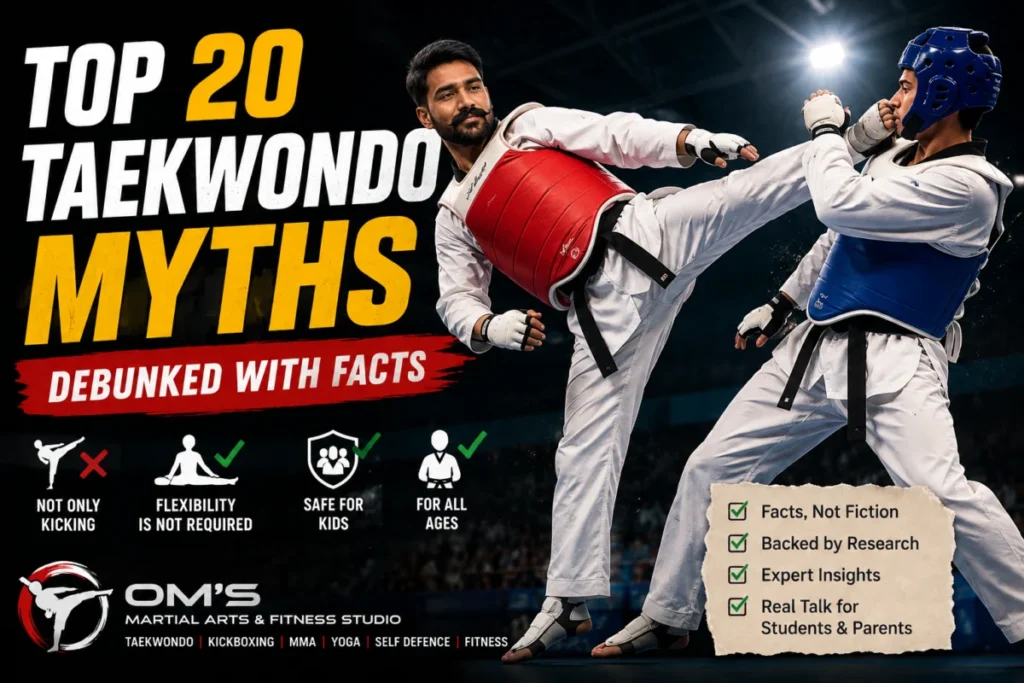

Taekwondo is a frequently misunderstood martial art due to stereotypes regarding its techniques, safety, and intended audience. While often characterized solely by kicking, it encompasses diverse strikes and defensive strategies. Training is inclusive, welcoming practitioners of all ages and fitness levels without requiring prior flexibility or athletic experience.
The discipline promotes self-regulation and physical health while providing foundational self-defense skills. Although it has specific sport-related limitations, legitimate programs prioritize technical proficiency over commercialized advancement. Consistent practice fosters long-term muscle memory and character development, debunking common concerns about injury risks, gender barriers, and training complexity.
Why Myths Persist
Taekwondo is one of the most widely practiced martial arts in the world — and one of the most widely misunderstood.
The myths come from everywhere: movies that show impossible flying kicks, gym bros who dismiss anything that isn’t “real fighting,” parents who worry about safety, and adults who believe they missed their window.
At Om’s Martial Arts & Fitness Studio, we hear these myths every week. From prospective students, from skeptical parents, from curious friends of our students. So we decided to address all 20 in one place — honestly, with facts, and without defensiveness.
Some myths have a grain of truth. Some are completely false. Some are outdated. Let’s sort them out.
[↑ Back to: The Complete Guide to Taekwondo]
The Myths
Myth 1: “Taekwondo is only about kicking.”
The Myth: Taekwondo is a one-dimensional art where you just kick. No hand techniques. No practical fighting.
The Fact: Taekwondo includes punches, blocks, knife-hand strikes, elbow strikes, stances, footwork, poomsae, sparring strategy, and self-defence applications. Kicks are emphasized (approximately 70% of techniques), but the art is not limited to them.
However, this myth has a grain of truth: compared to Karate or Boxing, Taekwondo does place disproportionate emphasis on kicking. If you want a more balanced hand-and-foot art, Kickboxing or Karate may suit you better. At Om’s, we offer all three.
Verdict: Mostly myth. Kicking is the emphasis, not the entirety.
Myth 2: “You need to be flexible to start Taekwondo.”
The Myth: If you can’t touch your toes, don’t bother.
The Fact: Flexibility is the result of Taekwondo training, not a prerequisite. At Om’s, most adult beginners cannot touch their toes. After 6 months of consistent training, most can kick above waist height. After 12 months, many can kick head height.
Flexibility is developed through progressive stretching, dynamic warm-ups, and the kicking practice itself. Our Power Yoga classes accelerate this process.
Verdict: Complete myth. If you were already flexible, you wouldn’t need the class.
Myth 3: “Taekwondo is dangerous for kids.”
The Myth: Kids will get hurt. Broken bones. Concussions. It’s too violent.
The Fact: Supervised Taekwondo training has a lower injury rate than football, basketball, gymnastics, and rugby (American Academy of Pediatrics data). At Om’s:
- Children do not free-sparr until the coach determines readiness (~6 months)
- All sparring uses full protective gear
- Contact is controlled and supervised
- The injury rate in our kids’ program is approximately 2-3 minor incidents per 1,000 training hours (mostly bruises)
Verdict: Myth. Taekwondo is one of the safest organized physical activities for children.
Myth 4: “Taekwondo will make my child aggressive.”
The Myth: Learning to kick and punch will turn my kid into a bully.
The Fact: Research consistently shows the opposite. A 2022 meta-analysis in Psychology of Sport and Exercise found that structured martial arts training in children was associated with reduced aggression, improved self-regulation, and increased prosocial behavior.
At Om’s, the first tenet is Courtesy. Students who use their skills to bully others are removed from the program. The dojo code explicitly prohibits misuse.
Verdict: Myth. Taekwondo reduces aggression, not increases it.
Myth 5: “Adults can’t learn Taekwondo.”
The Myth: If you didn’t start as a kid, it’s too late.
The Fact: Adults learn Taekwondo successfully at every age. We have students at Om’s who started at 25, 35, 45, and 58. Adults often progress faster than children in the early belts because they understand instructions, practice at home, and take theory seriously.
The training is adapted to adult fitness levels and joint health. The art is the same. The pride is the same.
Verdict: Complete myth. You are never too old.
[→ Related: Can Adults Start Taekwondo? Yes – Here’s How]
Myth 6: “Taekwondo is not useful for self-defence.”
The Myth: It’s a sport. It won’t help you in a real fight.
The Fact: Taekwondo develops distance management, striking power, situational awareness, and the confidence to act under pressure — all critical self-defence attributes. A well-placed front kick or roundhouse kick to the groin creates a 2-3 second escape window.
However, this myth has a grain of truth: Taekwondo does not include grappling, ground fighting, or weapon defence. For a complete self-defence education, combine Taekwondo with our Self Defence program.
Verdict: Partially true. Taekwondo is useful but incomplete for self-defence. Supplement it.
Myth 7: “Taekwondo kicks don’t work in a real fight.”
The Myth: High kicks are impractical. You’ll fall over. You’ll get grabbed.
The Fact: In a sport context, Taekwondo kicks are devastatingly effective (Olympic knockouts prove this). In a self-defence context, low and mid-level kicks (front kick to the groin, side kick to the knee) are highly practical. High spinning kicks are not recommended for street self-defence.
At Om’s, we teach context-appropriate technique: sport kicks for competition, practical strikes for self-defence.
Verdict: Partially true. High spinning kicks are sport techniques. Basic kicks are practical.
Myth 8: “You’ll get brain damage from sparring.”
The Myth: Getting kicked in the head will give you CTE like a boxer.
The Fact: WT Taekwondo sparring uses head guards, controlled contact, and limited rounds. The force threshold for scoring is calibrated to register clean techniques, not to cause damage. A 2023 study in the British Journal of Sports Medicine found that amateur Taekwondo has a lower rate of head injury than amateur boxing, rugby, and American football.
Professional-level competition carries higher risk, as does any contact sport. But recreational and amateur training at Om’s is very safe.
Verdict: Myth for recreational training. Risk exists in any contact sport but is well-managed.
Myth 9: “Taekwondo is a scam / belt factory.”
The Myth: Academies just want your money. They hand out belts to keep you enrolled.
The Fact: This is true of some academies (the “McDojo” problem exists in every martial art). However, at legitimate, TFI-affiliated schools like Om’s:
- Belt promotions require demonstrated technical proficiency
- Examinations include technique, poomsae, sparring, breaking, and theory
- Black belt (dan) certifications are issued through the Taekwondo Federation of India (TFI) and are nationally and internationally recognized
- You cannot buy a belt. You earn it.
How to identify a legitimate school: Check TFI affiliation. Ask about examination criteria. Watch a class. If the “master” guarantees a black belt in 12 months for a fee, walk away.
Verdict: True for bad schools. False for legitimate ones. Do your research.
Myth 10: “Taekwondo is only for young, athletic people.”
The Myth: You need to be fit, young, and coordinated.
The Fact: Taekwondo is for every body type, every age, and every fitness level. The training is progressive and adaptive. At Om’s, we train children, teenagers, adults, seniors, athletes, office workers, and people with physical limitations.
You do not need to be athletic to start. You become athletic through training.
Verdict: Complete myth.
Myth 11: “Black belt means you’re an expert.”
The Myth: Once you get your black belt, you’ve “mastered” Taekwondo.
The Fact: A 1st Dan black belt has mastered the fundamentals. It is the beginning of advanced study, not the end. The black belt curriculum (advanced poomsae, competition, teaching, philosophy) is vast. True mastery takes decades.
In Korean martial arts culture, a 1st Dan is considered a serious student, not a master. The title “Master” (Sabeom) typically begins at 4th Dan.
Verdict: Myth. Black belt is the end of the beginning, not the beginning of the end.
Myth 12: “Taekwondo is just a sport, not a martial art.”
The Myth: Olympic Taekwondo has removed the “martial” from “martial art.”
The Fact: WT sport Taekwondo is the competitive expression of the art. But Taekwondo also includes poomsae (forms), self-defence applications, breaking, philosophy, and character development — all of which are “martial art” elements.
At Om’s, we train both: sport sparring for competition AND traditional elements (poomsae, self-defence, philosophy) for complete development.
Verdict: Partially true for pure sport programs. False for comprehensive training.
Myth 13: “Taekwondo is ineffective against other martial arts.”
The Myth: A Taekwondo fighter will lose to a BJJ fighter, a boxer, or an MMA fighter.
The Fact: In a pure ruleset comparison, yes — a BJJ fighter will out-grapple a Taekwondo fighter, and a boxer will out-punch them. But this comparison is misleading. Every martial art has strengths and weaknesses.
In MMA, Taekwondo fighters like Anthony Pettis, Yair Rodriguez, and Valentina Shevchenko have used Taekwondo kicking to devastating effect. The art contributes to a complete fighter when combined with wrestling and grappling.
Verdict: Context-dependent. Taekwondo is not a complete fighting system alone, but its kicking is elite.
Myth 14: “You need expensive equipment.”
The Myth: You’ll spend thousands on gear before you even start.
The Fact: For your first month at Om’s, you need comfortable clothing and a water bottle. A dobok costs ₹800-2,000. A mouthguard costs ₹300. Basic protective gear (shin guards, forearm guards) costs ₹1,000-2,500. Total starter kit: under ₹3,000.
Competition gear (WT-approved hogu, head guard, foot protectors) is more expensive but is purchased only when you compete, which may be years into your training.
Verdict: Myth. Starter costs are modest.
[→ Related: Taekwondo Equipment – Complete Buying Guide]
Myth 15: “Taekwondo is a religion / cult.”
The Myth: The bowing, the Korean terminology, the philosophy — it’s indoctrination.
The Fact: Taekwondo is a martial art and sport, not a religion. The bowing is a cultural sign of respect (similar to a handshake). The Korean terminology preserves the art’s heritage. The philosophy (five tenets) is ethical, not theological.
People of all faiths and no faith practice Taekwondo. There is no deity, no scripture, no worship. You are free to practice any religion alongside Taekwondo.
Verdict: Complete myth.
Myth 16: “Women shouldn’t do Taekwondo.”
The Myth: It’s a men’s activity. Women will get hurt. It’s not feminine.
The Fact: Women make up approximately 45-50% of Taekwondo practitioners globally. Women’s Taekwondo has been an Olympic discipline since 2000. At Om’s, women make up 40% of our student body.
Taekwondo builds strength, flexibility, confidence, and self-defence capability — all of which are empowering, not “unfeminine.”
Verdict: Complete myth. And a harmful one.
[→ Related: Taekwondo for Women – Benefits, Safety & What to Expect]
Myth 17: “Taekwondo will make you too flexible / loose-jointed.”
The Myth: All that stretching will damage your joints.
The Fact: Properly progressive stretching strengthens joints, improves range of motion, and reduces injury risk. Hyper-mobility injuries occur from forced, improper stretching — not from structured training.
At Om’s, flexibility is developed gradually through dynamic warm-ups, static stretching, and Power Yoga. No one is forced into a split.
Verdict: Myth. Proper stretching protects joints, not damages them.
Myth 18: “All Taekwondo schools are the same.”
The Myth: One academy is the same as another. Just pick the closest one.
The Fact: Quality varies enormously between schools. Differences include:
- Coach certification and experience
- Curriculum structure (or lack thereof)
- Safety protocols
- Class size and age grouping
- Affiliation (TFI/WT vs. unaffiliated)
- Facility quality (matted floors, ventilation, cleanliness)
- Philosophy (character development vs. belt sales)
Always visit, watch a class, and ask questions before enrolling. At Om’s, we encourage prospective students to observe multiple sessions before deciding.
Verdict: Myth. Quality varies. Choose carefully.
Myth 19: “Taekwondo is too structured / rigid for creative people.”
The Myth: All those forms and rules will stifle creativity.
The Fact: Structure is the foundation of creativity. A musician must learn scales before improvising. A writer must learn grammar before writing poetry. A Taekwondo student must learn stances and techniques before creating their own combinations, sparring strategies, and freestyle poomsae.
At the advanced level, Taekwondo is highly creative: freestyle poomsae, tricking, competition strategy, and self-defence scenario adaptation all require improvisation and originality.
Verdict: Myth. Structure enables creativity, not suppresses it.
Myth 20: “Once you stop training, you lose everything.”
The Myth: If you take a break, all your skills disappear.
The Fact: Motor skills (kicking technique, stances, poomsae sequences) are stored in long-term muscle memory. A student who trained for 3 years and takes a 1-year break will regain their skill level much faster than a complete beginner. Fitness and flexibility decline faster, but technique is remarkably durable.
Many adults who trained as children return to Taekwondo in their 30s and progress rapidly. The foundation is still there.
Verdict: Myth. Skills fade but do not vanish. The foundation is permanent.
The Bottom Line
Taekwondo is not perfect. No martial art is. It has limitations (less hand technique than Boxing, no grappling, sport-focused sparring). Acknowledging these limitations is honest, not defensive.
But the myths — that it’s dangerous, that it’s only for kids, that it’s useless, that it’s a scam — are false. And they prevent people from experiencing one of the most complete, accessible, and rewarding physical disciplines in the world.
The best way to debunk a myth is to try the thing yourself.
[→ Book Your Free Trial Class at Om’s Martial Arts & Fitness Studio]
[→ Read the Complete Guide to Taekwondo]
[→ Explore All Our Programs – Taekwondo, Kickboxing, MMA, Yoga, Fitness]
Om’s Martial Arts & Fitness Studio – Don’t believe the myths. Believe the experience. Try it. Feel it. Decide for yourself.