
Why You Need to Know the Rules
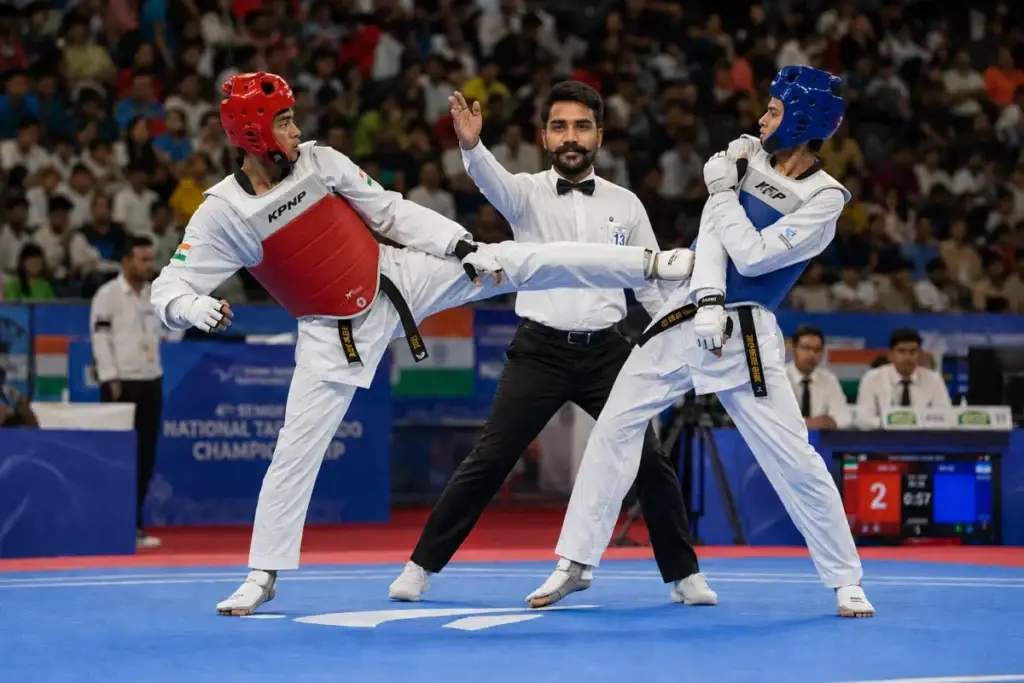
Whether you are a competitor, coach, parent, or spectator, understanding the rules of WT Taekwondo competition is essential. Rules determine:
- What scores points (and what doesn’t)
- What gets you penalized
- How matches are won and lost
- How tournaments are structured
- How Olympic qualification works
Rules also change periodically. World Taekwondo (WT) updates competition regulations to improve safety, fairness, and spectator appeal. This guide reflects the 2026 WT competition rules as applied at national and international events, including those governed by the Taekwondo Federation of India (TFI).
At Om’s Martial Arts & Fitness Studio, every competition-track student studies the rules as part of their training. You cannot win a match you do not understand.
[↑ Back to: The Complete Guide to Taekwondo]
Governing Bodies
| Body | Role | Jurisdiction |
|---|---|---|
| World Taekwondo (WT) | Global governing body; sets rules; sanctions events | International |
| Asian Taekwondo Union (ATU) | Continental body for Asia | Asia |
| Taekwondo Federation of India (TFI) | National governing body; conducts national championships; selects Indian teams | India |
| State Taekwondo Associations | Conduct state-level competitions; affiliate with TFI | State-level |
| IOC (International Olympic Committee) | Recognizes WT; includes Taekwondo in Olympic program | Olympic Games |
Match Format (2026)
Senior Division (17+ years)
| Feature | Rule |
|---|---|
| Format | Best of 3 rounds |
| Round duration | 2 minutes per round |
| Rest between rounds | 1 minute |
| Winning condition | Win 2 rounds to win the match |
| Round winner | Higher score at the end of the round |
| Tied round | If scores are tied at the end of a round, the round goes to the fighter with more technical points (kicks > punches). If still tied, the round is awarded by referee/judge decision. |
| Tied match (1-1 after 2 rounds) | Golden Round (4th round): first fighter to score wins. Duration: 1 minute. If no score, decided by superiority (referee/judge). |
| Knockout | If a fighter is knocked down and cannot continue after a 10-count, the match ends (RSC – Referee Stops Contest). |
| Injury | If a fighter cannot continue due to injury, the match is awarded to the opponent (unless caused by an illegal act, in which case the injuring fighter is disqualified). |
Junior / Cadet Divisions
| Division | Age | Rounds | Duration |
|---|---|---|---|
| Cadet | 12-14 | 3 rounds | 1.5 minutes |
| Junior | 15-17 | 3 rounds | 2 minutes |
| Senior | 17+ | Best of 3 | 2 minutes |
The Scoring System (Electronic PSS)
WT uses the PSS (Protector and Scoring System) — an electronic scoring system with sensors embedded in the chest protector (hogu) and foot protectors.
How It Works
- Sensors in the hogu detect valid strikes to the trunk.
- Sensors in the foot protectors detect valid kicks.
- When a strike meets the minimum force threshold for the weight division, a point is registered automatically.
- Head kicks are scored by corner judges (4 judges) using electronic scoring buttons. A majority (3 of 4) must register the hit within 1 second.
- Punches to the trunk are scored by corner judges (majority required).
Point Values (2026)
| Technique | Target | Points |
|---|---|---|
| Punch | Trunk protector (hogu) | 1 |
| Kick | Trunk protector (hogu) | 2 |
| Kick | Head | 3 |
| Spinning kick | Trunk protector (hogu) | 4 |
| Spinning kick | Head | 5 |
| Gam-jeom (penalty) against opponent | — | +1 to you |
What Counts as a Valid Strike?
- The strike must land on a legal target area (trunk protector or head)
- The strike must meet the minimum force threshold (calibrated by weight division)
- The technique must be permitted (no illegal techniques)
- The strike must be delivered with a permitted part of the body (fist for punches, foot/shin for kicks)
What Does NOT Score?
- Strikes to the back (spine area)
- Strikes below the waist
- Strikes with the knee, elbow, or head
- Strikes after the referee calls “Kal-yeo” (break)
- Strikes to a downed opponent
- Open-hand strikes
- Pushes without a striking technique
Legal and Illegal Techniques
Legal Techniques
| Category | Permitted |
|---|---|
| Punches | Straight punch with the front of the fist to the trunk protector |
| Kicks | Any kick using the foot or shin to the trunk protector or head |
| Spinning kicks | All spinning variations (back kick, hook kick, tornado) |
| Jumping kicks | All jumping variations |
Illegal Techniques (Fouls → Gam-jeom)
| Foul | Description |
|---|---|
| Grabbing or holding | Grabbing the opponent’s body, uniform, or gear |
| Pushing | Pushing the opponent with hands or body (without a striking technique) |
| Falling down deliberately | Dropping to the ground to avoid engagement |
| Avoiding combat (passivity) | Turning the back, running away, stalling |
| Kicking below the waist | Any kick to the legs, groin, or below the trunk protector |
| Striking after “Kal-yeo” | Attacking after the referee’s break command |
| Striking a downed opponent | Attacking while the opponent is on the ground |
| Headbutt, knee, or elbow strikes | Any strike using head, knee, or elbow |
| Open-hand strike | Slapping, palm strikes |
| Stepping out of the boundary | Both feet crossing the boundary line |
| Lifting the knee to block | Raising the knee above the waist to block a kick (in some rule interpretations) |
| Unsportsmanlike conduct | Arguing with the referee, disrespectful behavior, excessive celebration |
Penalty System
| Penalty | Consequence |
|---|---|
| Gam-jeom | +1 point awarded to the opponent |
| Multiple gam-jeoms | Accumulated; 10 gam-jeoms = disqualification (PUN) |
| Serious foul (intentional) | Immediate disqualification |
Weight Categories (2026)
Senior – Olympic Divisions
| Men | Women |
|---|---|
| -58 kg | -49 kg |
| -68 kg | -57 kg |
| -80 kg | -67 kg |
| +80 kg | +67 kg |
Senior – World Championship Divisions (Non-Olympic)
| Men | Women |
|---|---|
| -54 kg | -46 kg |
| -58 kg | -49 kg |
| -63 kg | -53 kg |
| -68 kg | -57 kg |
| -74 kg | -62 kg |
| -80 kg | -67 kg |
| -87 kg | -73 kg |
| +87 kg | +73 kg |
Junior / Cadet
Weight categories vary by event. TFI publishes specific categories for national championships annually.
Weigh-In Process
- Weigh-in occurs the day before or the morning of competition (event-dependent)
- Fighters must be within their weight category at weigh-in
- Failure to make weight = disqualification from the event
- At Om’s, competition fighters follow a safe weight management plan guided by the coaching and nutrition team. No dangerous cutting practices.
Referee Commands
| Command | Korean | Meaning |
|---|---|---|
| “Charyeot” | 차렷 | Attention |
| “Kyeong-rye” | 경례 | Bow |
| “Junbi” | 준비 | Ready |
| “Shi-jak” | 시작 | Begin (start the round) |
| “Kal-yeo” | 갈려 | Break (stop action) |
| “Kye-sok” | 계속 | Continue (resume fighting) |
| “Kong-kyeok” | 공격 | Attack (warning for passivity) |
| “Gam-jeom” | 감점 | Penalty point |
| “Kye-shi” | 계 | Count (referee’s 10-count for a knockdown) |
| “Shi-gan” | 시간 | Time (timeout) |
| “Kye-shi” | 계시 | Timer / count |
| “Hong” | 홍 | Blue (fighter in blue protector) |
| “Chung” | 청 | Red (fighter in red protector) |
| “Hong-seung” | 홍승 | Blue wins |
| “Chung-seung” | 청승 | Red wins |
Referee Hand Signals
- Point scored: Referee raises the arm on the scoring fighter’s side, indicating the technique and points.
- Gam-jeom: Referee raises one arm vertically, declares “Gam-jeom,” and points to the penalized fighter.
- Knockdown: Referee begins the count, one arm extended downward toward the downed fighter.
- RSC (Referee Stops Contest): Referee waves both arms across the body.
[→ Related: Taekwondo Referee Signals – Visual Guide]
Competition Area
| Feature | Specification |
|---|---|
| Shape | Octagonal (8-sided) |
| Size | 8m × 8m (competition area) |
| Surface | Non-slip matted floor (WT-approved) |
| Boundary | Marked by a contrasting color border |
| Corners | Two fighter corners (red and blue), two neutral corners |
Stepping Out of Bounds
- If one foot crosses the boundary line: no penalty (play continues)
- If both feet cross the boundary line: “Kal-yeo” is called, and a gam-jeom may be issued for avoidance
- If a fighter is pushed out by the opponent: no penalty to the fighter who stepped out
Protective Equipment (WT Competition)
| Item | Specification |
|---|---|
| Head guard | WT-approved; red or blue (matching corner) |
| Trunk protector (hogu) | WT-approved; contains PSS sensors; red or blue |
| Gloves | WT-approved; 4 oz (senior); contains sensors |
| Foot protectors | WT-approved; contains PSS sensors; red or blue |
| Forearm guards | WT-approved |
| Shin guards | WT-approved |
| Groin guard | Mandatory (men); worn under the uniform |
| Mouthguard | Mandatory; transparent or white |
| Uniform (dobok) | White; WT-approved; no markings except national flag and name |
Protest and Video Replay
Video Replay (IVR – Instant Video Replay)
- Each coach is allowed 1 video replay request per match
- If the protest is upheld, the request is retained
- If the protest is rejected, the request is lost
- Video replay can review: scoring errors, penalty errors, boundary violations, timing errors
Protest Process
- The coach must raise the protest within 30 seconds of the disputed action
- The coach throws a blue/red card (provided before the match) onto the mat
- The IVR jury reviews the footage
- The decision is final (no further appeal during the match)
- For broader disputes, a written protest can be filed with the Competition Supervisory Board within 30 minutes, accompanied by a protest fee
Olympic Qualification Pathway (2028 Los Angeles)
| Pathway | Details |
|---|---|
| World Ranking | Top 5 in each Olympic weight division qualify automatically |
| Continental Qualification | Top 2 from each continental qualification tournament (Asia, Europe, Africa, Pan Am, Oceania) |
| Host Nation | 1 automatic spot per gender (USA for 2028) |
| Universality Places | 2 spots per gender for underrepresented nations |
| Total quota | 128 athletes (64 men, 64 women) |
India’s Pathway
- Indian athletes qualify through the Asian Continental Qualification Tournament or World Ranking
- Selection is managed by the Taekwondo Federation of India (TFI) in coordination with the Indian Olympic Association (IOA) and Sports Authority of India (SAI)
- Athletes must be registered with TFI, hold a valid WT Global Athlete License, and meet anti-doping requirements (NADA/WADA)
[→ Related: How to Become an Olympic Taekwondo Athlete from India]
[→ Related: Taekwondo Federation of India – Registration & Competition Guide]
Frequently Asked Questions
Q: How long is a Taekwondo match?
A: Senior matches are best of 3 rounds × 2 minutes with 1-minute rest between rounds. A match can end in 2 rounds (if one fighter wins both) or go to a Golden Round if tied 1-1.
Q: How are points scored?
A: Through the electronic PSS system (sensors in the hogu and foot protectors) for body kicks, and by corner judges for head kicks and punches. Points: Punch = 1, Body kick = 2, Head kick = 3, Spinning body = 4, Spinning head = 5.
Q: What is a gam-jeom?
A: A penalty point awarded against a fighter for rule violations (grabbing, pushing, passivity, illegal strikes, etc.). Each gam-jeom gives +1 point to the opponent. Accumulating 10 gam-jeoms results in disqualification.
Q: Can you punch to the head in Taekwondo?
A: No. Punches are only permitted to the trunk protector (hogu). Head strikes are permitted only with kicks.
Q: What happens if both fighters are tied at the end?
A: If the match is tied 1-1 in rounds, a Golden Round is fought. The first fighter to score wins. If no score in the Golden Round, the winner is decided by superiority (referee/judge assessment of aggressiveness and technique).
Q: Are the rules the same for the Olympics?
A: Yes. Olympic Taekwondo follows WT competition rules. The format, scoring, and regulations are identical to WT World Championships.
Q: How do I register for a competition in India?
A: Through your state Taekwondo association, which is affiliated with the Taekwondo Federation of India (TFI). At Om’s, we handle registration for our competition-track students.
[→ Full FAQ: 500+ Taekwondo Questions Answered]
Compete with Confidence at Om’s
Knowing the rules is half the battle. The other half is training your body and mind to execute under pressure.
At Om’s Martial Arts & Fitness Studio, competition-track students train with WT rules integrated into every sparring session. We conduct mock tournaments, video review sessions, and rules workshops so that when you step on the mat, the rules are second nature.
[→ Book Your Free Trial Class at Om’s Martial Arts & Fitness Studio]
[→ Read the Complete Guide to Taekwondo]
[→ Next: Taekwondo Equipment – Complete Buying Guide]
Om’s Martial Arts & Fitness Studio – Know the rules. Train the rules. Win within the rules.