
The Most Time-Efficient Way to Get Fit
You have 20 minutes. That’s it. No hour-long treadmill session. No 90-minute weightlifting marathon. Just 20 minutes.
Can you get a complete, effective, fat-burning, cardiovascular-improving, muscle-building workout in 20 minutes?
Yes. With HIIT.
HIIT (High-Intensity Interval Training) is a training method that alternates short bursts of maximum effort with brief recovery periods. It is the most time-efficient form of cardiovascular training, and it is the conditioning backbone of every combat sport.
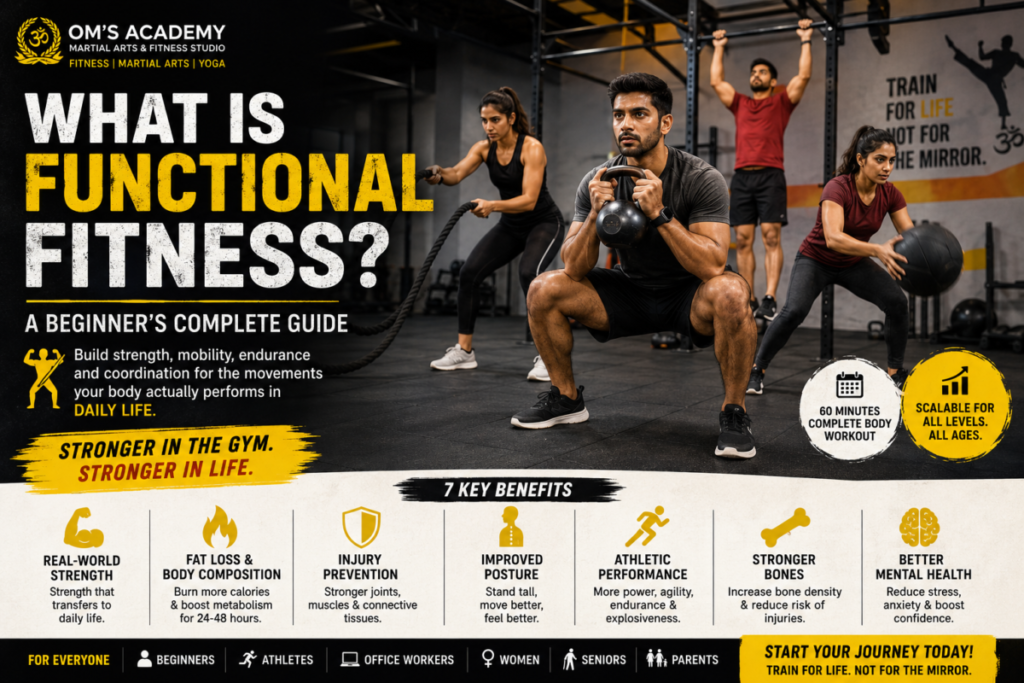
At Om’s Martial Arts & Fitness Studio, HIIT is integrated into our Functional Fitness classes, our martial arts conditioning, and our dedicated HIIT sessions. Because the ability to explode, recover, and explode again is the defining physical quality of a fighter — and of a fit, capable human being.
[↑ Back to: The Complete Guide to Fitness]
What Is HIIT?
The Definition
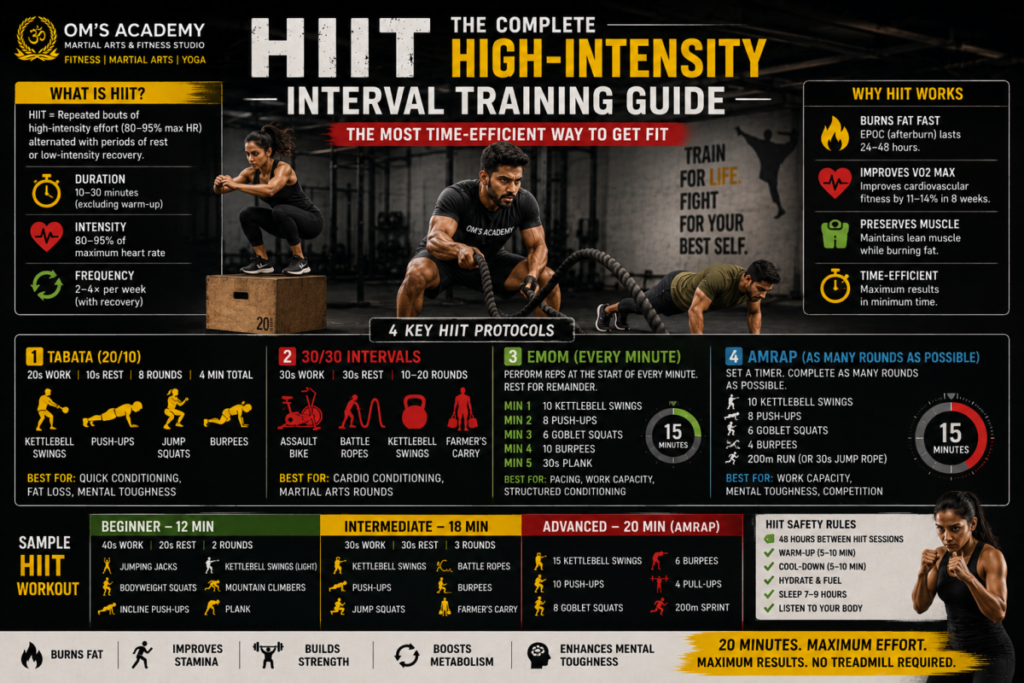
HIIT = Repeated bouts of high-intensity effort (80-95% max heart rate) alternated with periods of rest or low-intensity recovery.
| Component | Detail |
|---|---|
| Work interval | 10 seconds to 4 minutes of high-intensity effort |
| Rest interval | 10 seconds to 3 minutes of rest or low-intensity movement |
| Intensity | 80-95% of maximum heart rate during work intervals |
| Duration | 10-30 minutes total (excluding warm-up and cool-down) |
| Frequency | 2-4× per week (with adequate recovery) |
The Key Principle
The magic of HIIT is not the work. It is the contrast between work and rest. The high-intensity burst creates a metabolic disturbance. The recovery period allows you to repeat the burst. The repeated disturbance creates adaptations that steady-state cardio does not.
The Science: Why HIIT Works
EPOC (Excess Post-Exercise Oxygen Consumption)
After a HIIT session, your body continues to burn calories at an elevated rate for 24-48 hours. This is called EPOC (or the “afterburn effect”).
| Activity | EPOC Duration |
|---|---|
| LISS (walking, jogging) | 2-4 hours |
| Moderate cardio (cycling, swimming) | 6-12 hours |
| HIIT | 24-48 hours |
This means a 20-minute HIIT session burns calories long after you leave the gym. A 60-minute jog does not.
VO2 Max Improvement
VO2 max (maximum oxygen uptake) is the gold standard of cardiovascular fitness. HIIT improves VO2 max faster and more efficiently than steady-state cardio.
- A 2022 meta-analysis in British Journal of Sports Medicine found that HIIT improved VO2 max by 11-14% in 8 weeks — comparable to 40 minutes of steady-state cardio, in half the time.
Fat Loss
- A 2023 study in Obesity Reviews found that HIIT reduced body fat percentage by 1.5-2.5% over 12 weeks — comparable to moderate-intensity continuous training, in 40% less time.
- HIIT preferentially targets visceral fat (the dangerous fat around organs) more effectively than steady-state cardio.
Muscle Preservation
Unlike long-duration cardio (which can break down muscle), HIIT preserves lean muscle mass while burning fat. The high-intensity bursts stimulate muscle protein synthesis. The short duration prevents catabolism.
HIIT vs LISS (Low-Intensity Steady State)
| Factor | HIIT | LISS (Walking, Jogging, Cycling) |
|---|---|---|
| Duration | 10-30 min | 30-60+ min |
| Intensity | 80-95% max HR | 50-70% max HR |
| Calorie burn (session) | 200-400 (in 20 min) | 300-500 (in 45 min) |
| EPOC (afterburn) | 24-48 hours | 2-4 hours |
| VO2 max improvement | ⭐⭐⭐⭐⭐ | ⭐⭐⭐ |
| Fat loss efficiency | ⭐⭐⭐⭐⭐ (per minute) | ⭐⭐⭐ |
| Muscle preservation | ⭐⭐⭐⭐⭐ | ⭐⭐ (long duration can be catabolic) |
| Joint impact | Moderate (depends on exercises) | Low (walking, cycling) |
| Accessibility | Moderate (requires some fitness base) | ⭐⭐⭐⭐⭐ (anyone can walk) |
| Enjoyment | Polarizing (love it or hate it) | Generally enjoyable |
| Recovery demand | High (48 hours between sessions) | Low (can do daily) |
The Verdict
- HIIT is more time-efficient for fat loss, VO2 max, and muscle preservation.
- LISS is more accessible and has lower recovery demands.
- The best approach: combine both. HIIT 2-3×/week + LISS 2-3×/week (walking, cycling, swimming).
The 4 Key HIIT Protocols
1. Tabata (20/10)
The original HIIT protocol. Developed by Dr. Izumi Tabata (1996).
| Feature | Detail |
|---|---|
| Work | 20 seconds (maximum effort) |
| Rest | 10 seconds |
| Rounds | 8 (total: 4 minutes) |
| Intensity | 170% of VO2 max (all-out) |
Example Tabata:
- 20s Kettlebell Swings → 10s rest
- 20s Push-ups → 10s rest
- 20s Jump Squats → 10s rest
- 20s Burpees → 10s rest
- Repeat × 2 (total: 4 minutes)
Best for: Quick conditioning, fat loss, mental toughness.
2. 30/30 Intervals
| Feature | Detail |
|---|---|
| Work | 30 seconds (high effort, 85-90% max) |
| Rest | 30 seconds (active recovery or complete rest) |
| Rounds | 10-20 (total: 10-20 minutes) |
Example 30/30:
- 30s Assault Bike (hard) → 30s rest
- 30s Battle Ropes → 30s rest
- 30s Kettlebell Swings → 30s rest
- Repeat × 10-15
Best for: Cardiovascular conditioning, martial arts rounds (mimics fight intervals).
3. EMOM (Every Minute On the Minute)
| Feature | Detail |
|---|---|
| Format | At the start of every minute, perform a prescribed number of reps. Rest for the remainder of the minute. |
| Duration | 10-20 minutes |
Example EMOM (15 minutes):
- Minute 1: 10 Kettlebell Swings → rest until the next minute
- Minute 2: 8 Push-ups → rest
- Minute 3: 6 Goblet Squats → rest
- Minute 4: 10 Burpees → rest
- Minute 5: 30s Plank → rest
- Repeat × 3 (total: 15 minutes)
Best for: Pacing, work capacity, structured conditioning.
4. AMRAP (As Many Rounds/Reps As Possible)
| Feature | Detail |
|---|---|
| Format | Set a timer (10-20 minutes). Complete as many rounds of a prescribed circuit as possible. |
| Duration | 10-20 minutes |
Example AMRAP (15 minutes):
- 10 Kettlebell Swings
- 8 Push-ups
- 6 Goblet Squats
- 4 Burpees
- 200m Run (or 30s Jump Rope)
Score = total rounds completed in 15 minutes.
Best for: Work capacity, mental toughness, competitive conditioning.
Sample HIIT Workouts
Beginner (Weeks 1-4)
“The Starter” – 12 minutes
| Interval | Work | Rest |
|---|---|---|
| 1 | 20s Jumping Jacks | 40s rest |
| 2 | 20s Bodyweight Squats | 40s rest |
| 3 | 20s Incline Push-ups | 40s rest |
| 4 | 20s Kettlebell Swings (light) | 40s rest |
| 5 | 20s Mountain Climbers | 40s rest |
| 6 | 20s Plank | 40s rest |
Repeat × 2 (total: 12 minutes). Warm-up 5 min. Cool-down 5 min.
Intermediate (Weeks 5-12)
“The Grinder” – 18 minutes (30/30)
| Interval | Work | Rest |
|---|---|---|
| 1 | 30s Kettlebell Swings | 30s rest |
| 2 | 30s Push-ups | 30s rest |
| 3 | 30s Jump Squats | 30s rest |
| 4 | 30s Battle Ropes | 30s rest |
| 5 | 30s Burpees | 30s rest |
| 6 | 30s Farmer’s Carry | 30s rest |
Repeat × 3 (total: 18 minutes).
Advanced (12+ weeks)
“The Om’s Championship” – 20 minutes (AMRAP)
- 15 Kettlebell Swings (24 kg / 16 kg)
- 10 Push-ups (weighted or deficit)
- 8 Goblet Squats (heavy)
- 6 Burpees
- 4 Pull-ups
- 200m Sprint (or 45s Assault Bike)
Score = total rounds in 20 minutes.
HIIT for Martial Artists
Why Fighters Need HIIT
A martial arts fight is not steady-state cardio. It is a series of explosive bursts (combinations, takedowns, escapes) followed by brief recovery (clinching, circling, resetting). This is exactly what HIIT trains.
| Fight Demand | HIIT Equivalent |
|---|---|
| 3-5 strike combination | 10-15s work interval |
| Takedown attempt | 5-10s explosive burst |
| Clinch / reset | 10-20s active recovery |
| Round (3-5 min) | 3-5 min interval block |
| Between rounds (1 min) | 1 min rest |
The Fighter’s HIIT Protocol
| Day | Protocol | Duration | Focus |
|---|---|---|---|
| Monday | 30/30 Intervals (Assault Bike / Rowing) | 15 min | Cardiovascular base |
| Wednesday | Tabata (Kettlebell Swings + Burpees) | 8 min (2 Tabatas) | Explosive power, mental toughness |
| Friday | AMRAP (Fight-specific circuit) | 20 min | Work capacity, fight simulation |
Fight-Specific AMRAP (15 minutes)
- 10 Jab-Cross combinations (on pads or bag)
- 5 Sprawls
- 8 Kettlebell Swings
- 4 Burpees
- 30s Shadow Boxing (full intensity)
This mimics the work-to-rest ratio of a real fight.
Safety and Recovery
Who Should Be Cautious with HIIT?
| Condition | Modification |
|---|---|
| Complete beginner | Start with LISS (walking, cycling) for 2-4 weeks. Build a base. Then add 1 HIIT session per week. |
| Heart conditions | Consult a doctor before starting HIIT. |
| Joint issues | Use low-impact HIIT (Assault Bike, Rowing, Battle Ropes). Avoid jumping. |
| Overweight / deconditioned | Start with longer rest intervals (40s work / 40s rest). Build up gradually. |
| Pregnancy | Avoid HIIT. Use moderate-intensity continuous training. Consult a doctor. |
Recovery Rules
| Rule | Detail |
|---|---|
| 48 hours between HIIT sessions | HIIT is demanding. Your body needs 48 hours to recover. Do not do HIIT on consecutive days. |
| Warm-up (5-10 min) | Never do HIIT cold. Jump rope, dynamic stretches, light movement. |
| Cool-down (5-10 min) | Walk, stretch, breathe. Bring the heart rate down gradually. |
| Hydrate | Drink water before, during, and after. |
| Sleep (7-9 hours) | Recovery happens during sleep. No sleep = no adaptation. |
| Listen to your body | If you feel dizzy, nauseous, or excessively fatigued, stop. |
Frequently Asked Questions
Q: How long should a HIIT workout be?
A: 10-30 minutes (excluding warm-up and cool-down). The intensity makes longer durations unnecessary (and counterproductive). 20 minutes is the sweet spot.
Q: How often should I do HIIT?
A: 2-3× per week for most people. 4× per week for advanced athletes. Never on consecutive days. HIIT is a stressor — your body needs recovery to adapt.
Q: Is HIIT better than running for fat loss?
A: Per minute, yes. HIIT burns more calories per minute and creates a larger afterburn (EPOC). However, running is more accessible and has lower recovery demands. The best approach is both: HIIT 2-3×/week + walking/jogging 2-3×/week.
Q: Can I do HIIT at home?
A: Yes. Bodyweight HIIT (burpees, jump squats, push-ups, mountain climbers) requires no equipment. However, in-person coaching (at Om’s) ensures correct form and appropriate intensity.
Q: Is HIIT safe for beginners?
A: With modifications, yes. Start with longer rest intervals (40s work / 40s rest), lower-impact exercises (no jumping), and shorter sessions (10-12 minutes). Build up over 4-6 weeks. At Om’s, every HIIT session is scaled to the class’s level.
Q: Will HIIT make me lose muscle?
A: No. HIIT preserves lean muscle mass (unlike long-duration cardio). The high-intensity bursts stimulate muscle protein synthesis. Combined with strength training and adequate protein, HIIT supports muscle retention.
Q: What is the best HIIT exercise?
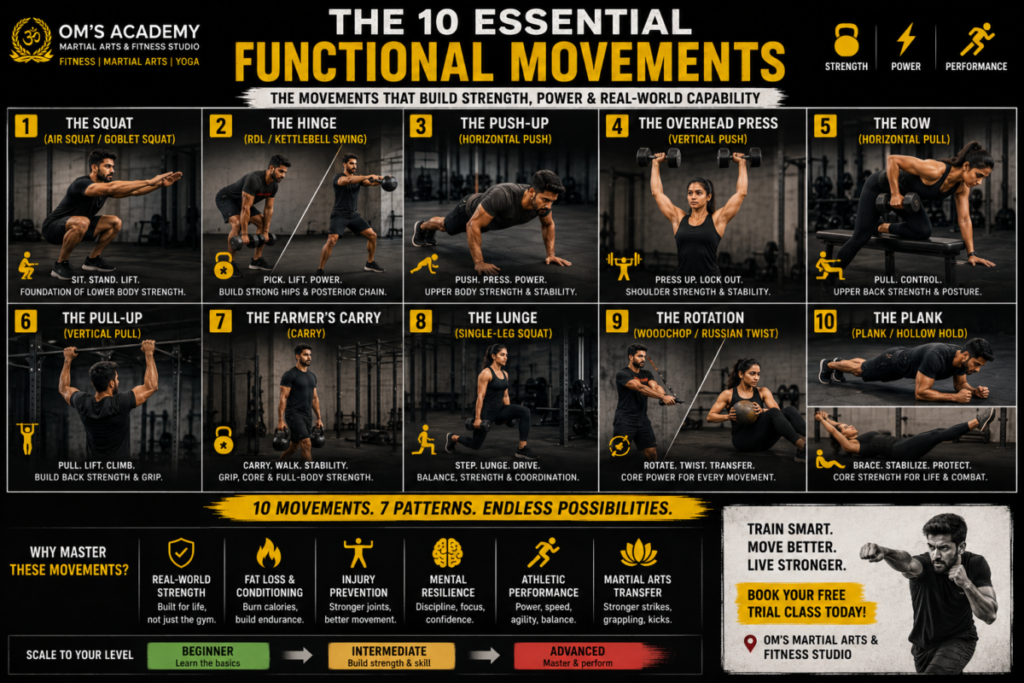
A: There is no single “best” exercise. The best HIIT workout combines multiple movements (kettlebell swings, push-ups, squats, burpees, carries). Variety prevents boredom and trains the whole body.
Q: How does HIIT help martial arts?
A: HIIT trains the exact energy system used in fighting: explosive bursts followed by brief recovery. It improves anaerobic power, cardiovascular recovery, and mental toughness — the three pillars of fight conditioning.
[→ Full FAQ: 300+ Fitness Questions Answered]
Train HIIT at Om’s
HIIT is not about suffering. It is about controlled, structured intensity — the kind that builds a body that can explode, recover, and explode again.
At Om’s Martial Arts & Fitness Studio, HIIT is integrated into our Functional Fitness classes, our martial arts conditioning, and our dedicated HIIT sessions. Every session is scaled, coached, and safe.
[→ Book Your Free Functional Fitness Trial Class at Om’s Martial Arts & Fitness Studio]
[→ Read the Complete Guide to Fitness]
[→ Next: Strength Training for Beginners – The Complete Guide]
Om’s Martial Arts & Fitness Studio – 20 minutes. Maximum effort. Maximum results. No treadmill required.