
The Most Important Thing You Can Do for Your Body
If you could do one thing for your long-term health, longevity, and quality of life, it would not be cardio. It would not be stretching. It would not be a detox tea.
It would be strength training.
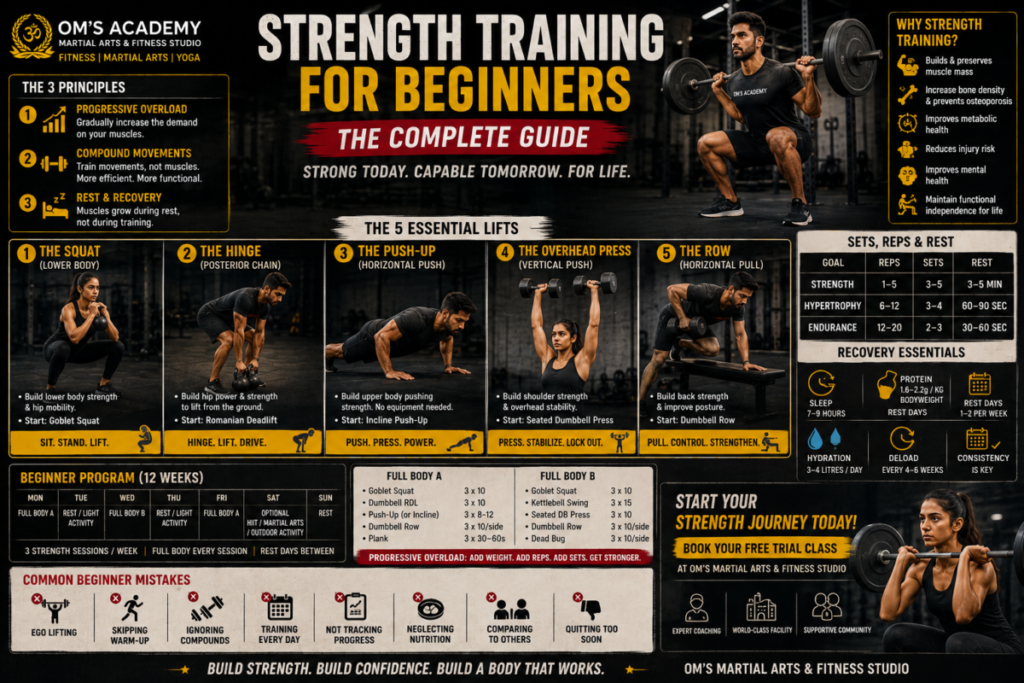
Strength training is the single most effective intervention for:
- Building and preserving muscle mass (which declines 3-8% per decade after age 30)
- Increasing bone density (preventing osteoporosis)
- Improving metabolic health (insulin sensitivity, blood pressure, cholesterol)
- Reducing injury risk (stronger muscles protect joints)
- Improving mental health (reducing anxiety and depression)
- Maintaining functional independence as you age (the ability to carry, lift, climb, and get up from the floor)
And yet, most people avoid it. They are intimidated by the weights. They think it will make them “bulky.” They don’t know where to start.
This guide fixes that.
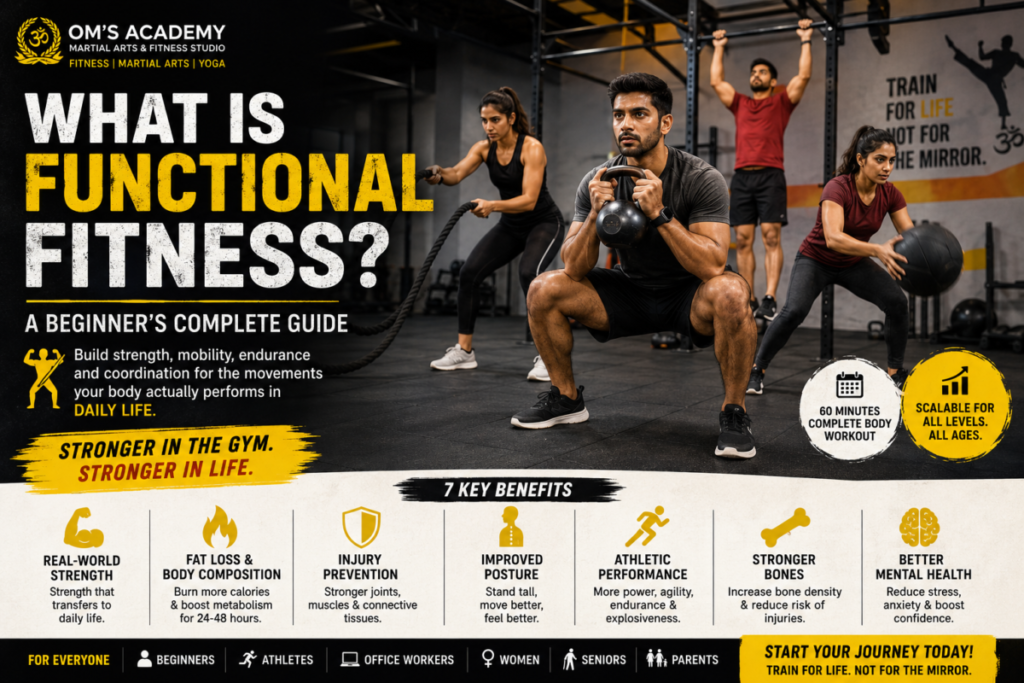
At Om’s Martial Arts & Fitness Studio, our Functional Fitness program includes structured strength training for every level — from complete beginners who have never touched a dumbbell to advanced athletes loading a barbell. This guide gives you the foundation.
[↑ Back to: The Complete Guide to Fitness]
The 3 Principles of Strength Training
1. Progressive Overload
The most important principle. To get stronger, you must gradually increase the demand on your muscles.
| Method | Example |
|---|---|
| Add weight | Squat 40 kg → 42.5 kg → 45 kg |
| Add reps | 3 × 8 → 3 × 10 → 3 × 12 |
| Add sets | 3 × 10 → 4 × 10 |
| Reduce rest | 90s rest → 75s rest → 60s rest |
| Slow the tempo | 2s down → 3s down → 4s down |
| Increase range of motion | Box squat (partial) → Full squat |
Without progressive overload, you will not get stronger. Your body adapts to a given stimulus. Once adapted, it stops changing. You must keep increasing the challenge.
2. Compound Movements
Train movements, not muscles. Compound (multi-joint) exercises recruit multiple muscle groups simultaneously, making them more efficient and more functional than isolation exercises.
| Compound | Isolation |
|---|---|
| Squat (quads + glutes + core) | Leg extension (quads only) |
| Deadlift (hamstrings + glutes + back + grip) | Leg curl (hamstrings only) |
| Bench press (chest + shoulders + triceps) | Chest fly (chest only) |
| Overhead press (shoulders + triceps + core) | Lateral raise (shoulders only) |
| Row (back + biceps + core) | Bicep curl (biceps only) |
Beginners should focus 80% on compound movements and 20% on isolation (accessories).
3. Rest and Recovery
Muscles grow during rest, not during training. Training breaks muscle tissue down. Recovery (sleep, nutrition, rest days) builds it back stronger.
| Recovery Factor | Guideline |
|---|---|
| Sleep | 7-9 hours per night |
| Protein | 1.6-2.2 g/kg bodyweight per day |
| Rest days | 1-2 per week (no strength training) |
| Deload weeks | Every 4-6 weeks, reduce volume by 40-50% |
| Hydration | 3-4 liters of water per day |
The 5 Essential Lifts
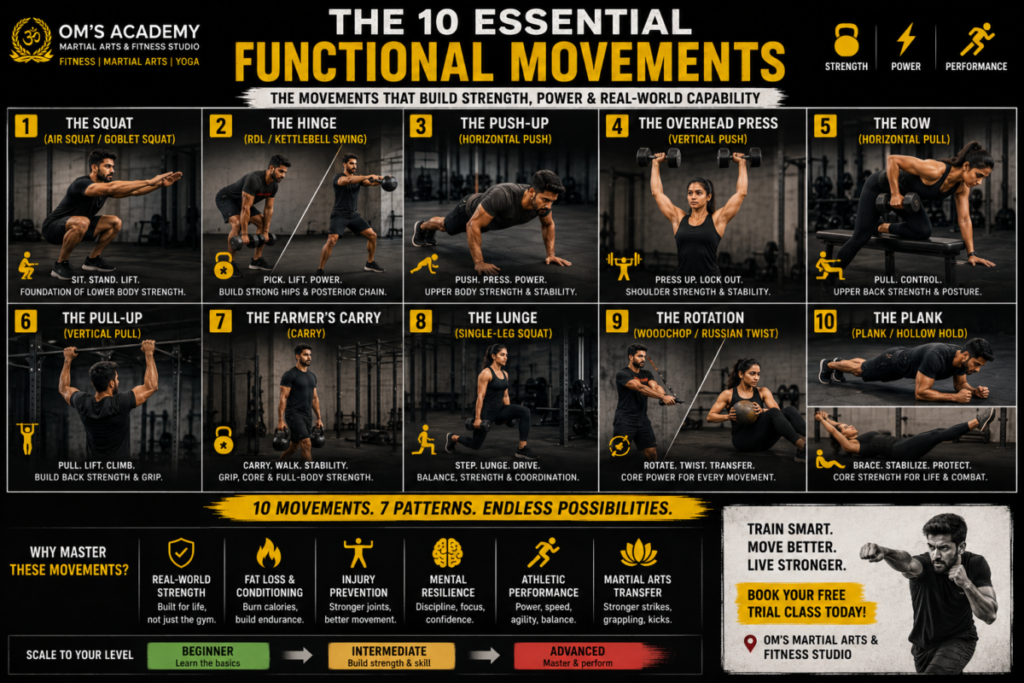
Every beginner strength program is built on 5 foundational lifts. Master these, and you have a complete program.
1. The Squat
Muscles: Quads, glutes, hamstrings, core, lower back
Why: The king of lower-body exercises. Builds leg strength, hip mobility, and core stability.
Beginner variation: Goblet squat (hold a dumbbell or kettlebell at your chest).
Step-by-Step:
- Hold a dumbbell vertically at your chest (goblet position).
- Feet shoulder-width apart. Toes slightly out.
- Push hips back, bend knees, lower until thighs are parallel (or below).
- Keep chest up, back flat, knees tracking over toes.
- Drive through heels to stand. Squeeze glutes at the top.
[→ Full Guide: The 10 Essential Functional Movements]
2. The Deadlift (Hip Hinge)
Muscles: Hamstrings, glutes, lower back, upper back, grip, core
Why: The king of posterior-chain exercises. Builds the strength to lift anything from the ground.
Beginner variation: Romanian Deadlift (RDL) with dumbbells or kettlebell.
Step-by-Step:
- Hold dumbbells in front of your thighs. Feet hip-width apart.
- Push hips back (hinge). Keep a slight bend in the knees.
- Lower the weights along your thighs until you feel a hamstring stretch.
- Keep your back flat. Do not round.
- Drive hips forward to stand. Squeeze glutes.
3. The Push-Up (Horizontal Push)
Muscles: Chest, shoulders, triceps, core
Why: The most accessible upper-body pushing exercise. No equipment needed.
Beginner variation: Incline push-up (hands on a bench) or knee push-up.
Step-by-Step:
- High plank position. Hands under shoulders. Body in a straight line.
- Lower your chest to 1-2 inches from the floor. Elbows at 45°.
- Press back up. Exhale on the way up.
4. The Overhead Press (Vertical Push)
Muscles: Shoulders, triceps, upper chest, core
Why: Builds overhead pressing strength and shoulder stability.
Beginner variation: Seated dumbbell press (back supported).
Step-by-Step:
- Sit on a bench with back support. Hold dumbbells at shoulder height.
- Press the dumbbells straight overhead until arms are extended.
- Lower to shoulder height with control.
5. The Row (Horizontal Pull)
Muscles: Upper back, lats, biceps, rear deltoids, core
Why: Balances the pushing exercises. Builds posture and pulling strength.
Beginner variation: Dumbbell row (one arm, supported on a bench).
Step-by-Step:
- One knee and one hand on a bench. Back flat.
- Hold a dumbbell in the opposite hand. Arm extended.
- Pull the dumbbell toward your hip. Squeeze the shoulder blade.
- Lower with control.
Sets, Reps, and Rest – Explained
The Terminology
| Term | Definition | Example |
|---|---|---|
| Rep (Repetition) | One complete execution of an exercise | 1 squat = 1 rep |
| Set | A group of consecutive reps | 10 squats = 1 set of 10 |
| Rest | The pause between sets | 90 seconds between sets |
| Load | The weight used | 40 kg goblet squat |
| Tempo | The speed of the rep | 3s down, 1s up |
Rep Ranges and Their Purpose
| Rep Range | Goal | Load |
|---|---|---|
| 1-5 reps | Maximal strength | Heavy (85-95% of 1RM) |
| 6-12 reps | Hypertrophy (muscle growth) | Moderate (70-85% of 1RM) |
| 12-20 reps | Muscular endurance | Light (50-70% of 1RM) |
Beginners should start in the 8-12 rep range. This builds a foundation of strength and muscle while learning proper form.
Rest Periods
| Goal | Rest Between Sets |
|---|---|
| Maximal strength (1-5 reps) | 3-5 minutes |
| Hypertrophy (6-12 reps) | 60-90 seconds |
| Endurance (12-20 reps) | 30-60 seconds |
The Beginner Program (12 Weeks)
The Schedule
| Day | Focus | Duration |
|---|---|---|
| Monday | Full Body A | 45-60 min |
| Tuesday | Rest / Light activity (walk, yoga) | — |
| Wednesday | Full Body B | 45-60 min |
| Thursday | Rest / Light activity | — |
| Friday | Full Body A | 45-60 min |
| Saturday | Optional: HIIT, martial arts, or outdoor activity | 30-60 min |
| Sunday | Rest | — |
3 strength sessions per week. Full body every session. Rest days between.
Full Body A
| Exercise | Sets × Reps | Rest | Notes |
|---|---|---|---|
| Goblet Squat | 3 × 10 | 90s | Start light. Focus on form. |
| Dumbbell RDL | 3 × 10 | 90s | Feel the hamstring stretch. Flat back. |
| Push-Up (or incline) | 3 × 8-12 | 60s | Chest to 1-2 inches from the floor. |
| Dumbbell Row | 3 × 10/side | 60s | Pull to the hip. Squeeze the shoulder blade. |
| Plank | 3 × 30-60s | 60s | One straight line. Breathe. |
Full Body B
| Exercise | Sets × Reps | Rest | Notes |
|---|---|---|---|
| Goblet Squat | 3 × 10 | 90s | Same as A. Add weight when 3×10 is easy. |
| Kettlebell Swing | 3 × 15 | 90s | Hip hinge. Power from the hips, not the arms. |
| Seated Dumbbell Press | 3 × 10 | 90s | Press straight overhead. Do not arch. |
| Dumbbell Row | 3 × 10/side | 60s | Same as A. |
| Dead Bug | 3 × 10/side | 60s | Lower back pressed into the floor. |
Progressive Overload Plan
| Weeks | Progression |
|---|---|
| 1-2 | Learn the movements. Light weight. Focus on form. |
| 3-4 | Add 1-2 reps per set (3×8 → 3×10 → 3×12). |
| 5-6 | Add weight (2.5 kg upper body, 5 kg lower body). Drop back to 3×8. Build to 3×12 again. |
| 7-8 | Add a 4th set (3×10 → 4×10). |
| 9-10 | Add weight again. Reduce rest (90s → 75s). |
| 11-12 | Test your progress. Increase loads. Celebrate. |
The rule: When you can complete 3 × 12 with good form, increase the weight by 2.5 kg (upper body) or 5 kg (lower body) and drop back to 3 × 8. Build to 3 × 12 again. Repeat.
Common Beginner Mistakes
| # | Mistake | Correction |
|---|---|---|
| 1 | Ego lifting (too heavy, too soon) | Start light. Master the form. Add weight gradually. |
| 2 | Skipping the warm-up | 5-10 minutes of dynamic movement before lifting. Cold muscles = injuries. |
| 3 | Ignoring compound movements | Squats, deadlifts, push-ups, presses, and rows are the foundation. Do them first. |
| 4 | Training every day | Muscles grow during rest. 3-4 sessions per week is optimal for beginners. |
| 5 | Not tracking progress | Write down your weights, sets, and reps. You cannot improve what you do not measure. |
| 6 | Neglecting nutrition | Protein (1.6-2.2 g/kg) and adequate calories are essential for muscle growth. |
| 7 | Comparing yourself to others | Your journey is yours. Compare yourself to who you were last month. |
| 8 | Skipping the cool-down | 5 minutes of stretching after training reduces soreness and improves flexibility. |
| 9 | Inconsistent schedule | 3 sessions per week, every week, for 12 weeks. Consistency beats intensity. |
| 10 | Quitting after 3 weeks | Results take 6-8 weeks to become visible. Trust the process. Show up. |
Frequently Asked Questions
Q: How long until I see results?
A: 2 weeks for improved energy and strength (neurological adaptation). 6-8 weeks for visible muscle growth. 12 weeks for a significant transformation.
Q: Will I get “bulky”?
A: No. Building significant muscle mass requires a caloric surplus, years of dedicated training, and (for men) high testosterone levels. Beginners will build lean, functional muscle — not bodybuilder mass. Women especially do not produce enough testosterone for significant hypertrophy.
Q: Can I do strength training and martial arts / yoga?
A: Yes, and you should. Strength training builds the engine (power, resilience). Martial arts build the skill. Yoga builds the chassis (flexibility, recovery). At Om’s, combined memberships give you access to all three.
Q: Do I need a gym membership?
A: No. A pair of adjustable dumbbells, a kettlebell, a pull-up bar, and a mat are sufficient for a complete beginner program. However, a gym provides more equipment and coaching. At Om’s, all equipment is provided.
Q: How much protein do I need?
A: 1.6-2.2 grams per kilogram of bodyweight per day. A 70 kg person needs 112-154 g of protein daily. Sources: eggs, chicken, fish, paneer, dal, tofu, curd, whey.
Q: Should I do cardio or weights first?
A: Weights first (when you are fresh). Cardio after (or on separate days). Strength training requires focus and energy. Doing it after cardio compromises form and intensity.
Q: Is strength training safe for beginners?
A: Yes, with proper instruction. Start with light weights. Focus on form. Progress gradually. At Om’s, every exercise is taught and supervised by certified instructors.
Q: Can I do strength training at 40 / 50 / 60?
A: Yes. Strength training is especially important as you age (prevents muscle loss, bone loss, and functional decline). Start light. Progress gradually. Consult a doctor if you have pre-existing conditions.
Q: What is the best strength training program for beginners?
A: A 3×/week full-body program built on the 5 essential lifts (squat, hinge, push, pull, core). The program above is designed for complete beginners. At Om’s, our Functional Fitness classes follow this structure with expert coaching.
[→ Full FAQ: 300+ Fitness Questions Answered]
Build Your Strength at Om’s
Strength is not a luxury. It is a necessity. The strength to carry your child. The strength to climb stairs without gasping. The strength to throw a punch, kick a pad, and get back up from the floor.
At Om’s Martial Arts & Fitness Studio, our Functional Fitness program builds real, functional strength — progressively, safely, and effectively.
[→ Book Your Free Functional Fitness Trial Class at Om’s Martial Arts & Fitness Studio]
[→ Read the Complete Guide to Fitness]
[→ Next Batch: Nutrition / Calories / Recovery]
Om’s Martial Arts & Fitness Studio – Strong is not a look. Strong is a capability. Build it here.