
The Short Answer
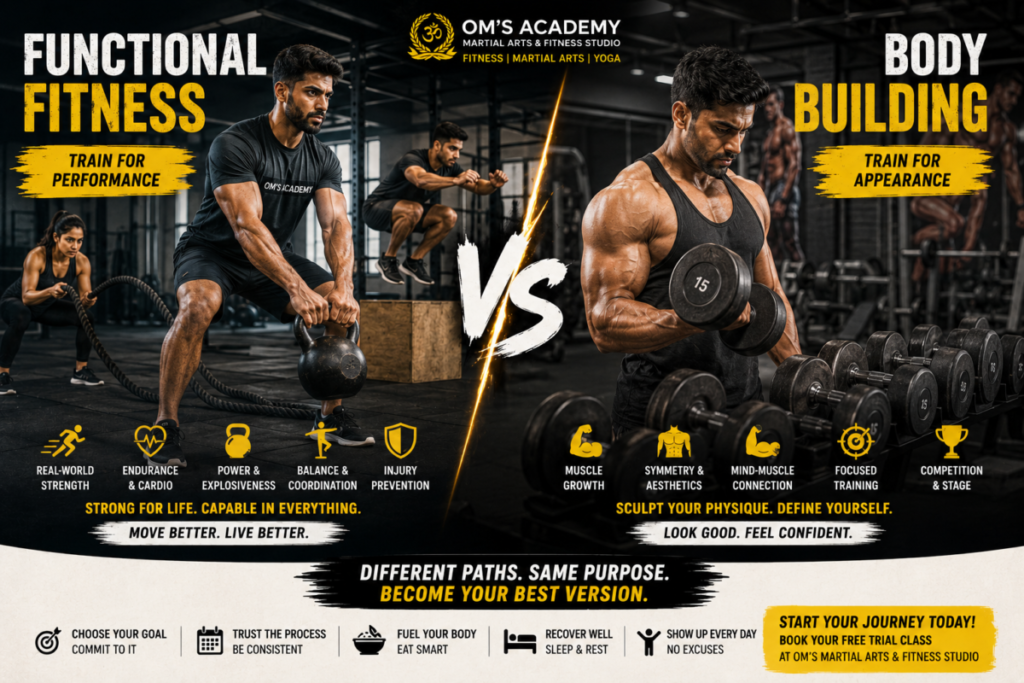
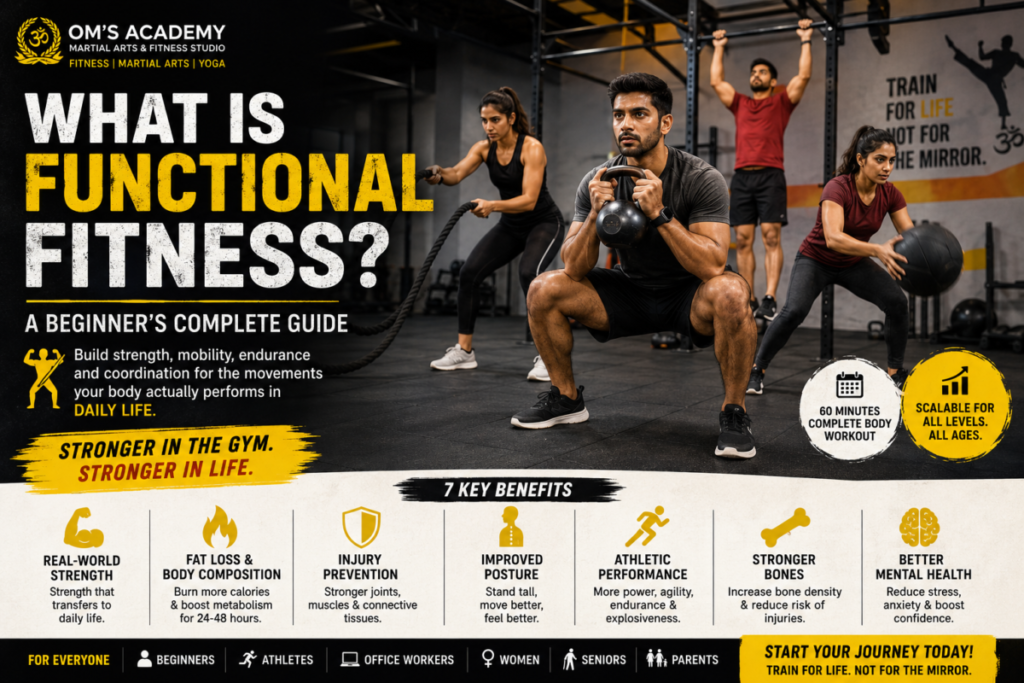
Functional fitness is a training approach that builds strength, mobility, endurance, and coordination for the movements your body actually performs in daily life — lifting, carrying, pushing, pulling, squatting, rotating, and balancing.
It is not about looking good in a mirror (though that happens). It is not about isolating a single muscle on a machine (though muscles grow). It is about building a body that works — a body that can pick up your child, carry groceries up stairs, sprint for a bus, throw a punch, kick a pad, and get back up from the floor without groaning.
At Om’s Martial Arts & Fitness Studio, our Functional Fitness program is the physical engine that powers everything else. Our martial artists use it for explosive power. Our yoga students use it for strength. Our beginners use it as a gateway to movement — a practice that builds real-world capability, not just gym aesthetics.
[↑ Back to: The Complete Guide to Fitness]
What Makes It “Functional”?
The word “functional” means: training movements, not muscles.
| Traditional Gym (Isolation) | Functional Fitness (Integration) |
|---|---|
| Leg extension machine (isolates quads) | Goblet squat (quads + glutes + core + balance) |
| Bicep curl (isolates biceps) | Kettlebell swing (posterior chain + core + grip + cardio) |
| Chest fly machine (isolates pecs) | Push-up (chest + shoulders + triceps + core) |
| Seated shoulder press (isolates deltoids) | Turkish get-up (full body + coordination + stability) |
| Lat pulldown (isolates lats) | Pull-up (lats + biceps + core + grip) |
The difference: A leg extension machine trains your quads to extend a knee while sitting. A goblet squat trains your quads, glutes, core, and balance to lift a load from the ground — which is what you actually do when you pick up a bag, a child, or a heavy box.
Functional fitness trains movement patterns, not individual muscles. And movement patterns are what your body uses in real life.
The 7 Fundamental Movement Patterns
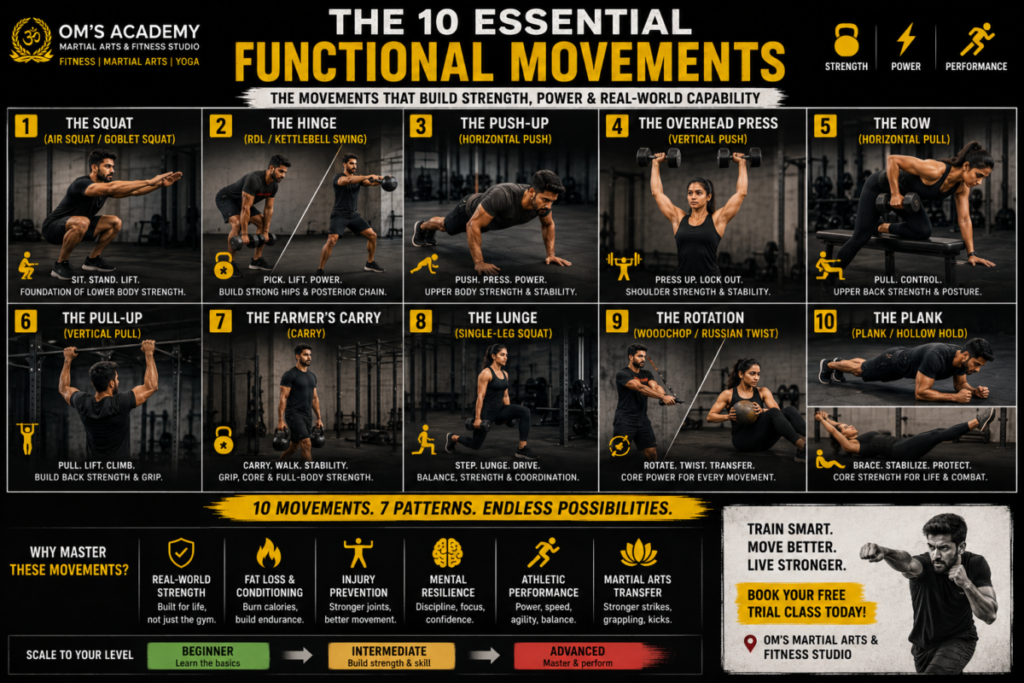
Every functional fitness program is built on 7 fundamental movement patterns. Master these, and you can handle any physical challenge life throws at you.
| # | Pattern | Examples | Real-Life Application |
|---|---|---|---|
| 1 | Squat | Goblet squat, air squat, front squat | Sitting down, standing up, lifting from the ground |
| 2 | Hinge | Deadlift, kettlebell swing, Romanian deadlift | Picking up heavy objects, hip power for kicks |
| 3 | Push (horizontal) | Push-up, bench press, floor press | Pushing a door, a cart, an opponent |
| 4 | Push (vertical) | Overhead press, handstand push-up, pike press | Lifting something overhead, pressing upward |
| 5 | Pull (horizontal) | Row, pull-up (horizontal variation), ring row | Pulling a door, a rope, an opponent |
| 6 | Pull (vertical) | Pull-up, chin-up, lat pulldown | Climbing, pulling yourself up |
| 7 | Carry / Rotate | Farmer’s carry, Turkish get-up, woodchop, medicine ball throw | Carrying groceries, rotating to throw, stabilizing under load |
At Om’s, every Functional Fitness session includes at least 4-5 of these patterns. No session is complete without a squat, a hinge, a push, a pull, and a carry.
What Does a Functional Fitness Class Look Like?
The Structure (60-Minute Class at Om’s)
| Segment | Duration | What Happens |
|---|---|---|
| Warm-Up | 10 min | Jump rope, animal movements (bear crawl, crab walk, inchworm), dynamic stretches, joint mobility |
| Skill / Strength Block | 15-20 min | Focused work on a movement pattern (e.g., goblet squats, push-ups, kettlebell swings). Progressive loading. |
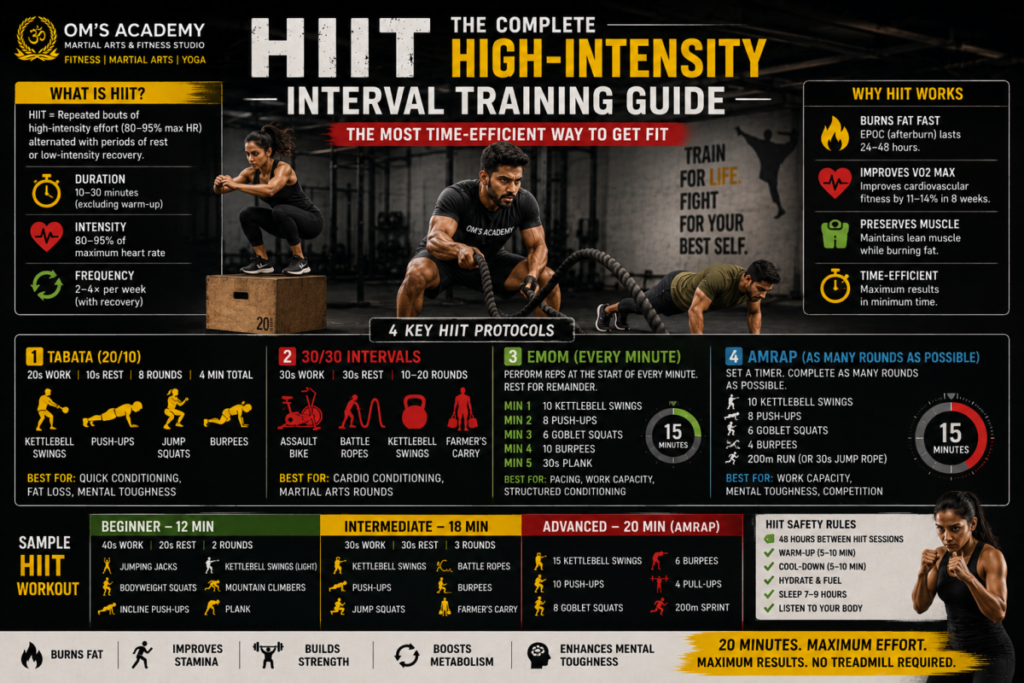
| WOD (Workout of the Day) | 20-25 min | High-intensity circuit combining multiple movements. Timed rounds, AMRAP (as many reps as possible), EMOM (every minute on the minute), or chipper format. |
| Core / Accessory | 5-10 min | Planks, hollow holds, Russian twists, farmer’s carries. |
| Cool-Down / Mobility | 5-10 min | Static stretching, foam rolling, breathing. |
Example WOD
“The Om’s Grinder” – 20-minute AMRAP:
- 10 Kettlebell Swings
- 8 Push-ups
- 6 Goblet Squats
- 4 Burpees
- 200m Run (or 30s jump rope)
Score = total rounds completed in 20 minutes.
Who Is Functional Fitness For?
Everyone. Seriously.
| Group | Why Functional Fitness Works |
|---|---|
| Complete beginners | No prior experience needed. Every movement is scaled. |
| Martial artists | Explosive power, core strength, conditioning, injury prevention. |
| Office workers | Posture correction, back pain relief, energy, stress relief. |
| Athletes | Sport-specific power, agility, endurance, injury resilience. |
| Women | Strength, bone density, body composition, confidence. |
| Seniors | Balance, fall prevention, functional independence, joint health. |
| Overweight / deconditioned | Scalable, low-skill entry, builds fitness gradually. |
| Parents | The strength to carry your child, the energy to play, the resilience to not break. |
7 Key Benefits of Functional Fitness
1. Real-World Strength
You build strength that transfers to daily life. Not the strength to curl 20 kg in front of a mirror. The strength to carry a 20 kg suitcase up three flights of stairs without gasping.
2. Fat Loss and Body Composition
A 60-minute functional fitness session burns 500-800 calories. The combination of strength training and high-intensity cardio creates an afterburn effect (EPOC) — your metabolism stays elevated for 24-48 hours after the session.
3. Injury Prevention
Functional training strengthens stabilizer muscles, joints, and connective tissue — the structures that prevent injuries. A strong core protects the lower back. Strong hips protect the knees. Strong shoulders protect the rotator cuff.
4. Improved Posture
Functional training strengthens the posterior chain (back, glutes, hamstrings) and the core — the muscles that hold you upright. This directly counters the forward-head, rounded-shoulder, anterior-pelvic-tilt posture caused by desk work.
5. Athletic Performance
Every sport requires power, agility, balance, and endurance. Functional fitness builds all four. Martial artists hit harder. Runners run faster. Yoga practitioners hold poses longer. Cricketers throw farther.
6. Bone Density
Resistance training (lifting, carrying, pushing, pulling) stimulates bone remodeling — the process by which bones become denser and stronger. This is critical for women (osteoporosis prevention) and seniors (fracture prevention).
7. Mental Health
High-intensity exercise releases endorphins, BDNF (brain-derived neurotrophic factor), and serotonin. A 2023 meta-analysis in British Journal of Sports Medicine found that exercise was as effective as medication for mild-moderate depression and anxiety.
[→ Related: The Science of Fitness – Research-Backed Training Principles]
Equipment Used in Functional Fitness
| Equipment | Purpose |
|---|---|
| Kettlebells | Swings, goblet squats, Turkish get-ups, carries |
| Dumbbells | Presses, rows, lunges, carries |
| Barbells | Deadlifts, squats, presses (advanced) |
| Medicine balls | Throws, slams, rotational power |
| Battle ropes | Cardiovascular conditioning, shoulder endurance |
| Pull-up bar / rings | Pull-ups, dips, rows, hangs |
| Plyo box | Box jumps, step-ups, elevated push-ups |
| Resistance bands | Warm-up, assistance, rehabilitation |
| Jump rope | Cardiovascular warm-up, footwork, coordination |
| Sandbags | Carries, throws, unstable load training |
| Bodyweight | Push-ups, squats, burpees, planks, lunges |
At Om’s, all equipment is provided. You need only comfortable athletic clothing, shoes, and a water bottle.
Common Beginner Questions
Q: Do I need gym experience?
A: No. Our beginner program teaches every movement from scratch. No prior experience, no fitness prerequisite, no age barrier.
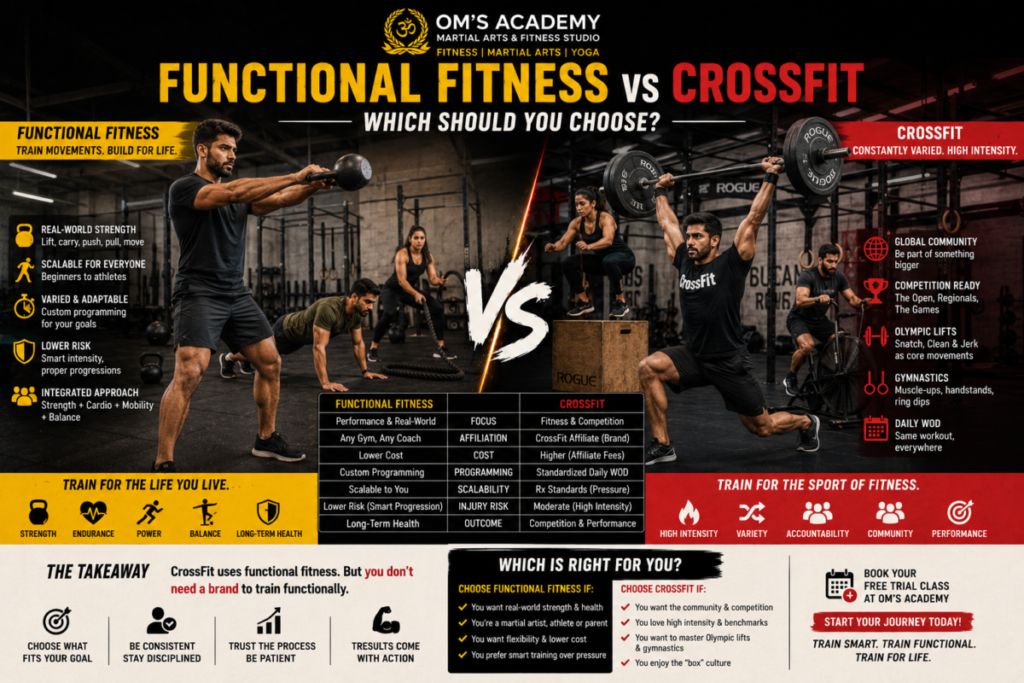
Q: Is functional fitness the same as CrossFit?
A: They overlap, but they are not identical. CrossFit is a branded methodology with specific programming, competitions, and affiliate gyms. Functional fitness is a training philosophy that can be applied in any gym, with any equipment, at any intensity. At Om’s, we use functional fitness principles without the CrossFit brand.
Q: Will I bulk up?
A: No. Functional fitness builds lean, functional muscle — not bodybuilder mass. You will look toned and athletic, not bulky. Women especially do not produce enough testosterone for significant hypertrophy from functional training.
Q: How often should I train?
A: For beginners: 3× per week. For intermediate: 4-5× per week. For athletes: 5-6× per week (periodized). Rest days are essential.
Q: Is it safe?
A: Yes, with proper instruction. Every movement is taught progressively. We scale intensity to your level. The injury rate in supervised functional fitness is lower than in football, basketball, or running.
Q: Can I do functional fitness and martial arts / yoga simultaneously?
A: Yes, and you should. Functional fitness builds the engine (strength, power, conditioning). Martial arts build the skill. Yoga builds the chassis (flexibility, balance, recovery). Together, they build a complete body. At Om’s, combined memberships give you access to all three.
Q: How long until I see results?
A: 2 weeks for improved energy and sleep. 4 weeks for noticeable strength improvement. 8 weeks for visible body composition changes. 12 weeks for a complete transformation.
[→ Full FAQ: 300+ Fitness Questions Answered]
Start Your Functional Fitness Journey Today
You do not need to be strong. You do not need to be fit. You do not need to be “gym-ready.”
You just need to show up, move, and breathe.
[→ Book Your Free Functional Fitness Trial Class at Om’s Martial Arts & Fitness Studio]
[→ View Functional Fitness Class Timetable & Fees]
[→ Read the Complete Guide to Fitness]
Om’s Martial Arts & Fitness Studio – Train for life. Not for the mirror. For the life you actually live.