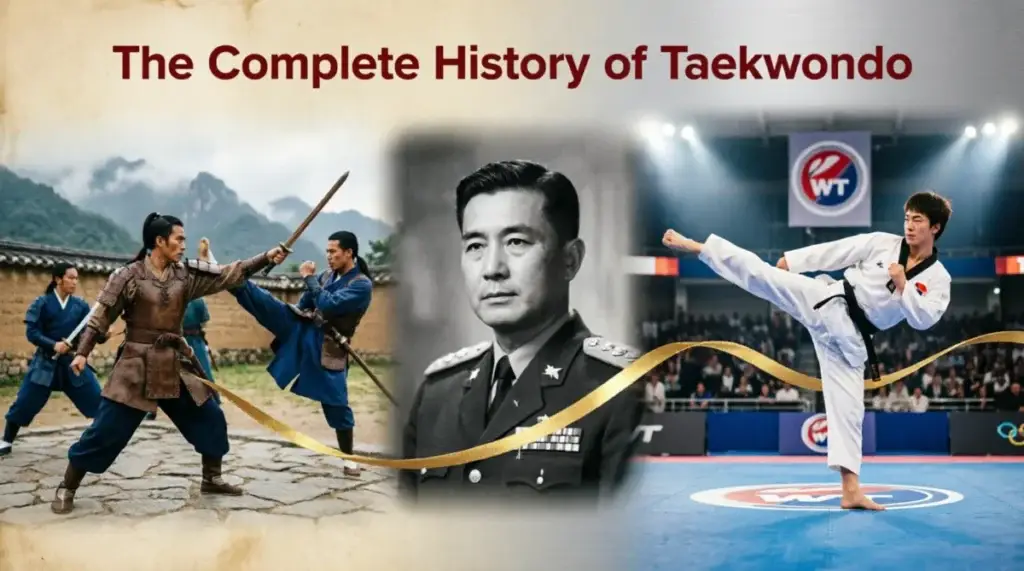

Taekwondo evolved from ancient Korean combat traditions like Subak and Taekkyeon. The Hwarang warriors established a moral code that still influences the art today. Despite suppression during the Japanese occupation, these traditions survived and integrated external influences like Karate and Kung Fu to form a distinct national identity.
The modern era began in 1955 when various martial arts schools unified under the name Taekwondo. This eventually led to two major streams: the International Taekwondo Federation and World Taekwondo. Today, the art is a global Olympic sport characterized by electronic scoring and standardized competitive pathways across many nations.
Why History Matters
You can throw a roundhouse kick without knowing where it came from. But understanding the history of Taekwondo transforms your training from physical exercise into cultural inheritance.
Every time you bow at the start of class, you honor a tradition that stretches back 2,000 years. Every time you recite the tenets, you echo the code of ancient warriors. Every time you step onto the competition mat, you walk a path paved by generals, freedom fighters, and visionaries who believed that a martial art could unify a nation and inspire the world.
This is the complete story.
At Om’s Martial Arts & Fitness Studio, history is not a footnote. It is taught at every belt level, tested at every promotion, and woven into the philosophy of our training. You are not just learning to kick. You are inheriting a legacy.
[↑ Back to: The Complete Guide to Taekwondo]
Part 1: Ancient Korea – The Roots (57 BC – 935 AD)
The Three Kingdoms Period
The Korean peninsula was once divided into three rival kingdoms:
| Kingdom | Period | Region |
|---|---|---|
| Goguryeo | 37 BC – 668 AD | Northern Korea / Manchuria |
| Baekje | 18 BC – 660 AD | Southwestern Korea |
| Silla | 57 BC – 935 AD | Southeastern Korea |
Each kingdom developed its own combat traditions. Archaeological evidence confirms that martial arts were practiced across all three:
- Goguryeo tomb murals (dating to ~37 BC – 427 AD) at Muyong-chong and Kakchu-chong depict figures in fighting stances, executing what appear to be kicks, punches, and blocks remarkably similar to modern Taekwondo techniques.
- Baekje records reference a combat system called Subak (수박) — a striking art using hands and feet.
- Silla developed the most documented and influential tradition through the Hwarang.
Subak and Taekkyeon
Before the name “Taekwondo” existed, Korean martial arts were known by various names:
| Name | Description |
|---|---|
| Subak (수박) | A general term for hand-and-foot combat. Practiced across all three kingdoms. |
| Taekkyeon (택견) | A fluid, dance-like kicking art emphasizing circular movements, trips, and sweeps. Recognized as a UNESCO Intangible Cultural Heritage (2011). |
| Gwonbeop (권법) | “Fist method” — a term influenced by Chinese Quan Fa. |
| Soo Bahk Do (수박도) | “Way of the striking hand” — a later formalization by Hwang Kee (founder of Moo Duk Kwan). |
These arts are the ancestors of Taekwondo. They were not identical to modern Taekwondo, but they established the Korean martial tradition of emphasizing kicks, footwork, and dynamic movement.
Part 2: The Hwarang Warriors (576 – 935 AD)
Who Were the Hwarang?
The Hwarang (화랑 – “Flowering Knights”) were an elite corps of young noblemen in the Silla Kingdom, established around 576 AD by King Jinheung.
They were not merely soldiers. The Hwarang were a holistic educational order — trained in:
- Combat (Subak, archery, swordsmanship, horsemanship)
- Academics (history, philosophy, literature)
- Arts (poetry, music, dance)
- Ethics (a moral code that governed their behavior)
The Hwarang Code (Sesok Ogye)
The Hwarang followed five secular commandments, recorded by the monk Won Gwang:
| Hwarang Commandment | Modern Taekwondo Parallel |
|---|---|
| Loyalty to the nation (사군이충) | Indomitable Spirit – standing for what is right |
| Respect for parents and teachers (사친이효) | Courtesy – bowing, addressing seniors |
| Trust among friends (교우이신) | Integrity – honesty in training and life |
| Courage in battle (임전무퇴) | Perseverance – never retreating from a challenge |
| Justice in killing (살생유택) | Self-Control – using force only when necessary |
These five commandments are the direct ancestors of the Five Tenets of modern Taekwondo. The connection is not coincidental. General Choi Hong Hi and the founders of Taekwondo explicitly drew on Hwarang philosophy when codifying the art’s ethical framework.
The Hwarang Legacy
The Hwarang played a decisive role in Silla’s unification of the Three Kingdoms (668 AD). Their combat effectiveness, combined with their moral discipline, made them one of the most formidable warrior classes in East Asian history.
After Silla’s decline, the Hwarang tradition faded, but its philosophy survived in Korean culture, martial arts, and eventually, Taekwondo.
[→ Related: The Five Tenets of Taekwondo – Meaning & Practice]
Part 3: The Goryeo and Joseon Dynasties (918 – 1897)
Goryeo Dynasty (918–1392)
During the Goryeo period, Subak was practiced as both a military training system and a competitive sport. Historical records describe Subak competitions held during festivals, with winners receiving prizes and recognition.
However, as the Goryeo dynasty progressed, the rise of Buddhist pacifism and the civil service examination system reduced the social status of martial arts. Combat training became less central to Korean society.
Joseon Dynasty (1392–1897)
The Joseon dynasty further marginalized martial arts. The ruling philosophy of Neo-Confucianism emphasized scholarship over physical combat. Martial arts were practiced primarily by the military class and in rural communities.
Key text: The Muye Dobo Tongji (무예도보통지 – “Comprehensive Illustrated Manual of Martial Arts”), published in 1790, documented Korean combat systems including:
- Unarmed combat (Gwonbeop)
- Swordsmanship
- Archery
- Spear and staff techniques
- Mounted combat
This manual is a critical historical document, preserving Korean martial traditions that would otherwise have been lost.
Taekkyeon survived as a folk game and combat art, practiced in villages and documented in paintings and writings. It remained a living tradition even as formal martial arts declined.
Part 4: Japanese Occupation (1910–1945)
The Suppression
In 1910, Japan formally annexed Korea. The occupation lasted 35 years and had a devastating impact on Korean culture:
- Korean language was banned in schools
- Korean names were replaced with Japanese names
- Korean martial arts were suppressed and banned
- Cultural practices were systematically erased
During this period, practicing Korean martial arts was an act of cultural resistance. Some practitioners trained in secret. Others traveled to Japan and China to study martial arts, bringing back knowledge that would later influence Taekwondo.
Influences Absorbed
| Where | What Was Learned | Influence on Taekwondo |
|---|---|---|
| Japan | Karate (Shotokan, Shito-ryu, Goju-ryu) | Stances, linear techniques, kata/poomsae structure, terminology |
| China | Kung Fu / Quan Fa | Circular movements, philosophy, breathing |
| Korea (secret) | Taekkyeon, Subak | Kicking emphasis, fluid footwork, Korean identity |
This period explains why early Taekwondo shares visible similarities with Japanese Karate — particularly in early forms and terminology. The founders of Taekwondo were honest about these influences while asserting the Korean identity of the art.
Part 5: Liberation and the Birth of Taekwondo (1945–1966)
The Five Original Kwans
After Korea’s liberation on August 15, 1945, martial arts schools (called kwans, 관) began opening across Seoul. The five original kwans are recognized as the foundations of Taekwondo:
| Kwan | Founder | Year | Style Influence |
|---|---|---|---|
| Chung Do Kwan (청도관) | Won Kuk Lee | 1944 | Shotokan Karate + Korean elements |
| Song Moo Kwan (송무관) | Byung Jick Ro | 1944 | Shotokan Karate |
| Moo Duk Kwan (무덕관) | Hwang Kee | 1944 | Chinese Kung Fu + Taekkyeon + Karate |
| Chang Moo Kwan (창무관) | Byung In Yoon | 1946 | Chinese Kung Fu + Karate |
| Jidokwan (지도관) | Chun Sang Sup | 1945 | Chinese Kung Fu + Karate |
Additional kwans formed later (Oh Do Kwan, Kang Duk Won, Han Moo Kwan), bringing the total to nine major kwans.
Each kwan had its own curriculum, terminology, and emphasis. Some were more Karate-influenced. Others emphasized Chinese or indigenous Korean elements. Unification was needed.
General Choi Hong Hi – The Father of Taekwondo
Choi Hong Hi (최홍희, 1918–2002) was a Korean Army general, martial artist, and the driving force behind the unification and naming of Taekwondo.
| Year | Event |
|---|---|
| 1918 | Born in Hwa-dae, Korea (now North Korea) |
| 1930s | Studies Taekkyeon under Han Il Dong |
| 1938–44 | Studies Shotokan Karate in Japan (under Gichin Funakoshi’s lineage); earns 2nd Dan |
| 1945 | Returns to liberated Korea; begins military career |
| 1953 | Publishes the first Korean martial arts textbook |
| 1955 | Convenes a naming committee that unifies the kwans under the name “Taekwondo” |
| 1959 | Becomes president of the Korean Taekwondo Association |
| 1966 | Founds the International Taekwondo Federation (ITF) |
| 1972 | Exiles to Canada after political disagreements with the South Korean government |
| 1980s–90s | Introduces Taekwondo to North Korea (controversial) |
| 2002 | Dies in Pyongyang, North Korea |
General Choi’s contributions:
- Named the art “Taekwondo”
- Developed the 24 patterns (tul) of ITF Taekwondo
- Codified the theory of power (reaction force, concentration, equilibrium, breath control, mass, speed)
- Established the first international governing body (ITF)
- Spread Taekwondo globally through military and diplomatic channels
His legacy is complex and contested (particularly his later relationship with North Korea), but his role in creating modern Taekwondo is undeniable.
The Naming of Taekwondo (April 11, 1955)
On April 11, 1955, a committee of kwan leaders, historians, and prominent figures convened to select a unified name for Korean martial arts. General Choi proposed “Taekwondo” (태권도), and the name was adopted.
The name was significant because:
- “Tae” (foot) and “Kwon” (fist) described the art’s technical content
- “Do” (way) elevated it from a fighting system to a philosophical path
- It was distinctly Korean — not a derivative of “Karate” or “Kung Fu”
- It unified the kwans under a single identity
Part 6: The ITF–WT Split (1966–1973)
The Political Context
The split between ITF and WT was not purely technical. It was deeply political, rooted in Cold War dynamics and Korean domestic politics.
| Year | Event |
|---|---|
| 1966 | General Choi founds the ITF in Seoul |
| 1971 | Choi falls out of favor with President Park Chung-hee |
| 1972 | Choi is exiled from South Korea; relocates ITF headquarters to Toronto, Canada |
| 1973 | The South Korean government, wanting a martial art governing body free from Choi’s influence, supports the creation of the World Taekwondo Federation (WTF, now WT) in Seoul |
| 1973 | First WT World Taekwondo Championships held in Seoul (19 countries) |
| 1980 | WT receives IOC recognition |
The Two Streams
| Feature | ITF | WT |
|---|---|---|
| Founder | General Choi Hong Hi | South Korean government / kwan leaders |
| Headquarters | Originally Seoul → Toronto → Vienna → Pyongyang (split further after Choi’s death) | Seoul, South Korea (Kukkiwon) |
| Sparring | Semi-contact; sine-wave movement; punches to head allowed | Full-contact; electronic scoring; punches to body only |
| Patterns | 24 Tul (Choi’s creations) | 8 Taegeuk + 9 advanced Poomsae |
| Olympic | Not recognized by IOC | Official Olympic sport |
| Global reach | ~120 countries | ~210 countries |
| India | Small presence | Primary system (TFI follows WT) |
At Om’s Martial Arts & Fitness Studio, we follow the WT system, which is the pathway recognized for national and international competition in India through the Taekwondo Federation of India (TFI).
[→ Related: ITF vs WT Taekwondo – Complete Comparison]
Part 7: The Olympic Journey (1980–Present)
| Year | Milestone |
|---|---|
| 1980 | WT receives IOC recognition |
| 1986 | Taekwondo included in the Asian Games (Seoul) |
| 1988 | Demonstration sport at the Seoul Olympics |
| 1992 | Demonstration sport at the Barcelona Olympics |
| 1994 | IOC votes to include Taekwondo as a full medal sport |
| 2000 | Official Olympic sport at the Sydney Games (8 weight divisions: 4 men, 4 women) |
| 2004 | Athens Olympics – electronic scoring introduced (body only) |
| 2008 | Beijing Olympics |
| 2012 | London Olympics – electronic scoring expanded |
| 2016 | Rio Olympics – electronic head scoring introduced |
| 2020 | Tokyo Olympics (held 2021) – new format: best of 3 rounds, 4 weight divisions per gender |
| 2024 | Paris Olympics – refined format, increased spectator engagement |
| 2028 | Confirmed for Los Angeles Olympics |
Olympic Taekwondo – Key Facts
- 8 gold medals per Games (4 men, 4 women)
- Over 130 countries participate in Olympic Taekwondo qualification
- South Korea is the most successful nation (12 gold medals through 2024)
- Notable champions: Steven López (USA, 2 gold), Hwang Kyung-seon (Korea, 2 gold), Jade Jones (UK, 2 gold), Panipak Wongpattanakit (Thailand, 2 gold)
Part 8: Taekwondo in India
| Year | Milestone |
|---|---|
| 1970s | Taekwondo introduced in India through military and diplomatic channels |
| 1976 | Taekwondo Federation of India (TFI) established |
| 1980s | State-level associations formed; national championships begin |
| 1990s | Indian athletes participate in Asian and World Championships |
| 2000s | Structured coaching programs; WT affiliation strengthened |
| 2010s | Growth in private academies; school and university programs expand |
| 2018 | Indian taekwondo athletes at Asian Games (Jakarta) |
| 2020s | Increased investment in coaching infrastructure, sports science, and athlete development |
| 2024 | Indian athletes compete in Paris Olympics qualification events |
| 2026 | TFI continues to expand grassroots programs across all states |
The Indian Ecosystem
Academies (like Om's Martial Arts & Fitness Studio)
        ↓
District Competitions
        ↓
State Championships (State Taekwondo Associations)
        ↓
National Championships (TFI)
        ↓
International Events (Asian Championships, World Championships, Grand Prix)
        ↓
Olympic Qualification → Olympic Games
At Om’s, we are proud to be part of this ecosystem. Our students compete at district, state, and national levels, and our coaching team prepares athletes for the full competitive pathway.
[→ Related: How to Become an Olympic Taekwondo Athlete from India]
[→ Related: Taekwondo Federation of India – Registration & Competition Guide]
Part 9: Modern Evolution (2010–Present)
Technical Evolution
| Era | Sparring Style |
|---|---|
| Pre-2000 | More traditional; powerful single techniques; less footwork |
| 2000–2010 | Electronic scoring changes strategy; body kicks dominate |
| 2010–2020 | “Cut kick” era; front-leg techniques; defensive, tactical fighting |
| 2020–present | Best-of-3 format; more aggressive; spinning kicks rewarded (4-5 points); spectator-friendly |
Global Growth
- 210+ member nations in World Taekwondo
- 80+ million practitioners worldwide
- Taekwondo is taught in schools, universities, military, and police forces globally
- Para Taekwondo debuted at the 2020 Tokyo Paralympics
- Freestyle Poomsae and Tricking have created new performance dimensions
The Future
- Continued Olympic presence (confirmed through 2028, likely beyond)
- Potential inclusion of team events and mixed-gender formats
- Growth in Africa, South Asia, and Oceania
- Integration of sports science, data analytics, and AI in training
- Expansion of Para Taekwondo and inclusive programs
Frequently Asked Questions
Q: Who invented Taekwondo?
A: Taekwondo was not “invented” by one person. It evolved from ancient Korean martial arts (Subak, Taekkyeon), was influenced by Japanese Karate and Chinese Kung Fu during the occupation era, and was unified and named in 1955 by a committee led by General Choi Hong Hi. The modern sport form (WT) was further developed by the kwan leaders and the South Korean government in the 1970s.
Q: Is Taekwondo really 2,000 years old?
A: The roots of Korean martial arts are 2,000+ years old (Goguryeo tomb murals, Hwarang tradition). However, Taekwondo as a named, unified art dates to 1955. The modern sport form (WT) dates to 1973. It is accurate to say Taekwondo has ancient roots and a modern form.
Q: Why did Taekwondo split into ITF and WT?
A: The split was primarily political. General Choi Hong Hi fell out of favor with the South Korean government in the early 1970s and was exiled. The government supported the creation of a new governing body (WT/WTF) independent of Choi. The two organizations developed different rules, patterns, and sparring styles.
Q: Which style does India follow?
A: India follows the WT (World Taekwondo) system through the Taekwondo Federation of India (TFI). This is the Olympic pathway.
Q: Is Taekwondo a Korean or Japanese art?
A: Taekwondo is Korean. It was influenced by Japanese Karate during the occupation era, but its identity, philosophy, terminology, and technical emphasis (especially kicking) are distinctly Korean. The founders explicitly created Taekwondo as a Korean national art.
[→ Full FAQ: 500+ Taekwondo Questions Answered]
Train With History at Om’s
When you step onto the mat at Om’s Martial Arts & Fitness Studio, you are not just exercising. You are continuing a story that began in the tombs of Goguryeo, was carried by the Hwarang, survived an occupation, was named by a general, split by politics, and united the world through the Olympics.
You are part of that story now.
[→ Book Your Free Trial Class at Om’s Martial Arts & Fitness Studio]
[→ Read the Complete Guide to Taekwondo]
[→ Next: The Five Tenets of Taekwondo – Meaning & Practice]
Om’s Martial Arts & Fitness Studio – 2,000 years of heritage. One mat. Your journey.